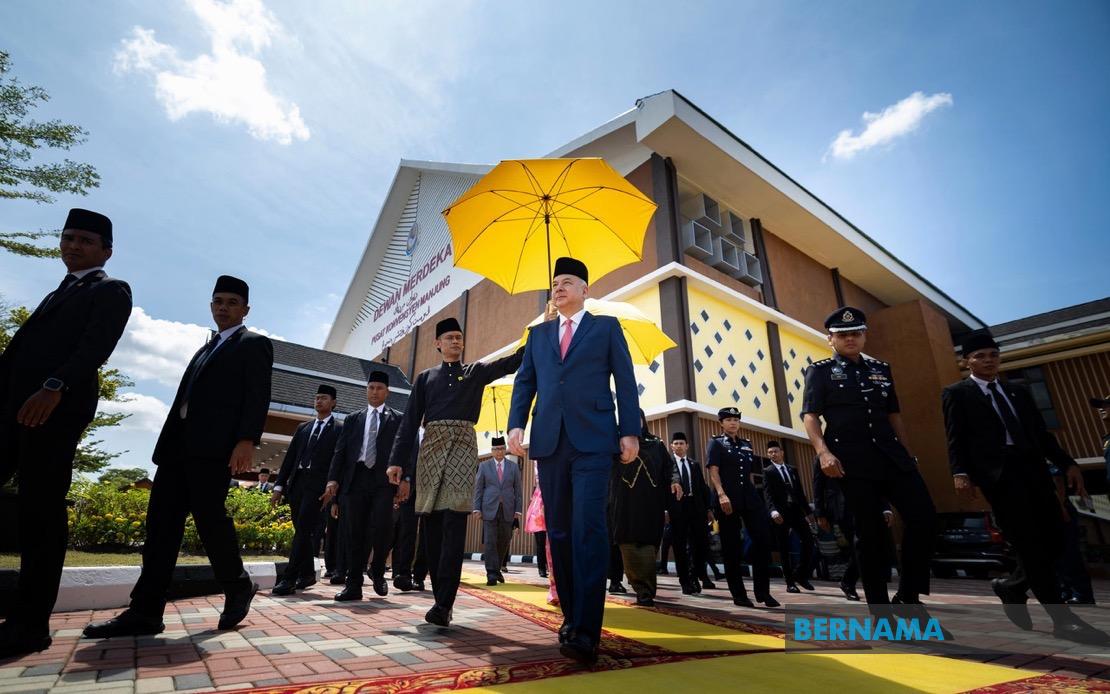
Sultan Nazrin Shah, the Sultan of Perak, formally opened the Merdeka Hall at Manjung Municipal Council in Lumut on August 4, unveiling a major infrastructure project that district officials say will reshape civic and cultural life in the region. The ceremony drew prominent state and federal figures, including the Raja Permaisuri of Perak, Tuanku Zara Salim, and the Raja Di Hilir of Perak, Raja Iskandar Dzurkarnain Sultan Idris Shah, alongside Perak Menteri Besar Datuk Seri Saarani Mohamad and Higher Education Minister Datuk Seri Dr Zambry Abd Kadir, underscoring the event's significance within Malaysia's political establishment.
The RM12.7 million facility represents an ambitious investment in Manjung's institutional infrastructure, designed to accommodate up to 2,500 people and serve as a multipurpose venue for governmental functions, conferences, seminars, and community gatherings. For a district with growing economic ambitions, such a venue addresses a longstanding infrastructure gap, providing a modern space capable of hosting events that would previously have required travel to larger nearby cities. The hall's capacity and facilities position it as a focal point for public engagement and commercial activity, potentially attracting conferences and cultural events that generate economic spillovers for local hospitality and service sectors.
Menteri Besar Saarani framed the opening as a convergence of three significant milestones for Manjung. The first acknowledges the delayed realisation of a plan conceived in 2016, when the previous state administration identified the need for a rebuilt civic hall. This multi-year journey reflects the complexities of securing federal funding and navigating bureaucratic approvals across electoral cycles—a reality familiar to municipal councils throughout Malaysia seeking major capital investments. The second milestone celebrates Manjung Municipal Council's 25th anniversary, marking a quarter-century since its elevation from district council status on January 1, 1980, to municipal council status on August 1, 2001. This administrative progression parallels the district's economic maturation and expanding governance responsibilities.
The third milestone carries particular strategic weight: the opening symbolises Manjung's commitment to achieving Tourism and Maritime City status by 2030. This ambitious designation reflects a deliberate economic repositioning, leveraging the district's natural endowments—coastal access, maritime heritage, and proximity to Pangkor Island—to diversify beyond traditional economic foundations. For a district historically dominated by port operations and resource extraction, the pivot toward tourism and maritime enterprise signals recognition of shifting regional economic dynamics and the need to create higher-value employment and attract skilled workers and entrepreneurs. The timing of the hall's completion aligns with broader Southeast Asian trends of secondary cities seeking to enhance their competitive positioning through infrastructure and branding initiatives.
Saarani emphasised that the project's progression from conception through completion reflected continuity of governance and functional collaboration between federal and state administrations. This observation carries subtle political significance in Malaysia's federalised system, where state governments and federal authorities frequently navigate territorial and budgetary tensions. The successful completion of a federally-funded project championed by a predecessor menteri besar suggests institutional mechanisms capable of transcending individual political transitions—though it also underscores how major capital projects often span multiple election cycles, requiring sustained political commitment regardless of electoral outcomes.
The symbolic nomenclature of the facility warrants attention. By naming the hall after Merdeka, the independence and freedom commemorated in Malaysia's founding, Saarani invoked the values embedded in the nation's constitutional order and the shared civic responsibilities that bind contemporary governance to historical struggle. His assertion that the name serves as a reminder that independence constitutes an ongoing trust requiring safeguarding reflects a broader discourse within Malaysian political leadership about the preservation and renewal of founding principles amid social change and modernisation pressures. This rhetorical framing elevates the hall beyond its practical functions to embody continuity with national identity.
The infrastructure investment occurs within a broader Perak context marked by economic diversification efforts and urban development initiatives. As one of Malaysia's traditionally resource-rich states, Perak has faced pressure to transition from historical reliance on tin mining and agricultural production toward services, tourism, and advanced manufacturing. Manjung, hosting major port facilities and petrochemical installations, occupies a strategic position in this transition. The civic hall and the Tourism and Maritime City initiative represent state-level attempts to capture value from Manjung's geographic and economic positioning, creating institutional and promotional frameworks that attract private investment and position the district as a destination rather than merely a transit point.
The 25-year trajectory of Manjung Municipal Council's administrative status also reflects Malaysia's broader municipal governance evolution. The upgrade from district to municipal council status granted expanded regulatory authority and revenue-raising capacity, though often without commensurate resource allocation. The new hall and its associated development objectives may signal efforts to leverage enhanced municipal status more effectively, translating administrative authority into tangible infrastructure and service improvements that strengthen local economic ecosystems and improve residents' quality of life.
The geographical and sectoral context shapes how Manjung's strategic aspirations intersect with broader Southeast Asian maritime and tourism trends. The region's growing prosperity, expanding middle-class tourism participation, and increasing focus on maritime security and blue-economy development create opportunities for coastal districts positioned between major urban agglomerations and island destinations. Manjung's proximity to Pangkor and other attractions, combined with enhanced infrastructure, positions it to capture portions of this expanding activity. The Tourism and Maritime City designation functions partly as a brand-positioning exercise within fiercely competitive regional tourism markets.
The investment timing also reflects Malaysia's post-pandemic recovery phase and renewed confidence in public infrastructure spending. After pandemic-disrupted budgets and constrained activity, state and federal governments have resumed major capital projects as confidence in economic growth prospects has strengthened. Manjung's civic hall, approved and funded during this period of cautious optimism, exemplifies how municipal administrations are translating renewed budgetary space into physical infrastructure designed to enhance civic capacity and economic competitiveness.
For Malaysian readers and policymakers, Manjung's experience illustrates several broader governance and development principles. Large infrastructure projects require sustained political commitment transcending electoral cycles and administrative transitions. Successful municipal development integrates physical infrastructure with strategic positioning and branding initiatives. The economic futures of secondary cities increasingly depend on deliberate diversification and value-chain positioning rather than historical resource endowments. Most fundamentally, the cooperation between federal and state authorities in funding and executing major projects remains essential to Malaysia's municipal development trajectory, even amid broader tensions within the federalised system.

