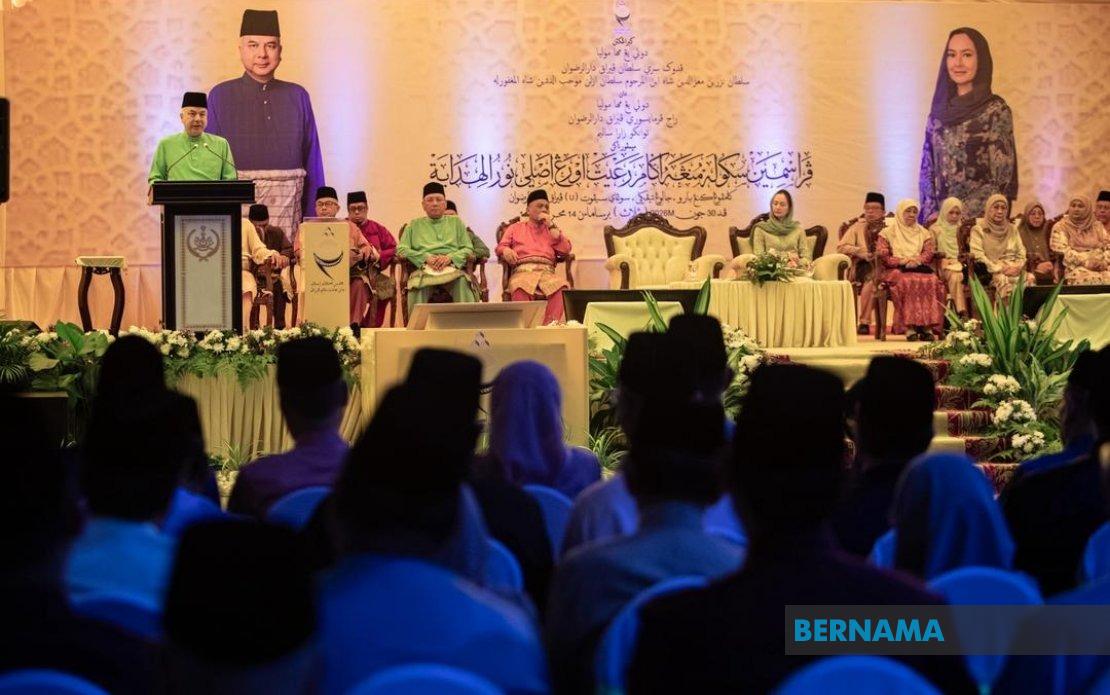
Sultan Nazrin Shah officially opened Sekolah Menengah Agama Rakyat (SMAR) Orang Asli Nurul Hidayah on June 30 in Kampung Kenang, Sungai Siput Utara, establishing a watershed moment for educational advancement within Perak's Orang Asli population. The ceremonial inauguration recognised the institution as the first of its kind nationwide—an Islamic secondary school designed specifically to serve indigenous learners while integrating religious instruction with conventional academic curricula. The milestone ceremony, attended by senior members of Perak's royal household including Raja Muda Raja Jaafar Raja Muda Musa and Raja Di Hilir Raja Iskandar Dzurkarnain Sultan Idris Shah, underscores the state's commitment to narrowing educational disparities affecting marginalised communities.
The presence of Menteri Besar Datuk Seri Saarani Mohamad alongside religious authorities including Tan Sri Mohd Annuar Zaini, president of the Perak Islamic Religious and Malay Customs Council (MAIPk), demonstrated broad institutional backing for the initiative. Datuk Harith Fadzilah Abdul Halim, director of the Perak Islamic Religious Department (JAIPk), also attended, signalling coordinated effort across government and religious governance structures. This convergence of executive, royal and ecclesiastical leadership illustrates how education policy targeting disadvantaged indigenous populations transcends departmental boundaries and commands political priority in Perak's development agenda.
Speaking during the ceremony, Sultan Nazrin outlined how SMAR Nurul Hidayah represents far more than bricks and mortar. The institution germinated from a grassroots learning centre focused on basic Islamic instruction—known locally as dakwah and fardu ain education—before evolving into a comprehensive educational facility spanning three decades. The organic expansion from informal religious tuition to a fully accredited secondary school offering integrated academic and faith-based programmes demonstrates how community-driven initiatives can eventually obtain institutional recognition and resources. This trajectory mirrors broader patterns in Malaysian education where successful pilot projects serving vulnerable populations gain state endorsement and expansion.
The ruler emphasised that establishing this school constituted a substantial financial and social investment in Orang Asli youth futures rather than a symbolic gesture. By framing the facility as an engine for human capital development, Sultan Nazrin positioned indigenous education within Malaysia's broader economic diversification strategy. For policymakers across Southeast Asia grappling with how to incorporate marginalised populations into knowledge economies, the Perak model offers practical demonstration that targeted, culturally-sensitive educational infrastructure can yield measurable outcomes. The Sultan's rhetoric connected individual student advancement to national development imperatives, suggesting that Orang Asli educational empowerment serves Malaysia's collective interests.
MAIPk's role in sponsoring and supporting the institution reflects how Malaysia's Islamic bureaucracy increasingly directs resources toward social welfare and community development beyond conventional mosque administration. The council's commitment to ensuring equitable educational access regardless of geography or socioeconomic background represents an evolution in how Islamic institutions interpret their developmental mandate. For Malaysian policymakers, this model demonstrates how religious bodies can serve as delivery mechanisms for inclusive education policy, particularly in rural and remotely-settled areas where government capacity constraints have historically limited service provision.
Sultan Nazrin highlighted the school's documented success in producing graduates who subsequently returned to serve their communities as educators and awareness-builders. This reverse migration of human capital—where educated youth reinvest their qualifications in indigenous community development—creates multiplier effects that extend beyond individual advancement. The phenomenon suggests that culturally-grounded education systems that maintain ties to community identities may generate stronger commitment to local service than conventional boarding schools that sever geographic connections. This observation carries implications for other Southeast Asian nations designing education strategies for indigenous and minority populations.
The ruler articulated a comprehensive educational philosophy extending beyond academic knowledge acquisition to encompass spiritual development, emotional maturation and physical wellbeing. This four-dimensional framework—intellectual, spiritual, emotional and physical—reflects international best practices in holistic education while remaining grounded in Islamic pedagogical traditions. Sultan Nazrin argued that genuine education requires transmitting values, instilling character and nurturing moral reasoning rather than merely transferring information. This conceptual approach addresses persistent criticisms that Malaysian education systems prioritise examination performance over deeper competency development and ethical formation.
The timing of this inauguration signals Perak's prioritisation of educational infrastructure investment during a period when federal-state education coordination mechanisms continue evolving. The Menteri Besar's attendance emphasises state government commitment to complementing national curriculum standards with localised programming responsive to specific community contexts. For Orang Asli populations historically marginalised in educational planning, this provincial-level initiative demonstrates how devolved governance structures can enable responsive policy-making closer to communities' actual circumstances and needs.
The school's integration of contemporary academic curricula with Islamic religious instruction offers a potentially replicable model for other Malaysian states with significant Orang Asli populations, including Pahang, Johor and Terengganu. The success of the Sungai Siput institution suggests that combining cultural sensitivity with religious education does not compromise academic rigour. International evidence increasingly demonstrates that schools respecting learners' religious and cultural identities while maintaining academic standards achieve superior outcomes compared to assimilationist approaches. The Perak experience thus provides a domestically-grounded case study supporting policies that validate rather than suppress indigenous educational traditions.
Sultan Nazrin's emphasis on producing graduates possessing both academic excellence and character grounded in Islamic values addresses persistent Malaysian concerns about education's dual role in developing human capital and maintaining social cohesion. The framing suggests that educational development and moral formation need not represent competing priorities but rather mutually-reinforcing objectives. For Southeast Asian policymakers designing education systems in plural societies, this integrated approach offers a framework for simultaneously pursuing individual advancement and community stability without implying that development requires cultural homogenisation.
The school's achievement in nurturing future leaders with demonstrated commitment to serving indigenous communities represents a form of social capital development that conventional educational metrics may not adequately capture. The Sultan's acknowledgment of alumni returning to strengthen community educational ecosystems and raise awareness within Orang Asli populations indicates that SMAR Nurul Hidayah functions as a community development institution extending well beyond classroom boundaries. This broader developmental impact—transforming not just individual students but entire communities—justifies continued investment and serves as a benchmarking measure for evaluating indigenous education initiatives across the region.

