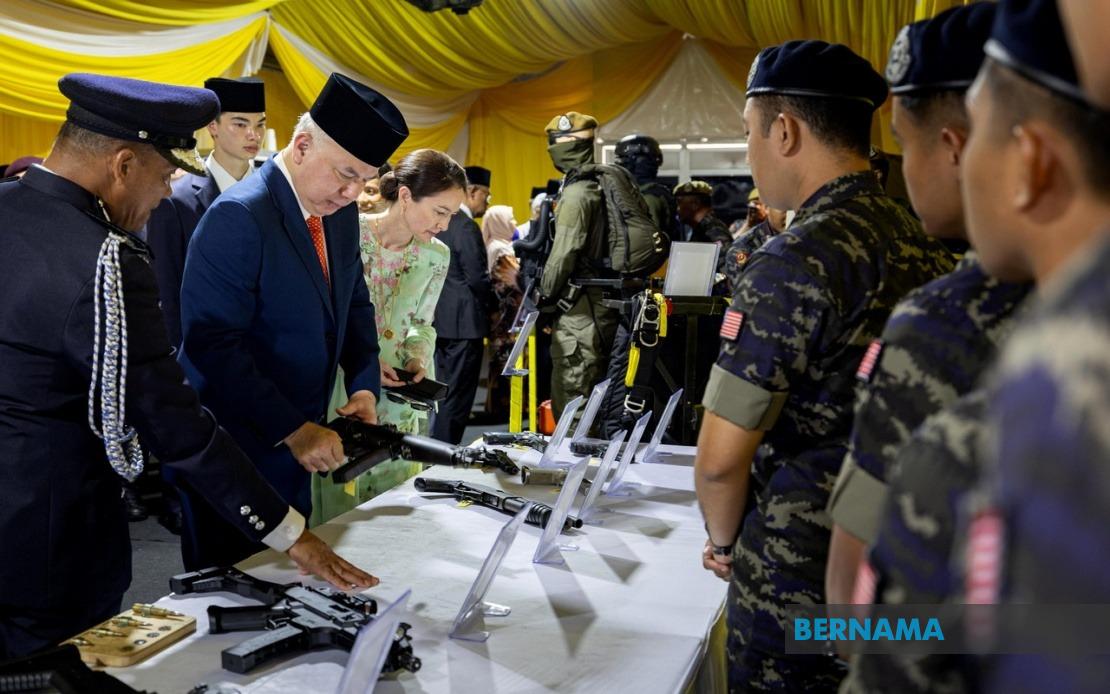
Sultan Nazrin Shah, the reigning Sultan of Perak, officially commissioned the newly built Sultan Nazrin Shah 69 Commando Camp in Ulu Kinta on July 7, marking a significant milestone in Malaysia's national defence infrastructure. The ceremony was attended by members of the Perak royal household, including the Raja Permaisuri Tuanku Zara Salim, Raja Muda Raja Jaafar Raja Muda Musa, and Raja DiHilir Raja Iskandar Dzurkarnain Sultan Idris Shah, alongside senior government officials and security leadership.
Home Minister Datuk Seri Saifuddin Nasution Ismail, who delivered the keynote address, underscored that the facility exemplifies the MADANI Government's determination to enhance the operational readiness and capabilities of the country's security apparatus in response to contemporary threats. Saifuddin Nasution characterised the camp not merely as infrastructure development, but as a tangible expression of the state's commitment to equipping its protective forces with world-class training grounds, facilities, and administrative systems necessary to maintain the nation's stability and sovereignty in an era of complex security challenges.
Malaysia's standing in global security matters provided context for the initiative. The country achieved a ranking of 12th among 163 nations in the most recent Global Peace Index assessment, a distinction that Saifuddin Nasution noted represented a source of collective pride and validation of the security sector's effectiveness. This positioning underscores Malaysia's relative success in maintaining internal stability compared to international peers, though ongoing investment in defence infrastructure remains essential to sustain such achievements.
The 69 Commando unit, established in 1969, has accumulated an extensive operational record spanning more than five decades. The force has demonstrated its capabilities across an expansive range of security operations, including counter-insurgency efforts against communist movements during the nation's earlier decades, the response to the Al-Maunah incident in 2000, counter-terrorism activities following Ops Daulat in Lahad Datu, Sabah in 2013, and participation in international obligations such as the special deployment related to the MH17 aviation tragedy in 2014. Beyond high-profile operations, the unit has maintained consistent engagement in hostage rescue missions and responses to elevated-risk security threats requiring elite tactical capabilities.
The construction of the new facility represented a substantial financial commitment from the federal government. The Sultan Nazrin Shah Camp was developed at a cost exceeding RM206 million across a 338-hectare site strategically selected in Perak's Ulu Kinta region. Saifuddin Nasution described the planning process as meticulous, with architects and defence specialists ensuring that every element of the facility aligned with the operational requirements and training protocols essential for a specialised commando force. The camp was formally transferred to the Royal Malaysia Police in 2024, establishing it as a modern, comprehensive complex dedicated to operations, training administration, and personnel development.
The facility's significance extends beyond its immediate tactical utility. Saifuddin Nasution characterised the Sultan Nazrin Shah Camp as a strategic national investment designed to function as a catalyst for sustained enhancement of the 69 Commando's operational capabilities across multiple generations. This framing reflects a longer-term strategic perspective, positioning the infrastructure not as a temporary solution but as a foundational asset that will support Malaysia's security framework for decades. The naming of the facility after the reigning Sultan of Perak carries symbolic weight, acknowledging both the royal house's custodial role in state security and the unit's historical connection to Perak.
The camp is envisioned as a crucible for cultivating the next generation of 69 Commando personnel who will inherit and advance the unit's operational legacy. Beyond training facilities and administrative infrastructure, Saifuddin Nasution emphasised that the camp would function as a centre for expertise development, reinforcement of combat discipline and fighting capability, and cultivation of strategic partnerships essential to Malaysia's continued security posture. These multifaceted functions position the facility as instrumental to maintaining institutional continuity while adapting to emerging security threats.
From a broader regional perspective, Malaysia's investment in specialised commando infrastructure reflects the nation's positioning amid evolving security dynamics across Southeast Asia. As transnational security challenges—including terrorism, maritime threats, and cross-border criminal operations—continue to complicate the regional security environment, nations with advanced commando and special operations capabilities maintain strategic advantages in rapid response and precision operations. The Sultan Nazrin Shah Camp equips Malaysia to sustain such capabilities, supporting the country's role as a stabilising force in a region where security cooperation and interoperability remain critical.
The attendance of Inspector-General of Police Tan Sri Mohd Khalid Ismail and Menteri Besar Datuk Seri Saarani Mohamad highlighted the multi-layered governance structure surrounding the facility. Although administered by the Royal Malaysia Police, the camp's strategic importance transcends single-institution remit, engaging state government leadership, federal security authorities, and royal institutional interests. This configuration reflects Malaysia's security governance framework, wherein federal police structures, state administrations, and royal institutions collectively contribute to internal stability and the management of national security policy.
Saifuddin Nasution's remarks throughout the ceremony emphasised continuity and institutional memory. By explicitly referencing the 69 Commando's historical contributions and sacrifices across multiple decades and operational contexts, the Home Minister positioned the facility as a tribute to the unit's personnel—both current and retired—whose service underpinned the nation's security achievements. This commemorative dimension adds legitimacy to the substantial government expenditure on the facility, framing it as appropriate recognition of professional dedication rather than mere capital allocation.
The physical scale of the installation—338 hectares dedicated to commando operations and training—reflects the operational demands of elite military units. Such expansive grounds accommodate live-fire ranges, tactical training scenarios, accommodation facilities, administrative infrastructure, and specialised training environments necessary for commando-level proficiency. The facility's design capacity potentially positions it as Southeast Asia's most sophisticated commando training centre, enhancing Malaysia's potential to conduct international security cooperation and training partnerships with allied nations' special operations forces.
Looking forward, the Sultan Nazrin Shah Camp's operational impact will likely manifest across multiple dimensions. Enhanced training capacity will improve the 69 Commando's response capabilities to terrorism, organised crime, and transnational security threats. The facility's modern infrastructure will support recruitment and retention of high-calibre personnel attracted to professional development opportunities. Furthermore, the facility may facilitate Malaysia's international security partnerships, positioning the country as a regional hub for commando-level training and operational cooperation with allied nations navigating comparable security challenges.
The opening ceremony crystallised the Malaysian government's assessment that sustained investment in specialised security infrastructure remains essential to maintaining internal stability and regional strategic relevance. As the 69 Commando enters the next phase of its operational existence with dedicated, purpose-built facilities, Malaysia reinforces its commitment to national defence while signalling to both domestic audiences and regional partners that the state prioritises professional, capability-driven approaches to contemporary security management. The Sultan Nazrin Shah Camp thus represents not merely infrastructure development but a statement of national security values and strategic priorities.

