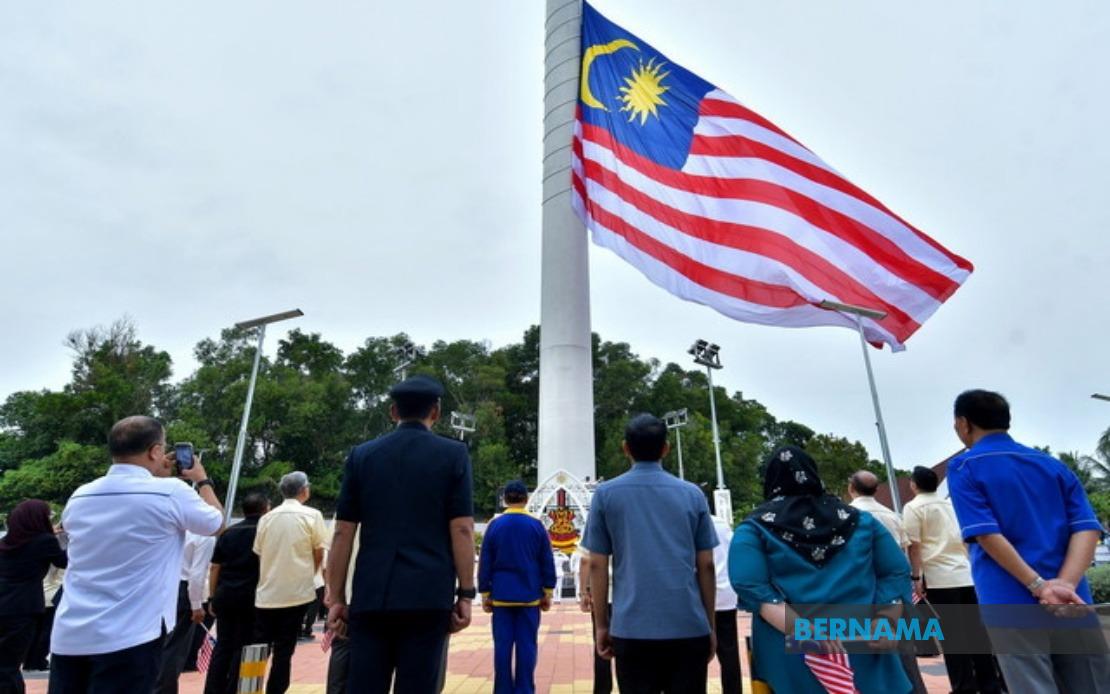
During the National Day and Malaysia Day observance period, the Sultan of Selangor, Sultan Sharafuddin Idris Shah, has articulated a vision of the Jalur Gemilang that extends far beyond its ceremonial display. Speaking at a flag-hoisting ceremony held at Dataran Selangor on August 26, the Ruler stressed that Malaysia's national flag represents a binding emblem transcending the ethnic, religious and ideological divisions that characterise contemporary Malaysian society. His intervention comes at a moment when national symbols and their interpretation have become contested terrain in Malaysia's increasingly polarised political landscape.
The Sultan's remarks underscore a critical distinction between symbolic patriotism and substantive nation-building. While the hoisting of thousands of flags throughout the month of August and early September creates visible expressions of national pride, His Royal Highness observed that this ceremonial dimension masks a more demanding undertaking. The true measure of the Jalur Gemilang's significance, he suggested, lies not in how frequently it appears on poles and buildings but rather in whether Malaysians can construct a functional society rooted in mutual respect and peaceful coexistence. This framing reorients discussions about national identity from outward displays to inward commitment.
Central to the Sultan's message is an insistence that the flag acknowledges no hierarchies of belonging based on ancestry or belief. Throughout Malaysia's history since independence, questions of national belonging have been contested, with various groups articulating competing visions of Malaysian identity grounded in different constitutional interpretations and communal interests. The Ruler's explicit statement that the Jalur Gemilang makes no distinction between Malays, Chinese, Indians, Kadazan-Dusuns, Ibans and other communities, nor between followers of Islam, Buddhism, Christianity, Hinduism and other faiths, represents a reassertion of constitutional principles against interpretations that privilege certain groups. By invoking the flag's inherent neutrality on such matters, Sultan Sharafuddin positioned his intervention as a defence of Malaysia's foundational pluralistic framework.
The Sultan's emphasis on intergenerational responsibility reflects growing concern within Malaysia's institutional leadership about social cohesion. His call for younger Malaysians to receive education emphasising respect for religious, racial and cultural diversity addresses a structural challenge facing the nation. Educational curricula, community engagement patterns and media consumption habits shape how emerging citizens understand their relationship to the broader national community. When the Ruler advocates for teaching respect across difference, he implicitly acknowledges that such attitudes require intentional cultivation rather than emerging naturally from mere proximity or constitutional design.
Equally significant is the Sultan's critique directed at political and institutional leaders. His assertion that those in positions of authority must exemplify moderation, tolerance and compassion while rejecting political, racial or religious divisions as instruments of mobilisation represents a rebuke to observed patterns in Malaysian governance. The invocation of such standards from the constitutional monarchy—an institution expected to transcend partisan politics—carries particular weight. When rulers speak to such matters, they typically do so after careful consideration of prevailing conditions, suggesting that leadership conduct on these dimensions warrants public attention.
The framing of independence celebrations as occasions for strengthening rather than merely commemorating national unity reflects a subtle but important reorientation. Traditional Independence Day messaging often emphasises historical achievements—the securing of sovereignty, the drafting of foundational documents, the establishment of institutions. The Sultan's approach repositions these anniversaries as moments for evaluating contemporary practice against foundational ideals and recommitting to their realisation. This temporal dimension acknowledges that independence, conceptualised narrowly as political autonomy, represents merely the beginning of a nation-building project extending across generations.
The ceremony at Dataran Selangor, where the Jalur Gemilang would remain hoisted from August 26 through September 17, creates a physical focal point for these conceptual claims. The decision to extend the flag's display across both National Day and Malaysia Day—celebrations marking Malaya's independence and the formation of the federation—reinforces territorial and constitutional unity. By consenting to this extended display and accompanying it with the Ruler's statement, Sultan Sharafuddin ensured that the symbolic gesture acquired substantive meaning through articulated principle.
For Malaysian readers and observers across Southeast Asia, the Sultan's intervention carries implications extending beyond ceremonial proprieties. Malaysia's reputation internationally has become increasingly shadowed by concerns about social division, institutional capture and erosion of pluralistic norms. Political observers in neighbouring countries, themselves grappling with comparable tensions between majoritarian impulses and constitutional pluralism, frequently reference Malaysian developments as bellwethers. When senior constitutional figures like Sultan Sharafuddin publicly reaffirm inclusive principles, such statements acquire regional significance as indicators of institutional commitment to foundational frameworks.
The Sultan's acknowledgment that constructing a genuinely inclusive society represents a more demanding task than symbolic patriotism speaks to a maturation of national discourse. Early post-independence rhetoric often presented national unity as an automatic consequence of constitutional design and goodwill. Decades of contested implementation have demonstrated that sustained commitment to inclusive principles requires continuous institutional and individual effort. The Ruler's candid assessment that building a country where citizens of all backgrounds feel respected and accepted constitutes a substantial project reflects this accumulated experience.
Looking forward, the Sultan's framing establishes criteria against which the National Day and Malaysia Day observance period might be evaluated. Beyond counting flags or measuring attendance at ceremonies, his remarks invite assessment of whether political conduct during these months exemplifies the principles he articulated—whether leaders moderate inflammatory rhetoric, whether media coverage emphasises shared identity, whether community events genuinely facilitate inter-group interaction. Such metrics transcend pageantry to engage substantive dimensions of national life.
The Sultan's intervention also reflects a constitutional principle often underemphasised in contemporary Malaysian discourse: the custodial role of the monarchy regarding national symbols and values. While executive and legislative branches make policy decisions and pursue partisan agendas, the monarchy traditionally occupies institutional space permitting articulation of non-partisan principles. His Royal Highness's deployment of this space to defend inclusive nationalism against contemporary challenges represents an exercise of constitutional function that extends beyond ceremonial requirements.
Ultimately, Sultan Sharafuddin's message during the National Day and Malaysia Day period contains both affirmation and challenge. He affirmed that the Jalur Gemilang, as a symbol belonging to all Malaysians, retains power to inspire and unite. Simultaneously, he challenged the nation and its leaders to ensure that this symbolic unity translates into lived reality—that the flag's inclusive neutrality finds reflection in institutional practice, political conduct and community relations. For a nation contending with persistent questions about social cohesion and shared identity, such insistence on the distinction between symbols and substance provides both a measure of Malaysia's current state and a compass for future direction.

