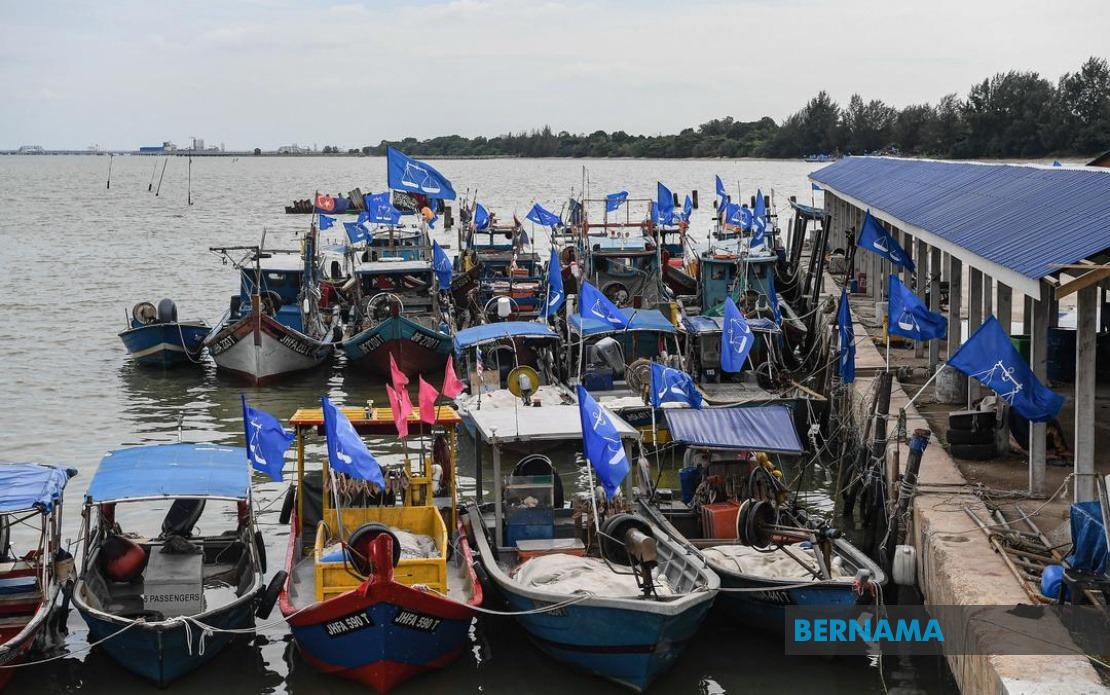
After nearly ten years operating from a makeshift location, the business community in Sungai Rengit faces an increasingly dire situation. The coastal settlement, positioned within the Tanjung Surat state constituency and serving as a crucial service hub for workers at the Pengerang Integrated Petroleum Complex, has become emblematic of how temporary infrastructure arrangements can calcify into permanent neglect. The traders and fishermen gathering here have now channeled their frustrations into electoral pressure, with the 16th Johor state election offering a chance for change as Pakatan Harapan candidate Faizul Abdul Ghani challenges incumbent Barisan Nasional representative Aznan Tamin.
The Medan Selera Sungai Rengit food court encapsulates the structural problem. What began as a provisional arrangement following displacement from their original site has extended far beyond the promised year-and-a-half duration, leaving operators uncertain about the fundamental status of their commercial base. The decision to relocate them originally—ostensibly for a development project—has never been satisfactorily explained to the affected traders, breeding resentment that compounds the practical difficulties of conducting business in substandard conditions. This uncertainty has prevented traders from investing in their stalls or planning for genuine business expansion, effectively trapping them in a liminal commercial space where neither government nor market logic provides security.
The physical deterioration of the temporary site tells a story of administrative abandonment. Traders operate from structures that amount to little more than canvas canopies stretched over plywood walls, offering minimal protection against Johor's intense monsoon rains and relentless heat. The lack of proper doors and secure fixtures leaves businesses vulnerable to opportunistic theft, with several cases recorded since 2024 began. For traders like Lai Swee Hong, who has maintained her beverage business for three decades, the contrast is stark: three decades of accumulated customer relationships and business reputation cannot cushion against the indignity of working without basic security infrastructure. The proposed alternative site, located on a one-way road with severely limited parking facilities, proves commercially unviable for traders whose customer base depends on convenience and accessibility.
Security concerns have evolved from an occasional inconvenience into a systematic erosion of business viability. Food trader Wini Fasiha Zawawi has personally experienced multiple thefts of kitchen equipment, losses that, while individually modest, accumulate into a concerning drain on already tight profit margins typical of hawker-stall economics. Despite police patrols and formal reports lodged with local authorities, the problem persists unresolved. The apparent indifference of responsible agencies suggests that infrastructure improvements for trader welfare rank low in municipal planning priorities, a pattern that extends beyond Sungai Rengit but feels particularly acute in this geographically isolated community dependent on external administrative systems.
The fishing community faces a distinctly different but equally pressing challenge. The sector confronts a cost-of-living squeeze that threatens the viability of artisanal and semi-industrial fishing operations. Fuel subsidy arrangements have proven essential for maintaining operational profitability, yet fishermen view these measures as constantly at risk of reduction or removal as government budgets tighten. For Sin Hock Hwee, whose half-century in the profession spans multiple economic cycles and policy regimes, the fuel subsidy represents not luxury but the margin between sustainable livelihood and financial ruin. The government's ability to maintain or expand such support mechanisms has direct bearing on whether younger fishermen like Hidayat Isa, at 35 already representing a generational transition in the sector, can viably continue in their chosen occupation.
Jetty infrastructure deficiencies compound the operational challenges facing fishermen. Inadequate port facilities increase the time required for vessel preparation and catch processing, effectively reducing productive fishing hours and increasing exposure to weather risks. The younger generation of fishing entrepreneurs particularly emphasizes the need for upgraded facilities that would enable more efficient operations and potentially attract investment in modern equipment. Hidayat Isa's appeal for the elected representative to demonstrate proactive sensitivity toward young fishermen reflects an implicit concern that policy-making has traditionally focused on aging incumbents while neglecting succession planning and infrastructure investment needed to retain the next generation in the profession.
The broader context involves Sungai Rengit's position as a service community for the Pengerang Integrated Petroleum Complex, one of Malaysia's major industrial installations. The asymmetry is striking: a sophisticated petroleum infrastructure attracts considerable engineering attention and capital investment, yet the adjacent community providing essential residential and commercial services for complex workers receives minimal parallel development. This pattern—where resource-extraction infrastructure development fails to generate proportional community benefit—exemplifies a recurring challenge in Malaysian industrial development zones where external companies dominate planning priorities while local stakeholders struggle for basic amenities.
The electoral timing creates genuine opportunity for accountability. The contest between Faizul Abdul Ghani and incumbent Aznan Tamin occurs within a broader statewide competition featuring 172 candidates contesting 56 state seats, with voting scheduled for July 11. For an electorate concentrated in a specific geographic community with clearly articulated grievances, this represents perhaps the strongest leverage point available to demand responsiveness. Both candidates must address specific infrastructure deficits and security concerns if they hope to secure votes from traders and fishermen whose economic position makes them acutely sensitive to government performance on practical service delivery.
The underlying governance question extends beyond this single constituency. Why have temporary arrangements, initially presented as provisional expedients, persisted for nearly a decade without resolution? The answer likely involves bureaucratic fragmentation, where responsibility for trader relocation, site upgrades, security provision, and alternative location development splits across multiple government departments and local authorities, each constrained by budget limitations and competing priorities. Breaking this gridlock requires either significant new government investment or an elected representative willing to coordinate across departmental boundaries—a demand for effective constituency advocacy that goes beyond ceremonial representation.
For Sungai Rengit's business community, the election represents both opportunity and potential disappointment. Traders and fishermen are articulating reasonable demands: adequate security infrastructure, suitable commercial locations, and policy continuity on fuel subsidies. These are not revolutionary expectations but basic service standards that residents of more politically central areas might take for granted. The fact that these must be advocated for at electoral time suggests systematic neglect rather than temporary oversight. Whether the newly elected assemblyman—whoever emerges victorious—prioritizes these grievances or relegates them to a perpetual queue of future projects will reveal much about the actual responsiveness of Malaysia's devolved governance system to constituencies geographically and politically peripheral to state capital power centers.

