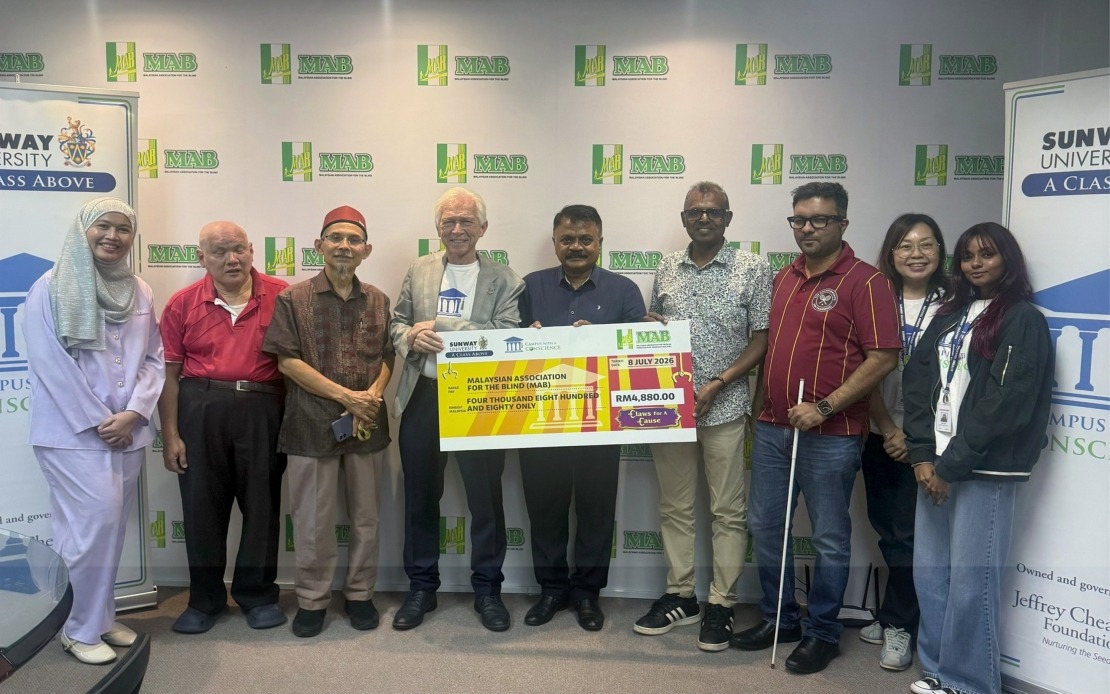
Sunway University has successfully mobilised its campus community to raise RM4,880 for the Malaysian Association for the Blind through an inventive fundraising campaign that transformed an ordinary arcade game into a vehicle for charitable giving. The "Claws For A Cause" initiative, executed in partnership with entertainment company Space Panda and operating under the university's Campus With A Conscience programme, ran for a full week and engaged both students and staff members in supporting a cause that affects thousands of Malaysians living with visual impairments.
The mechanics of the campaign were deliberately simple yet effective: a claw machine game, typically associated with recreational entertainment, became an instrument through which the campus community could contribute meaningfully to disability support services. Participants paid to operate the machine, with proceeds directed entirely to MAB. This approach proved particularly resonant with university students, who often respond enthusiastically to causes that combine social responsibility with interactive, low-pressure engagement. By embedding fundraising within a familiar gaming context rather than relying solely on traditional donation appeals, Sunway University demonstrated nuanced understanding of how to motivate young people toward charitable action.
Professor Sibrandes Poppema, President and Vice-Chancellor of Sunway University, framed the initiative as an expression of the institution's broader mission architecture. In his statement, he emphasised that Sunway University positions itself as a fifth-generation educational establishment committed to integration of academic rigour with demonstrable social contribution. The language employed—describing the university as "mission-driven"—reflects contemporary positioning of higher education institutions not merely as knowledge repositories but as active agents of societal transformation. This framing carries particular significance in Malaysia's tertiary education landscape, where universities increasingly face expectations to demonstrate tangible community value beyond conventional academic outputs.
The partnership with Space Panda reveals an important strategic dimension to the campaign's success. Rather than relying exclusively on internal university resources and volunteer labour, Sunway University leveraged commercial sector expertise and infrastructure to amplify campaign reach and operational effectiveness. Space Panda's provision of gaming equipment and logistical support transformed what might otherwise have been a modest fundraising stall into a professionally managed installation capable of generating sustained engagement throughout the designated week. This model of academia-industry collaboration offers instructive lessons for other Malaysian universities contemplating community outreach initiatives with constrained budgets.
The Malaysian Association for the Blind, which received the RM4,880 contribution, operates within a complex landscape of visual impairment support in Malaysia. With an estimated population of individuals experiencing various degrees of visual disability, MAB serves as a critical organisation providing rehabilitation services, vocational training, advocacy, and social support. The funding contribution, while modest in absolute terms, enables the organisation to expand specific programmes or sustain existing services during budgetary pressures. For context, the funds generated through Sunway University's initiative could support multiple beneficiaries in MAB's educational or vocational rehabilitation programmes.
Marcus, Director of Space Panda, articulated the commercial partner's motivation in language emphasising social consciousness within private enterprise. His statement that "small acts of kindness could make a meaningful difference" reflects broader corporate social responsibility discourse prevalent among Malaysian companies seeking to demonstrate alignment with sustainable development goals and community welfare commitments. By explicitly highlighting the significance of supporting organisations that empower individuals with visual impairments, Space Panda positioned itself not merely as a logistics provider but as a stakeholder in inclusive society-building.
The "Claws For A Cause" campaign illustrates emerging trends in how Malaysian tertiary institutions approach community engagement. Rather than maintaining traditional separation between university recreational spaces and charitable activities, Sunway University integrated social responsibility into existing campus infrastructure and routines. This embedded approach to fundraising often generates higher participation rates than segregated campaigns, as individuals encounter donation opportunities within their regular campus movements. The strategy particularly resonates with younger demographics accustomed to gamified engagement and interactive experiences.
From a regional perspective, the Sunway University initiative demonstrates how Southeast Asian universities are increasingly adopting creative fundraising methodologies that move beyond conventional charity galas or donation appeals. The approach aligns with international best practices in cause marketing, where brands and institutions collaborate to create mutually beneficial arrangements: the university fulfils its community engagement mandate while the commercial partner enhances brand reputation through demonstrated social commitment. This model proves particularly effective in contexts where both academic and private sector resources remain constrained.
The significance of supporting visual impairment charities extends beyond immediate fundraising figures. Blindness and severe visual impairment constitute substantial disability categories in Malaysia, yet often receive less public attention than other health conditions. By directing campus resources toward MAB, Sunway University helped elevate visibility of visual disability within university consciousness and contributed to normalising charitable support for this population segment. This awareness-raising function frequently generates secondary benefits as individuals exposed to campaigns subsequently maintain engagement with cause-related organisations through volunteering, advocacy, or sustained financial support.
The sustainability and replicability of the "Claws For A Cause" model warrant consideration by other educational institutions. The relatively low operational complexity, minimal resource requirements, and proven capacity to generate community participation suggest potential for adaptation across Malaysian campuses. Several universities could conceivably coordinate similar initiatives benefiting different charitable organisations, creating a decentralised network of cause-related fundraising activities across the tertiary education sector. Such coordination might eventually establish game-based fundraising as a recognisable fundraising category within Malaysian university calendars.
Looking forward, the success of this initiative positions Sunway University to expand its partnership portfolio with commercial entities capable of providing infrastructure support for future campaigns. The university's demonstrated commitment to Campus With A Conscience programming, now validated through measurable fundraising outcomes, strengthens its institutional positioning as a socially engaged institution. For Malaysian students and their families evaluating university options, evidence of genuine community engagement—rather than performative corporate social responsibility—increasingly influences enrolment decisions and institution selection.
The RM4,880 raised through this campaign represents more than a monetary contribution to disability support services; it embodies a methodological statement about how modern universities can catalyse community participation toward social good. By transforming recreation into responsibility and gamification into giving, Sunway University demonstrated that fundraising need not feel like sacrifice. This psychological reframing potentially unlocks greater future participation from campus communities often reluctant to respond to traditional charitable appeals, establishing foundations for sustained institutional engagement with Malaysian civil society.

