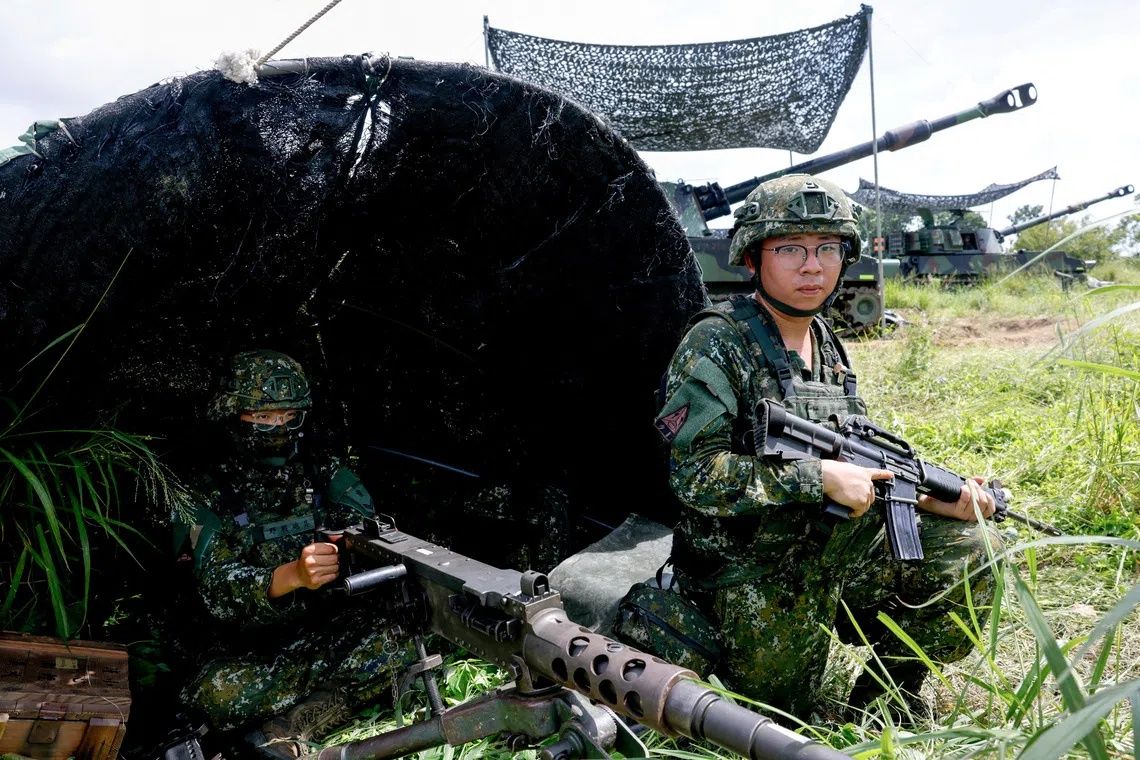
Taiwan launched its annual Han Kuang military exercise on Wednesday, marking a significant evolution in how the island prepares its armed forces and civilian population for potential conflict. The 10-day drill, which began with orders issued from an underground command centre in Taipei, represents the most comprehensive test yet of Taiwan's ability to maintain operational cohesion when circumstances deviate from predetermined plans. With more than 20,000 troops mobilised, including around 5,000 reservists, the exercise signals Taiwan's determination to move beyond conventional, highly choreographed training towards more demanding and unpredictable scenarios that reflect real wartime conditions.
A particularly notable innovation this year involves the deliberate throttling of mobile internet speeds across the island for the first time in the drill's four-decade history. This measure aims to evaluate how civilians and government institutions would maintain communications and coordination if bandwidth became severely restricted following a potential Chinese attack. The decision underscores Taiwan's strategic assessment that any conflict would likely involve attempts to cripple critical infrastructure, and that civilian preparedness is as important as military readiness. By simulating such constraints now, Taiwan's defence establishment hopes to identify vulnerabilities in communication networks and develop contingency protocols before an actual crisis occurs.
A key methodological change involves adopting what military planners call the "backbrief" approach, borrowed directly from United States military doctrine. Under this system, junior officers who receive orders must restate mission details and operational intent back to their commanders before executing them. This seemingly straightforward procedure represents a fundamental shift in how Taiwan's military operates, prioritising clarity and mutual understanding over hierarchical obedience. Defence officials emphasise that this mechanism ensures commanders and subordinates maintain alignment on strategic objectives, reducing the likelihood of miscommunication under the fog of war. For Malaysian observers, this reflects international best practices in military command structures that many regional armed forces have begun adopting to enhance operational effectiveness.
The exercise places considerable emphasis on scenarios that planners believe Beijing would prioritise in any conflict: the early destruction or disruption of command centres, naval ports, logistics networks, and defence manufacturing facilities. Taiwan's defence establishment has evidently concluded that a Chinese military campaign would follow a strategy of rapid paralysis rather than gradual attrition. By rehearsing responses to such attacks, Taiwan's military can develop protocols for maintaining command authority even when conventional communication systems fail and key installations come under assault. The drills will include the simulated relocation of a major arsenal, the mobilisation of civilian factories for wartime production, and escort exercises off Taiwan's Pacific coast to test naval capabilities in contested waters.
Taiwanese defence officials have indicated that past exercises suffered from being overly controlled and somewhat artificial in nature, with outcomes essentially predetermined through careful scenario management. This year's emphasis on introducing "unexpected scenarios" to field commanders represents a deliberate move away from such practices. Commanders will face situations where the tactical situation does not match pre-established enemy profiles, forcing them to reassess threats, adjust plans, and issue new orders in real time. This pedagogical approach acknowledges that actual warfare seldom conforms to military theory, and that adaptability—the capacity to think clearly under pressure and make sound decisions with incomplete information—matters as much as technical proficiency.
The resilience-building aspect of the exercise extends well beyond military personnel. Taiwan has incorporated elements testing how local government officials and civilian administrators would maintain government functions during cascading crises, from natural disasters to foreign invasion. This civil-military integration reflects an understanding that modern conflict does not observe the traditional boundary between military and civilian domains. In the Malaysian context, where civilian infrastructure and government continuity would face similar threats in any regional conflict, Taiwan's holistic approach to disaster and war preparedness offers instructive lessons for Southeast Asian nations developing their own contingency plans.
Taiwanese planners have also introduced an "embedded reporter" mechanism to assess how the island would manage information operations and combat enemy disinformation during actual hostilities. This recognition that control of narrative constitutes a crucial aspect of modern warfare reflects lessons learned from recent conflicts, particularly Russia's approach in Ukraine. Taiwan's defence ministry is essentially conducting dress rehearsals for wartime media management, testing how frontline military units would release information and counter false narratives while maintaining operational security. Such preparation assumes that conflict with China would involve sustained information warfare alongside kinetic operations, with both domestic and international audiences as critical battlegrounds.
The timing and scale of this year's exercises cannot be separated from the strategic context of escalating Chinese military pressure on Taiwan. In recent months, Chinese military activities around the island have intensified significantly, with increased frequency of aircraft incursions and naval operations. Taiwan's defence establishment clearly views these Han Kuang drills not merely as routine training but as a public demonstration of resolve and readiness. By conducting the most sophisticated and realistic exercises in the programme's history, Taiwan signals to both Beijing and the international community—particularly allies such as the United States—that it takes its defensive obligations seriously and continues upgrading its military capabilities.
For regional observers in Southeast Asia, Taiwan's approach to military modernisation and civil defence raises important questions about how smaller nations should prepare for potential great power conflicts. Taiwan's emphasis on resilience, distributed command authority, and civilian integration contrasts sharply with traditional military doctrines that emphasise centralised control and military-centric solutions. Malaysia and other ASEAN members might consider whether Taiwan's experience offers relevant models for their own defence planning, particularly given that several Southeast Asian nations face similar challenges of protecting extended coastlines and maritime interests against more powerful neighbours. Taiwan's explicit acknowledgment that modern military exercises must move beyond laboratory conditions towards genuine field environments represents a maturation of military thinking that has implications well beyond the island itself.
Chinese authorities have not responded to requests for comment regarding the Taiwan exercises, maintaining their established practice of minimal public reaction to Taiwanese military activities. However, the absence of official response should not be interpreted as indifference; Chinese military planners undoubtedly monitor such drills closely to understand Taiwan's evolving defensive posture and command philosophy. The strategic asymmetry remains pronounced—China possesses vastly superior military resources and can afford high operational tempos and large-scale exercises. Taiwan's advantage lies instead in fighting on terrain it knows intimately and in the motivation of defending its homeland, factors that become increasingly important when military capabilities are more evenly matched. By conducting increasingly realistic exercises, Taiwan acknowledges this asymmetry while working to maximise the defensive advantages it does possess.
The evolution of Taiwan's military exercises reflects broader trends in how democracies prepare for potential conflict with authoritarian powers. Flexibility, decentralised decision-making, transparent communication, and civilian engagement represent values that democratic militaries increasingly prioritise precisely because they offer resilience advantages in unpredictable environments. Taiwan's Han Kuang drills thus embody not merely military modernisation but also a strategic choice about what kind of society fights back when challenged. For Malaysia and other Southeast Asian democracies, Taiwan's experience suggests that military preparedness remains inseparable from questions about governance structures, civil-military relations, and the kind of national resilience that emerges from genuine societal engagement in security challenges.

