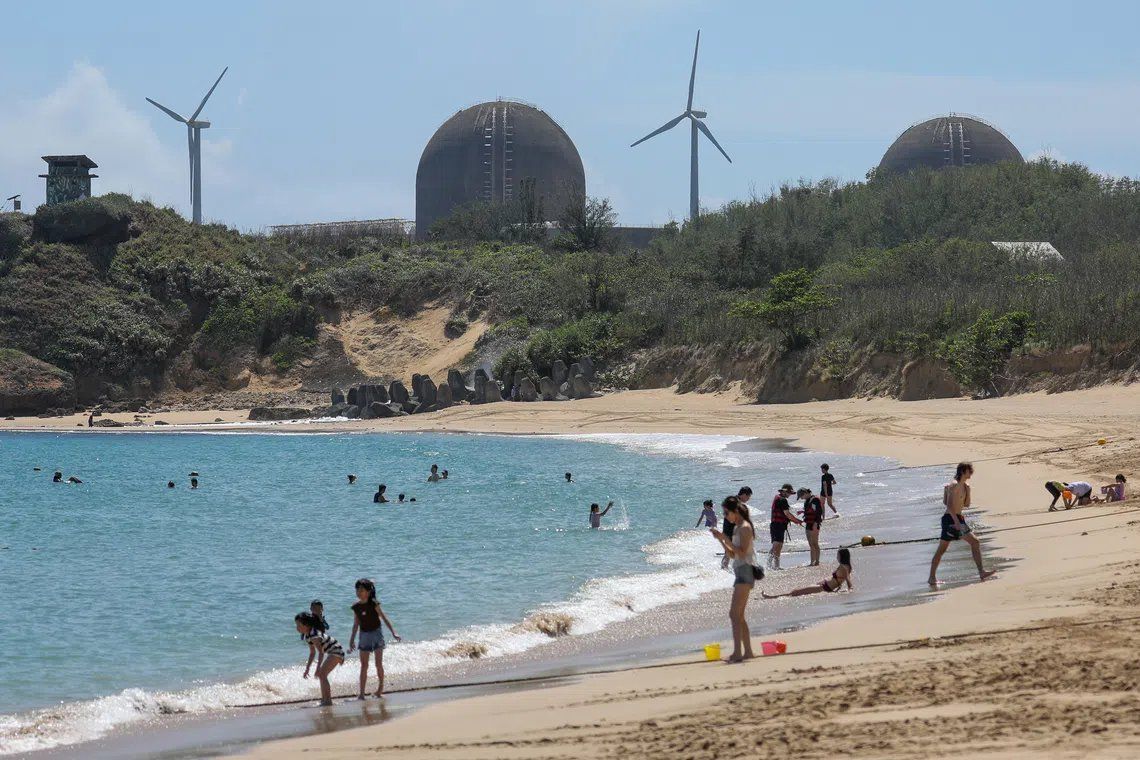
Taiwan faces yet another national referendum on nuclear power policy, this time bundled with local elections scheduled for November 28. This marks the island's fourth ballot on nuclear matters within a single decade, raising uncomfortable questions about whether direct democracy has become a plaything of partisan interests rather than a genuine mechanism for settling major policy questions. The convergence of this referendum with the "nine-in-one" elections—which will determine county magistrates and eight other categories of officials across Taiwan—suggests the real drivers behind the proposal extend far beyond energy policy considerations.
The November referendum specifically asks voters whether the government should abandon its "Nuclear-Free Homeland" policy, framing the question around public health, electricity affordability, national defence resilience, and support for artificial intelligence development. This framing itself reflects careful political messaging, tying nuclear energy to concerns about Taiwan's technological competitiveness and security—issues that resonate across the political spectrum. Yet the Central Election Commission approved this question while rejecting two others submitted this year: one on legalising caning for serious crimes and another on allocating traffic fine revenues to road safety and public transport. The CEC's reasoning that the caning proposal violated human rights standards offers a glimpse into how even direct democracy mechanisms come with gatekeeping mechanisms.
The timing and repetition raise substantive questions about whether genuine shifts in public opinion justify a fourth referendum so soon. Taiwan's energy landscape has indeed shifted since the previous nuclear vote in August 2025, with global oil supply disruptions stemming from Strait of Hormuz tensions and mounting electricity demands driven by the artificial intelligence boom creating legitimate reasons for policy reconsideration. However, experts studying Taiwan's political system argue these practical considerations pale beside electoral calculations. The opposition Kuomintang and Taiwan People's Party appear convinced that issues like nuclear energy can energise voters more inclined toward conservative positions, particularly in close local races where every percentage point of turnout differential matters.
Historical evidence supports this electoral strategy. During the 2018 local elections, ten national referendums were held simultaneously, and the KMT achieved notably strong results that day. Qi Dongtao, a senior research fellow at the East Asian Institute of the National University of Singapore, suggests this pattern is unlikely coincidental. He argues that the electoral calculation "is probably at least as important as the policy substance of the referendums themselves." The opposition's gambit relies on a well-documented tendency for conservative voters to turn out in higher numbers when cultural and security-related questions appear on the ballot alongside local races, potentially tilting outcomes in competitive contests.
Beyond mobilisation effects, opposition parties view referendums as platforms for narrative-building. Chong Ja Ian, an associate professor of political science at NUS, observes that the KMT attempts to position itself as tough on crime and governance, frequently invoking Singapore as a counterexample of efficient law and order. By placing contentious issues before voters, the opposition can argue that the ruling Democratic Progressive Party constrains more forceful governance. This rhetorical strategy transforms referendums into tools for reframing the political debate rather than settling specific policy questions through genuine deliberation.
The proliferation of referendums itself represents a structural shift in Taiwan's political system. Before 2017, referendums required 50 per cent turnout to be valid, which proved an almost insurmountable barrier—former president Chen Shui-bian's 2004 referendums on cross-strait relations failed despite overwhelming majority support for the proposals. The revised threshold now requires only that "Yes" votes exceed "No" votes and that affirmative votes constitute at least 25 per cent of the total electorate. This democratisation of the referendum mechanism has paradoxically transformed direct democracy from an exceptional tool into a routine feature of Taiwan's electoral calendar. The result is sharp growth in referendum proposals, particularly following partisan initiatives.
Lin Jia-he, an associate professor at National Chengchi University's College of Law, voices concern that Taiwan's referendum frequency far exceeds international norms. He contrasts Taiwan's three-month timeline from announcement to vote with Switzerland's standard three-to-five-year deliberative period, during which government agencies and citizens engage sustained examination of complex policy questions. The compressed schedule in Taiwan prevents genuine public understanding of intricate energy policy trade-offs, the costs and benefits of different generation technologies, and grid stability implications. Voters encounter these questions stripped of the contextual knowledge necessary for informed choice, reducing referendums to gestures of apparent democratic participation masking insufficient deliberation.
Qi warns that this instrumental use of referendums risks fundamentally corrupting the democratic tool itself. When political parties treat referendums primarily as mechanisms for partisan mobilisation, direct democracy transforms from "an instrument of popular authorisation on major questions" into "another arena of partisan competition." Referendums should function as occasional recourse to fundamental questions, not as regular supplements to electoral contests. The current Taiwanese practice suggests a troubling normalisation where parties routinely place contentious issues on ballots specifically designed to activate their base, rather than because genuine uncertainty about policy direction requires popular input.
Voter scepticism reflects growing awareness of this dynamic. Sean Chang, a 39-year-old Taipei resident in public relations, articulated common frustration during interviews. While he initially viewed referendums as a meaningful democratic mechanism, he increasingly perceives them as "a tool for each political party to manipulate public opinion." The cognitive burden of processing repeated referendums eventually becomes exhausting, leading voters like Chang to disengage entirely. This suggests that excessive referendums may ultimately undermine democratic legitimacy rather than enhancing it, as citizens develop cynicism about the authentic democratic intentions behind questions placed before them.
The November elections themselves command substantial stakes, with 11,051 local public officials competing across Taiwan. While local campaigns typically emphasise domestic concerns, analysts understand these contests as bellwethers for national-level political trajectories, with implications extending to Taiwan's next presidential election due by 2028. The nuclear referendum's presence on the ballot ensures that energy policy becomes entangled with broader narratives about governance competence, law and order, and national security that shape voter preferences across multiple races. This layering of policy questions, electoral contests, and partisan competition creates complex terrain where voters struggle to isolate distinct policy judgments from team-based political calculations.
For regional observers, Taiwan's referendum experience offers instructive lessons about how direct democracy mechanisms, despite theoretical appeal, can be captured by partisan interests when institutional frameworks fail to protect their integrity. Malaysia, Singapore, and other Southeast Asian democracies monitoring Taiwan's political evolution should consider whether lowering thresholds for referendums without establishing robust deliberative processes inevitably produces the instrumentalisation visible in contemporary Taiwan. The balance between expanding popular participation and maintaining meaningful democratic substance remains precarious, requiring institutional guardrails that Taiwan's current system has not yet adequately provided.

