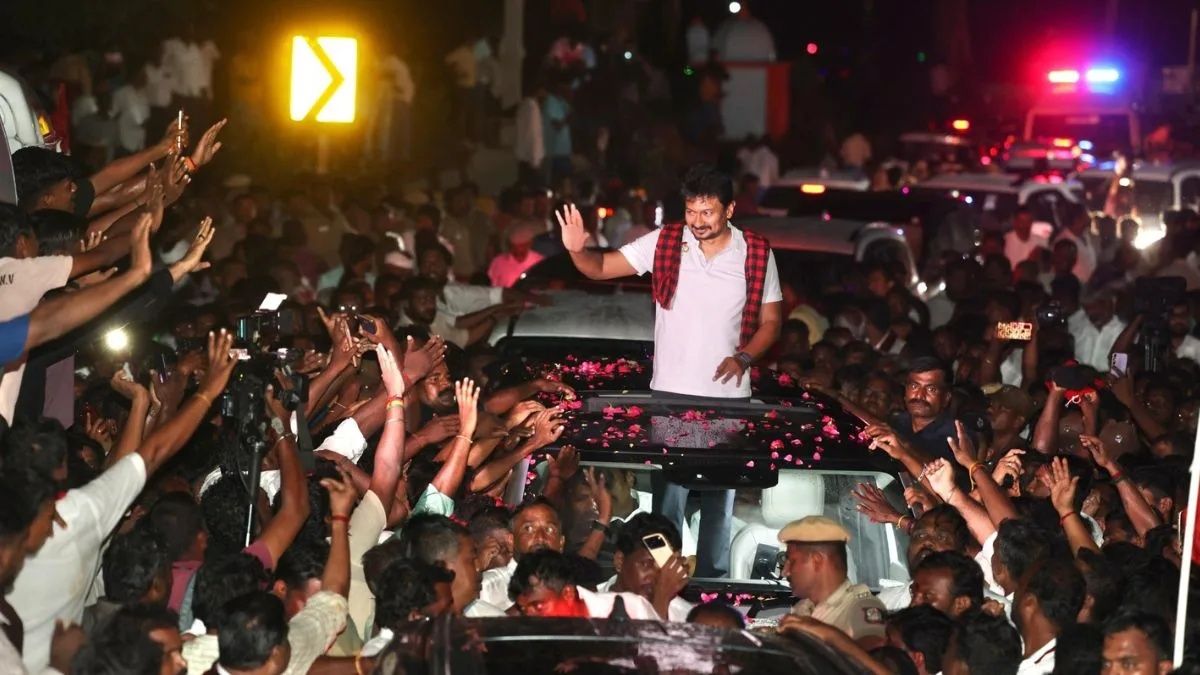
Udhayanidhi Stalin, the Leader of Opposition in Tamil Nadu, has been freed on station bail after an extended interrogation session relating to comments he made that have triggered a significant political row in the southern Indian state. The former deputy chief minister's release on Tuesday evening came after he spent considerable time being questioned at Sengipatti police station, where he had been taken following his arrest the previous day. The incident exemplifies the intensifying political tensions between the ruling TVK government and the opposition DMK party in Tamil Nadu's fractious political landscape.
Hundreds of DMK party workers gathered outside the police station to welcome Stalin upon his release, demonstrating the party's solidarity with its prominent leader. The crowd's chants reflected the broader DMK strategy of portraying Stalin's detention as an example of political persecution by Chief Minister Vijay's administration. The reception underscored the deep polarization that currently characterizes Tamil Nadu politics, with both sides treating the incident as emblematic of their broader ideological conflicts over governance and administrative fairness.
In a press conference immediately following his release, Stalin categorically denied that his statements carried any disrespectful or inappropriate intentions. He characterized his arrest as part of a calculated diversion strategy employed by the ruling government to distract public attention from substantive policy failures, particularly regarding agricultural and water management issues. His defence emphasized that he had been exercising his legitimate right to criticise government policies and advocating for farmers' interests when the controversy erupted.
The controversy originated during a DMK-organized demonstration in Thanjavur where Stalin was addressing farmers and supporters regarding the longstanding Cauvery water dispute and Karnataka's proposed Mekedatu dam project. These issues remain deeply sensitive across Tamil Nadu, as the state has repeatedly expressed concerns about water availability from the Cauvery River and regards the neighbouring state's dam construction plans as a potential threat to its agricultural sector. While Stalin was discussing these water-related concerns, a supporter in the crowd called out the name of Trisha, a prominent Tamil cinema actress believed to have personal connections to Chief Minister Vijay.
Upon hearing the actress's name mentioned, Stalin paused, smiled, and responded with a remark that has since become the flashpoint for this controversy. He said, "Wherever water comes, whether it comes or not, water should come there." What might appear innocuous on the surface has been interpreted by the ruling TVK government and critics as containing sexual innuendo directed at the actress, effectively weaponizing a reference to a public figure for political effect. The government's interpretation has resonated with conservative segments of society concerned about the objectification of women in public discourse.
The TVK government responded swiftly to the controversy, characterizing Stalin's remarks as constituting verbal harassment and the objectification of a woman. Rather than treating it as a minor political slip or campaign-trail gaffe, the ruling party escalated the matter by approaching the National Commission for Women, India's apex body tasked with safeguarding women's rights and addressing grievances related to gender-based discrimination. Simultaneously, the government filed a formal police complaint against Stalin, setting in motion the legal machinery that ultimately led to his arrest from his Chennai residence.
The arrest and subsequent interrogation represent a notable escalation in the political confrontation between Tamil Nadu's ruling and opposition forces. For the DMK, the detention of Stalin symbolizes government overreach and the use of state apparatus for political vendetta. For the TVK, the action demonstrates their commitment to protecting women's dignity in public discourse and their willingness to pursue legal avenues when they perceive such violations. This divergence in interpretation reveals the fundamental lack of consensus about what constitutes appropriate political expression in contemporary Tamil Nadu.
The incident also reflects broader concerns across Indian politics about the intersection of celebrity culture, gender, and political rhetoric. Actresses and film personalities occupy an outsized role in Tamil Nadu's political sphere, with Chief Minister Vijay himself being a former prominent cinema actor. This unique context means that references to film personalities in political speech can carry additional layers of meaning and sensitivity that might not exist elsewhere. The weaponization of such references for political purposes raises questions about the boundaries of acceptable campaign rhetoric and the protection of individuals from personal attacks disguised as political commentary.
Staling's defence that his words carried only a literal meaning regarding water availability, while potentially technically defensible, does little to address the interpretation problem that has already taken root in public discourse. The very fact that multiple observers perceived sexual innuendo in his statement suggests that either his choice of words was imprudent, or his interpretation of his own remarks fails to account for how audiences actually received the message. This gap between intended and received meaning represents a common challenge in political communication, particularly when figures speak extemporaneously to large gatherings where individual words can be isolated and recontextualized.
The broader implications of this controversy extend beyond Tamil Nadu's immediate political competition. Southeast Asian observers should note how Indian states are deploying legal mechanisms, police action, and appeals to women's rights commissions as tools in political contests. The willingness to arrest opposition politicians on charges related to alleged public conduct reflects the instrumentalization of law enforcement for political purposes, a trend that affects the quality of democratic discourse and the freedom of politicians to criticize government policies without fear of legal retaliation. The question of whether Stalin's remarks genuinely warranted police intervention or whether the response represents political overreach will likely remain contentious.
As the case proceeds through the legal system, the larger question hovering over Tamil Nadu politics concerns the limits of political expression and the point at which criticism of government policies transforms into personal attacks that warrant legal intervention. Stalin's characterization of the government as a "circus" and his assertion that arrest awaits any DMK legislator who speaks publicly suggests he views the current administration's approach to law enforcement as broadly politicized. Whether public opinion in Tamil Nadu views his detention as justified accountability or political persecution will significantly influence the electoral calculations for all parties heading toward the state's next assembly elections.
The controversy ultimately demonstrates how modern political conflicts increasingly spill across multiple domains simultaneously—legislative chambers, protest grounds, police stations, and media platforms—with each institution becoming a venue for partisan competition. The involvement of the National Commission for Women in what some view as an essentially political dispute also raises questions about whether specialized institutions designed to protect vulnerable populations risk becoming instrumentalized for partisan advantage when powerful political actors invoke their mechanisms. These patterns, replicated across Indian states and potentially relevant to other democracies in the region, deserve careful scrutiny from those concerned with maintaining robust but fair democratic competition.

