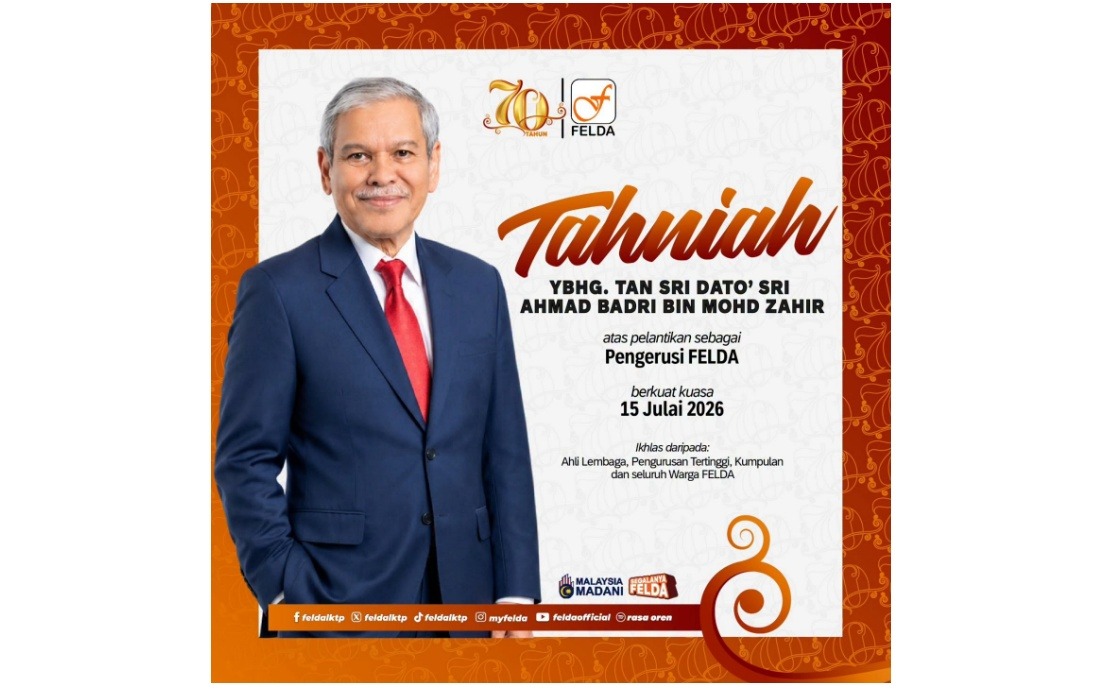
The Federal Land Development Authority has announced the appointment of Tan Sri Ahmad Badri Mohd Zahir as its new chairman, marking a significant leadership transition for the agency that oversees Malaysia's crucial agricultural settler scheme. The appointment signals the government's commitment to strengthening governance within one of the country's oldest institutional bodies, tasked with supporting more than three million settlers across extensive land development schemes nationwide.
Ahmad Badri brings formidable credentials to the role, having accumulated more than thirty years of service across Malaysia's public administration and corporate landscape since initially joining the Ministry of Finance in 1989. His career trajectory demonstrates deep experience navigating complex organisational structures and managing institutions of substantial national importance. Most notably, he served as Treasury Secretary-General between 2018 and 2020, a position that places him at the apex of Malaysia's fiscal governance during a period of significant economic transition and budgetary adjustment.
His professional portfolio extends across several institutions critical to Malaysia's financial and economic architecture. Ahmad Badri previously held the chairmanship of the Employees Provident Fund, the mandatory retirement savings scheme affecting millions of Malaysian workers. This experience positioning him to understand the interconnection between institutional sustainability, fund management, and protection of member interests—principles directly applicable to safeguarding the welfare of FELDA settlers whose livelihoods depend on the authority's effective operation.
Beyond his EPF tenure, Ahmad Badri has accumulated board experience across Malaysia's most significant economic entities. He served as a board member of Bank Negara Malaysia, positioning him within the nation's monetary policy apparatus, and held directorships at Permodalan Nasional Berhad and Tenaga Nasional Berhad, two pillars of Malaysia's capital markets and energy infrastructure respectively. These roles demonstrate exposure to strategic decision-making at the highest levels of institutional governance across financial services, national investment, and critical infrastructure sectors.
Currently, his responsibilities remain extensive and varied. Ahmad Badri chairs RHB Bank Bhd, one of Malaysia's leading financial institutions, and similarly leads the Malaysian Rubber Board, the government agency responsible for Malaysia's rubber sector—itself a cornerstone of agricultural commerce and export revenue. He additionally serves as a board director of Sime Darby Bhd, one of Southeast Asia's largest multinational conglomerates with substantial operations across plantations, property, and industrial sectors. This current portfolio reveals a leader simultaneously engaged with banking, agriculture, and diversified business management.
His educational formation complements his professional ascent, combining technical agricultural expertise with advanced business training. Ahmad Badri holds a bachelor's degree in Estate Management from Universiti Teknologi MARA, grounding him in the practical dimensions of land administration and agricultural development. His Master of Business Administration from the University of Hull adds contemporary management theory and international perspectives to his knowledge base, equipping him with frameworks for organisational transformation and strategic planning.
The government's statement accompanying the appointment emphasises Ahmad Badri's anticipated role in advancing FELDA's transformation agenda while maintaining alignment with Malaysia's broader sustainable and inclusive development objectives. This framing suggests FELDA faces strategic imperatives extending beyond traditional settler support toward modernisation, environmental sustainability, and economic inclusivity. The appointment implies recognition that FELDA's future requires leadership conversant with both heritage land-settlement commitments and contemporary development paradigms.
FELDA's settler population represents a crucial constituency within Malaysian society, encompassing agricultural families distributed across the nation's plantations and developed lands. The authority functions simultaneously as an economic development institution and a welfare provider, navigating the tension between commercial sustainability and social responsibility. Ahmad Badri's background in treasury management, retirement funds administration, and institutional governance suggests he brings perspective on balancing fiduciary duties with beneficiary welfare—a balance FELDA must maintain for settler prosperity.
The leadership transition occurs within a broader context of institutional governance evolution across Malaysia's governmental and quasi-governmental sector. Strategic leadership appointments increasingly reflect emphasis on proven capability across complex organisations, financial management, and stakeholder engagement. Ahmad Badri's trajectory from ministry position through treasury leadership to corporate directorates follows this pattern, suggesting the appointment reflects deliberate selection based on demonstrated competence rather than political patronage alone.
For FELDA settlers, this appointment potentially signifies renewed focus on organisational effectiveness and strategic positioning within Malaysia's agricultural sector. As global commodity markets, climate pressures, and technological advancement reshape agricultural economics, FELDA requires leadership capable of navigating modernisation while protecting settler interests. Ahmad Badri's experience managing large-scale institutions through transitional periods positions him to address these dual imperatives simultaneously.
The broader implications extend to Malaysia's institutional development and governance quality. Leadership appointments across major statutory bodies influence not only those organisations but investor confidence, international perceptions, and domestic stakeholder trust in institutional competence. Ahmad Badri's appointment signals commitment to professional governance standards and merit-based selection, potentially reinforcing broader institutional credibility at a time when governance quality remains economically consequential for Malaysia's regional standing and investment attractiveness.

