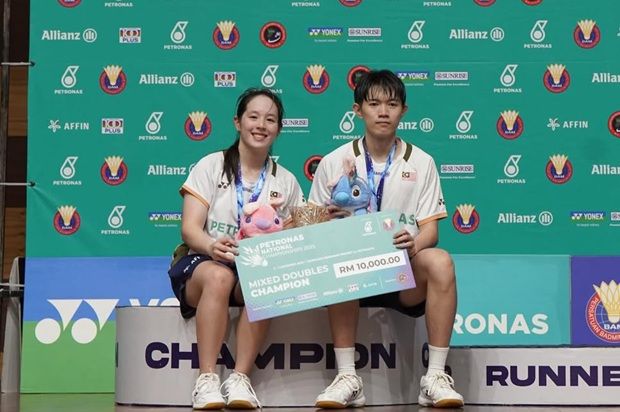
Clarissa San steps into the spotlight of one of badminton's most prestigious tournaments next week with guidance from her new mixed doubles partner Tang Jie, who has assumed a dual role as both competitor and mentor as the 20-year-old makes her Japan Open debut. The pairing formed following an injury to her original partner Toh Ee Wei, who sustained an anterior cruciate ligament (ACL) injury and is currently undergoing rehabilitation in Melbourne. Despite the sudden change in circumstances, Clarissa has embraced the opportunity to compete at a BWF World Tour premier event, bringing with it both excitement and the weight of expectation.
The Selangor-born shuttler finds herself in enviable company as she navigates her maiden appearance at the Japan Open. Tang Jie and mixed doubles head coach Nova Widianto have established a consistent message with the teenager: approach each match with composure rather than apprehension. This counsel reflects a deeper understanding of how tournament pressure can derail emerging players, particularly those stepping into elite competition for the first time. Clarissa has absorbed this guidance, recognising that her state of mind will significantly influence her performance on court.
During training sessions and team interactions, both Tang Jie and Widianto have repeatedly reinforced the importance of emotional control. Their refrain remains straightforward yet profound: avoid allowing anxiety to dominate her thinking, maintain clarity under pressure, and above all, extract enjoyment from competing at such a rarified level. This approach prioritises long-term development over immediate results, a philosophy increasingly adopted by Malaysian badminton coaching structures as they build depth across various categories.
Clarissa's own mindset reflects maturity beyond her years. She acknowledges that maintaining realistic expectations serves her well, particularly given the magnitude of her debut. Rather than harbouring grand ambitions for the tournament, she has anchored her objectives to a more foundational goal: translating the technical and tactical work developed during recent training blocks into match situations. This measured approach suggests she understands the learning curve she faces when confronting opponents from around the world.
The partnership between Tang Jie and Clarissa will commence against Taiwan's Yang Po-hsuan and Hu Ling-fang in their opening fixture. This first-round test provides both an opportunity to settle nerves and establish rhythm in their early collaboration. The tournament progression could reveal whether their budding chemistry translates into competitive success across multiple matches.
Clarissa has spoken openly about her technical shortcomings, demonstrating the self-awareness that often distinguishes players with genuine developmental potential. She recognises areas requiring refinement and views the Japan Open not merely as a competition but as an intensive educational experience. Having Tang Jie at her side provides continuity and reassurance, particularly when mistakes occur during high-stakes matches. His willingness to guide her through errors suggests a maturity in his own approach to competition and mentorship that strengthens their pairing.
The mentor-mentee dynamic operating within their partnership distinguishes this pairing from typical professional relationships in badminton. Tang Jie has essentially accepted responsibility for Clarissa's growth, functioning as both peer and older figure, a role he appears to discharge naturally. For a player of Clarissa's generation, having someone of Tang Jie's experience invested in her development creates a supportive environment where mistakes become learning opportunities rather than sources of discouragement.
Clarissa's trajectory through these early tournaments alongside Tang Jie will establish the foundation for future campaigns. Beyond the Japan Open, the pair will compete together in three or four additional tournaments, providing extended exposure to elite-level competition. This scheduling offers Clarissa the chance to accumulate experience and develop consistency in partnership with Tang Jie, building familiarity and understanding that typically improves mixed doubles performance significantly.
Malaysia's badminton contingent at the Japan Open extends beyond Tang Jie and Clarissa, with several other pairings representing the nation's mixed doubles strength. Jimmy Wong and Cheng Su Yin will contest their opening match against Japan's Yuichi Shimogami and Sayaka Hobara, while the independent pairing of Goh Soon Huat and Shevon Lai Jemie faces Americans Chen Zhi Yi and Francesca Corbett. Meanwhile, Wong Tien Ci and Lim Chiew Sien confront a sterner challenge in the form of China's fifth-seeded pairing of Guo Xinwa and Chen Fanghui, a matchup that will test their current capabilities against one of the world's strongest mixed doubles combinations.
The depth of Malaysian mixed doubles entries reflects the sport's strength domestically and the nation's aspiration to maintain competitive presence across major international tournaments. Clarissa's debut, supported by Tang Jie's mentorship, represents another chapter in this ongoing narrative of Malaysian badminton development and international ambition.

