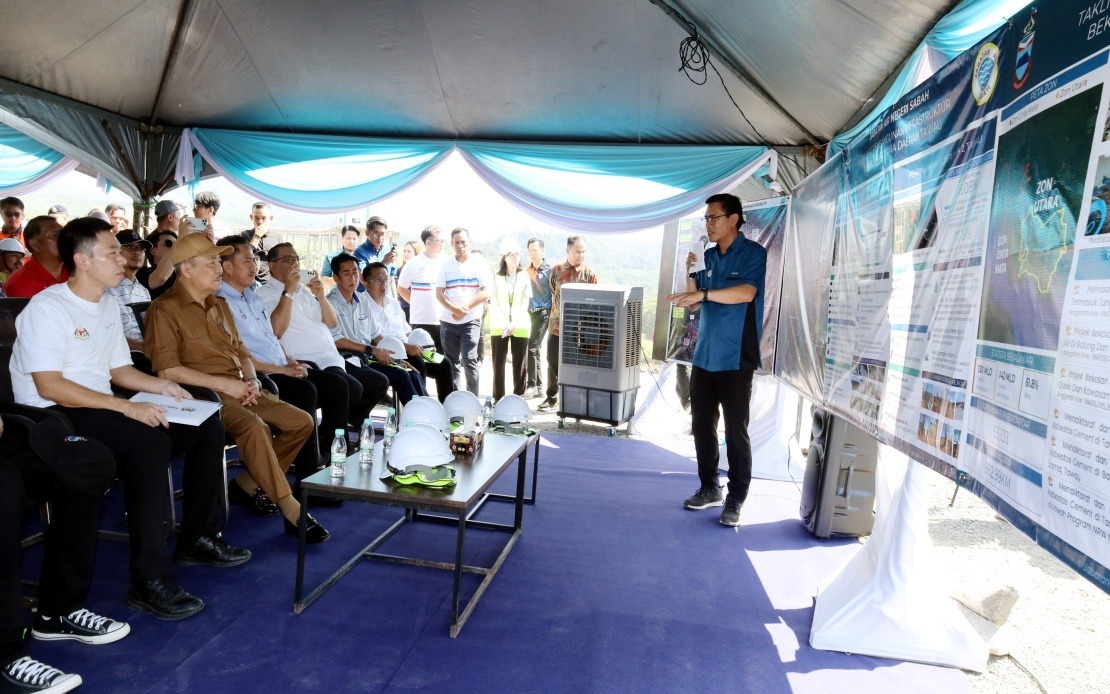
Tawau's persistent struggle to meet water demand should finally reach a turning point before the end of 2027, when the RM450.5 million Tawau Water Supply Scheme Phase III completes its ambitious infrastructure overhaul. Sabah Chief Minister Datuk Seri Hajiji Noor outlined the timeline during a site visit to the Tawau Dam and Cinta Mata 2 Water Treatment Plant, signalling that despite contractor delays, the project remains on course to deliver relief to a town that has grappled with insufficient supply for years.
The chronic shortage reflects a widening gap between what Tawau produces and what residents demand. Currently, the town generates only 130 million litres of treated water daily against a demand sitting at 142 million litres—a deficit of 12 million litres that forces rationing and strains households and businesses. With 53,133 registered water accounts serving both the urban core and surrounding communities, the shortfall touches tens of thousands of consumers. This gap has persisted despite previous infrastructure investments, making Phase III a critical inflection point for the region's development prospects.
At the heart of the solution stands the Tawau Dam itself, a raw water storage facility designed to hold 30 million cubic metres and substantially reduce downstream flooding risks while ensuring year-round supply reliability. As of late July, construction had progressed to 74.04 per cent completion, according to Rodney Tinggas, senior assistant director of the Sabah State Water Department's Monitoring Branch and the project's manager. The dam represents the foundational piece of infrastructure upon which the entire scheme depends, capturing seasonal runoff and stabilizing supply during dry periods when shortages typically bite hardest.
Supporting the dam is a distribution network comprising 11.6 kilometres of 700-millimetre raw water supply pipelines feeding three treatment facilities: the existing Cinta Mata 1 plant, the Cinta Mata 2 facility under construction, and the Utara treatment plant. Together, these plants will deliver a combined treated water capacity of 161 million litres per day—substantially exceeding current demand and providing buffer capacity for population growth and economic expansion. This combined capacity represents a 31 million litre daily increase over existing production, fundamentally reshaping Tawau's water security outlook.
The Cinta Mata 2 Water Treatment Plant, budgeted at RM299.9 million, forms the most visible component of the modernization effort. Scheduled to conclude by July 22, 2028, the facility will independently treat 30 million litres daily and directly serve approximately 42,000 consumers across Tawau and neighbouring districts. Progress has been measured but steady, reaching 16.08 per cent physical completion by late July. The longer timeline for the treatment plant compared to the overall scheme reflects the technical complexity of establishing advanced water processing infrastructure, though project officials maintain confidence in the trajectory.
CM Hajiji acknowledged that the contractor had sought additional time, a not uncommon occurrence in large infrastructure projects across Malaysia and the region. Nevertheless, he emphasized that the state government views the scheme as a critical priority and has signalled willingness to inject supplementary funding if technical assessments from the Sabah State Water Department and the Department of Irrigation and Drainage determine such investment necessary. This flexibility suggests political commitment to breaking the impasse rather than allowing project drift.
The water crisis in Tawau carries broader implications beyond immediate consumer inconvenience. Sustained shortages constrain industrial development, discourage investment in resource-intensive sectors, and impose hidden costs on households through bottled water purchases and water trucking services during dry spells. Tourism, retail, hospitality, and manufacturing all face operational uncertainty when water supply proves unpredictable. By securing adequate supply, Phase III unlocks economic potential that has been artificially suppressed by infrastructure constraints.
That the Hajiji administration views this as an inherited problem rather than one it created sets important political context. Previous governance periods deferred necessary capital investment, allowing the gap between supply and demand to widen over two decades. The current state government has positioned the water scheme as evidence of responsible stewardship—a willingness to tackle difficult, expensive, long-cycle projects despite their fiscal burden. In the competitive landscape of Malaysian state politics, such infrastructure delivery records matter considerably when voters assess gubernatorial performance.
The Tawau Water Supply Scheme also exemplifies the infrastructure deficit across Sabah more broadly. The state's economic growth potential has long been constrained by deficiencies in water, power, transport, and digital connectivity. Water scarcity particularly affects the east coast districts, where rapid urbanization and agricultural development have outpaced utility planning. Tawau's experience reflects a pattern seen across Southeast Asia, where established infrastructure proves inadequate for expanding populations and economies, requiring periodic catch-up investments of substantial scale.
From a technical standpoint, the dam-plus-treatment-plant model represents sound engineering practice for tropical regions with pronounced wet and dry seasons. Raw water storage during monsoons ensures availability during the drier months when surface water naturally diminishes. Modern treatment plants can handle varying raw water quality, an important buffer against seasonal contamination events or upstream pollution. The three-plant distribution approach also provides redundancy—if one facility requires maintenance, the others can partially compensate, improving system resilience.
Completion before end-2027 would deliver tangible results within a reasonable timeframe for political continuity and community patience. Large infrastructure projects routinely extend beyond initial schedules, yet this scheme maintains focus on a defined endpoint. Success requires sustained contractor performance, continued political support across budget cycles, and absence of major unforeseen technical obstacles. For Tawau's residents, who have endured rationing and water truck deliveries during peak demand periods, the prospect of reliable supply within three years represents genuine cause for cautious optimism.

