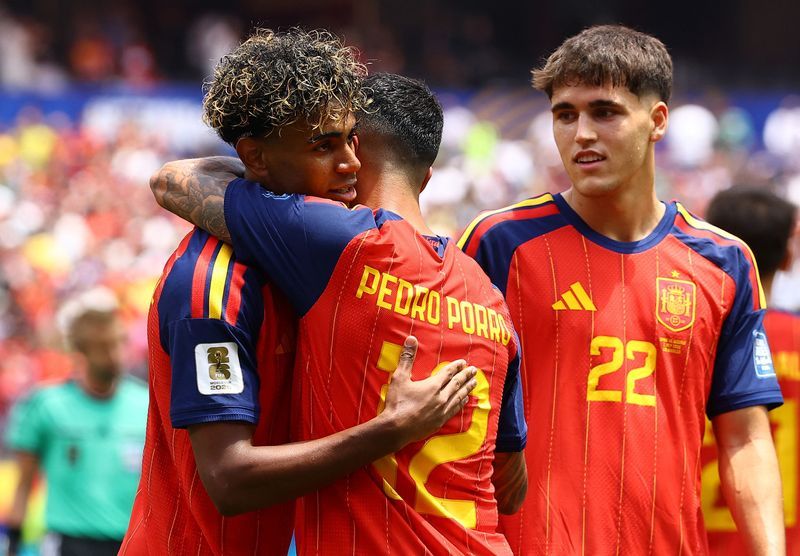
Spain's comprehensive 3-0 demolition of Austria signals a team rediscovering its rhythm and menace as 18-year-old winger Lamine Yamal sheds early fitness concerns to become the focal point of Luis de la Fuente's World Cup campaign. The Barcelona prodigy has catalysed a striking turnaround in Spanish form, transforming a side that began the tournament looking laboured and blunt into one that orchestrates the kind of controlled yet penetrative football that secured European Championship glory in Germany earlier this year.
Yamal's initial World Cup campaign was hampered by a nagging hamstring injury that forced him onto the bench as Spain stumbled through a goalless stalemate against Cape Verde. That performance exposed the fragility lurking beneath Spain's continental dominance—without the teenage sensation's dynamism on the right flank, the midfield machinery that once purred with such precision sputtered and struggled. The match against African qualifiers revealed a team stripped of its usual swagger, unable to impose the tempo or intensity that had made them virtually untouchable throughout their European Championship run, raising uncomfortable questions about squad depth and tactical flexibility.
The slow acclimatisation to tournament football reflected broader concerns about Spain's preparation for their North American venture. Alongside Yamal's fitness issues, fellow winger Nico Williams faced his own physical challenges that disrupted De la Fuente's carefully calibrated attacking balance. With Gavi and Ferran Torres operating down the flanks against Cape Verde, Spain resembled a shadow of themselves—a team playing textbook football without the cutting edge that makes such structured approaches actually penetrate resolute defences. The contrast between their lethargic opening performance and their subsequent transformation highlights just how integral Yamal has become to Spanish attacking philosophy.
Since gaining match rhythm and physical sharpness, Yamal has engineered a remarkable evolution in Spanish performance. The introduction of Alex Baena on the left wing alongside Yamal's resurgence on the right has restored the dual-threat attacking structure that opponents find almost impossible to neutralise. Baena's constant movement and ball-carrying created a second avenue of attack that stretched Austria's defensive formation, while Yamal's presence acted as a gravitational force drawing defenders toward him, creating pockets of space elsewhere across the pitch. This synergy between the two wings allowed Spain to recover the width and directness that complemented rather than contradicted their possession-based philosophy.
Yamal's brilliance against Austria transcended conventional statistics—he departed the match as player of the match despite neither scoring nor registering an assist, a reflection of his subtler but profound impact on proceedings. Rather than relying on traditional attacking metrics, Yamal manipulated the game through his off-the-ball positioning and one-on-one prowess against defenders, constantly forcing Austrian full-backs into uncomfortable decisions and unsettling the team's defensive shape. His ability to attract multiple defenders created space for midfield conductors Rodri and Pedri to operate more freely, allowing Spain to recycle possession with the tempo and precision that has become their trademark.
The tactical sophistication revealed against Austria demonstrates why Yamal has evolved from Barcelona prospect to essential World Cup asset so rapidly. Since emerging from La Masia Academy as a 16-year-old, the teenager has possessed an unusual quality—the capacity to make structured, possession-based football feel spontaneous and alive rather than choreographed and predictable. He drifts inside at crucial moments when the opposition tightens their formation, triggering transitions in Spain's attacking shape that allow Rodri and Pedri to reclaim their creative dominance. This interplay between rigid structure and fluid improvisation defines modern Spanish football under De la Fuente.
Beyond the attacking dimension, Spain's defensive solidity against Austria painted a picture of a team increasingly confident in their tournament trajectory. Austria failed to register a single shot on target throughout the 90 minutes, a defensive achievement not witnessed since Germany's 2014 World Cup final victory over Argentina. This statistic carries particular weight given that Spain has also maintained their World Cup clean sheet streak dating back to their defeat by Japan in 2022, stretching across an unbeaten run of 34 matches. Such defensive discipline, combined with their newly restored attacking fluidity, suggests De la Fuente has finally assembled a squad capable of sustaining pressure across both phases of play.
For Malaysia and wider Southeast Asian observers, Spain's trajectory in this World Cup campaign offers instructive lessons about squad construction and tactical adaptation. The reliance on Yamal's individual brilliance and physical attributes within a collective framework reflects a broader principle in modern international football—that talented individuals operating within structures amplify rather than undermine team performance. Spain's recovery from their tepid opening demonstrates the importance of patience and tactical flexibility during tournament football, where early setbacks can be overcome through confident adjustment and the return to fitness of key personnel.
The implications of Spain's resurgence extend beyond their immediate knockout opponents. As one of the tournament's traditional powerhouses, their re-emergence as genuine contenders reshapes the competitive landscape and tactical approaches of other ambitious teams. Teams still eyeing knockout progression must now confront not the fragmented Spanish side that laboured against Cape Verde, but rather the coherent, dangerous combination that dismantled Austria with ruthless efficiency. Yamal's maturation into a tournament-decisive player at just 18 years old underscores the generational shift occurring within Spanish football as veteran figures give way to fresh talent integrated within established systems.
Looking ahead, Spain's challenge lies in maintaining this upward trajectory against increasingly formidable opponents while managing Yamal's physical demands through what promises to be an intense tournament schedule. The teenager's impact cannot be sustained through individual heroics alone—it requires the entire team to function at peak efficiency, something that remains a work in progress. Midfield control must improve over longer passages, and the spacing between defensive and attacking lines requires tightening to prevent more organised opponents from exploiting the gaps that Austria's less cohesive structure occasionally exposed.
Yet the performance against Austria justifiably restored confidence among Spanish supporters and observers that the team's European Championship form was no flash in the pan. With Yamal now fit, fearless and increasingly embedded as the team's attacking protagonist, Spain have transformed from tournament curiosity into legitimate contenders capable of imposing their football on any opponent. The teenage sensation has bent Austria to his rhythmic will, and in doing so, demonstrated that Spain's future remains vibrant despite the predictable predictions of decline that follow every generational transition in international football.

