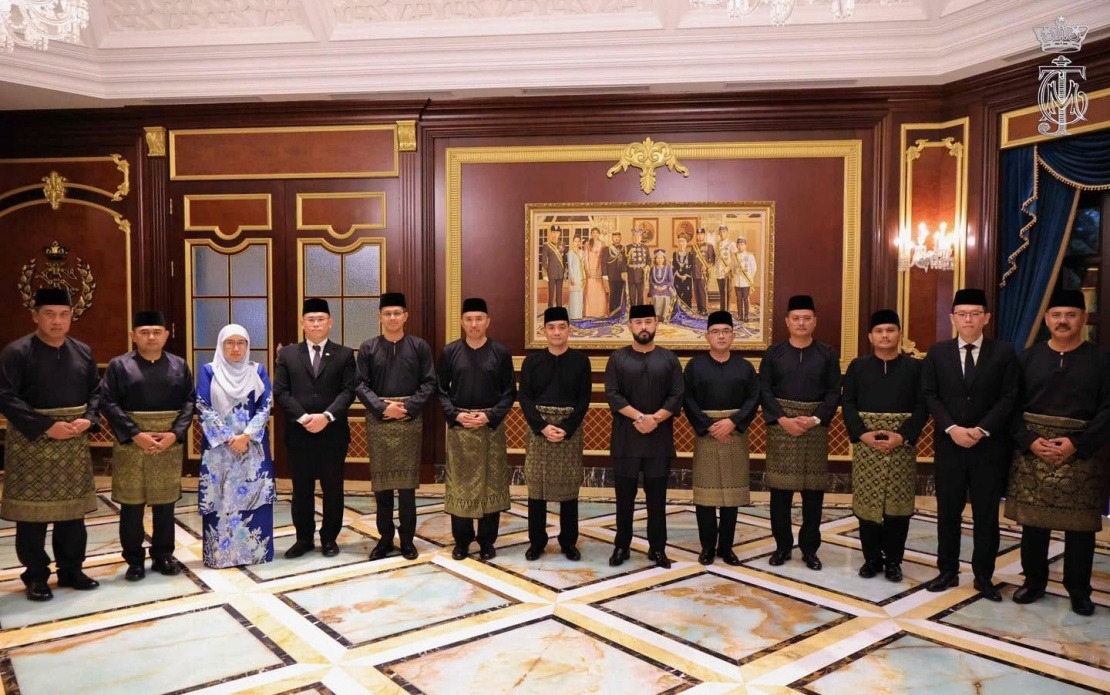
A new chapter in Johor governance began on Thursday when ten state assemblymen took their oaths of office as members of the State Executive Council in a ceremony presided over by the Regent of Johor, Tunku Mahkota Ismail, at the iconic Istana Bukit Serene. The swearing-in ceremony marked a significant milestone in the formation of the state administration following the recent electoral mandate, with senior government officials and the newly appointed Menteri Besar witnessing the proceedings.
The expanded executive body brings together a mix of experience and fresh perspectives. Among the oath-takers were six established assemblymen: Mohd Hairi Mad Shah representing Larkin, Datuk Mohd Jafni Md Shukor from Bukit Permai, Mohd Fared Mohd Khalid of Semerah, Ling Tian Soon from Yong Peng, Lee Ting Han from Paloh, and Mohamad Fazli Mohamad Salleh representing Bukit Pasir. These individuals bring varying degrees of legislative experience to their new executive roles within the state government structure.
Equally significant were the four newcomers entering the Exco for the first time, signalling Menteri Besar Datuk Onn Hafiz Ghazi's intention to inject fresh energy into state administration. Md Israk Abdullah from Kukup, P. Pannir Selvam from Perling, Hasrunizah Hassan from Pulai Sebatang, and Muhammad Naqib Md Ghazali from Panti represent a younger generation of Johor leadership. This deliberate inclusion of new talent reflects broader efforts within Barisan Nasional to balance continuity with innovation in state governance.
Menteri Besar Onn Hafiz, himself sworn in just days earlier for his second consecutive term, oversaw the ceremony alongside key figures including Royal Court Council Yang Dipertua Datuk Dr Abdul Rahim Ramli and State Secretary Datuk Mohammed Ridha Abd Kadir. The presence of these senior officials underscored the ceremonial importance and constitutional significance of the occasion, reinforcing the formal transition of power and the beginning of a new administrative cycle.
Onn Hafiz's return to the Menteri Besar position came on the heels of a resounding electoral victory that Barisan Nasional secured in the 16th Johor state election. The coalition's performance in Machap, where Onn Hafiz holds his own assembly seat, demonstrated the breadth of support behind his leadership—he secured the seat with a commanding majority of 15,375 votes, substantially outpacing opposition candidates. This personal mandate provided a strong foundation for his second term at the helm of the state executive.
The scale of Barisan Nasional's victory extended well beyond the Menteri Besar's own constituency. The coalition's capture of 48 out of 56 state seats gave the government an overwhelming parliamentary advantage and a clear, decisive mandate to govern. This supermajority not only ensures stability in state government but also provides substantial room for policy implementation and legislative initiatives without the constraints that typically accompany narrow margins of victory.
For Malaysian and Southeast Asian observers, the Johor outcome carries broader implications for federal political dynamics. As the most economically developed state in Malaysia and a crucial BN stronghold, Johor's election results served as a bellwether for the coalition's organisational strength and public support following the 2022 federal elections. The decisive nature of the victory suggested that Barisan Nasional had successfully consolidated its political base and recovered ground in a state that represents a significant portion of the peninsula's economic output and population.
The composition of the new Exco reflects careful consideration of demographic representation and portfolio allocation needs. The inclusion of Pannir Selvam, presumably representing the Indian Malaysian community, alongside Ling Tian Soon, who represents the Chinese Malaysian community, alongside predominantly Malay and Muslim assemblymen demonstrates an attempt to maintain the ethnic and religious balance that has traditionally characterised Malaysian coalition governance. This deliberate construction helps ensure that the executive council reflects the diverse composition of Johor's population.
The first Exco meeting and portfolio allocations would normally follow such ceremonial swearing-in proceedings, though these were not detailed in the initial announcements. The assignment of ministerial portfolios—whether covering education, health, infrastructure, economic development, or other critical state functions—would reveal Onn Hafiz's strategic priorities for his second term and his confidence in individual appointees. These decisions would shape the focus and trajectory of state administration over the coming years.
Historically, Johor's governance has carried weight within Malaysian federalism given the state's economic significance, its position as a gateway to Singapore, and its role in regional connectivity initiatives. The formation of a strong, stable executive under BN stewardship suggested continuity in pro-business policies, infrastructure development, and federal-state coordination. The state's role in economic corridors and manufacturing hubs would likely remain central to government priorities.
The swearing-in also occurred against the backdrop of Malaysia's broader political evolution following recent electoral cycles. The reinforcement of BN governance in a key state provided the coalition with a provincial platform to demonstrate effective administration and deliver visible results to voters. Success in Johor could influence voter sentiment in other states heading toward their own electoral contests or renewal cycles.
With the executive council now fully constituted, Johor's state government could proceed with full implementation of its administrative agenda. The stability afforded by the substantial parliamentary majority and the relative homogeneity of coalition support meant that legislative initiatives were unlikely to face serious opposition or obstruction. This created an environment conducive to long-term planning and major policy implementation that might require sustained commitment across multiple sessions.

