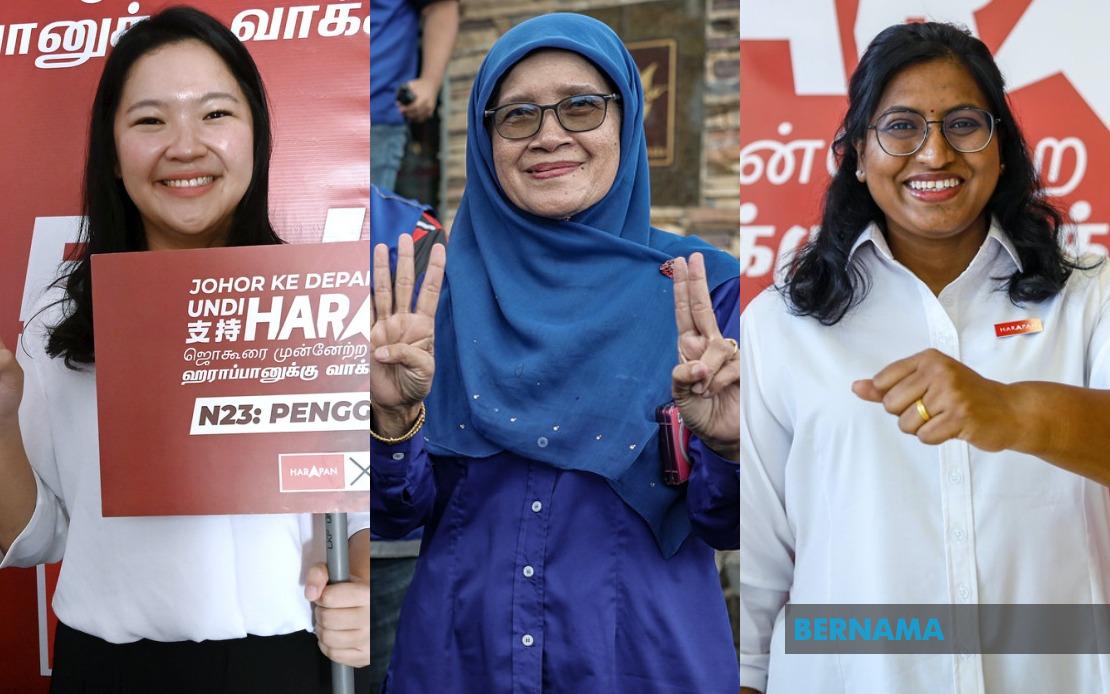
The 16th Johor State Election delivered modest progress for women's political representation, with ten female candidates securing assembly seats out of 34 who stood for election. The outcome demonstrated that voters across the state were prepared to support women leaders, though the proportion of female victors remains relatively constrained given that women comprised nearly one-fifth of all candidates in the contest.
Barisan Nasional dominated the women's contest as it did overall, producing seven successful female candidates compared to three from Pakatan Harapan. This distribution mirrors the broader election outcome, in which BN captured 48 of 56 seats. The breakdown revealed that female representation climbed within BN's assembly contingent but remained modest within the PH bloc, reflecting different recruitment and campaign strategies between the coalitions in a state where BN's organizational machinery typically operates more effectively.
Among the BN victors, Nadhirah Afiqah Abdull Rahim's triumph in Serom carried particular symbolic weight. The Ledang Puteri UMNO chief contested for the first time and immediately secured a commanding majority of 9,406 votes against both Perikatan Nasional and Pakatan Harapan opponents. Her debut performance illustrated that new female candidates could generate sufficient voter enthusiasm to overcome established rivals, challenging assumptions that incumbency provides insurmountable advantages in Malaysian electoral contests.
Nor Rashidah Ramli's victory in Parit Raja represented a substantial swing toward BN's preferred candidates. She accumulated 19,572 votes for a majority exceeding 13,576, a dramatic improvement on BN's performance five years earlier when the seat changed hands with merely 4,219 votes separating victor from runner-up. This surge indicated that Johor voters, particularly in the southern constituencies, had shifted decisively toward the BN coalition, with women candidates riding this broader momentum effectively.
Incumbent legislators dominated among the victorious women, with several defending their seats across multiple election cycles. Alwiyah Talib secured Endau for her third consecutive term, demonstrating that female representatives who establish themselves in their constituencies can develop durable political bases resistant to opposition challenges. Similarly, Norlizah Noh delivered a resounding performance in Johor Lama with a 16,344-vote majority, suggesting that voters valued continuity and established relationships with their elected representatives.
The victories in marginal and opposition-leaning seats carried particular significance for understanding shifting electoral dynamics. Chan San San's capture of Johor Jaya, traditionally regarded as a Democratic Action Party stronghold, represented a notable upset. Accumulating 35,971 votes across a crowded four-way contest, she outperformed expectations for a BN candidate in territory where the opposition coalition had previously dominated. This result underscored Johor's rightward political realignment and suggested that the state's suburban constituencies were proving more volatile than historical patterns suggested.
Hasrunizah Hassan's expanded majority in Pulai Sebatang revealed consolidation of BN support even in seats the coalition already controlled. Her 13,590-vote advantage represented a significant increase from the 2022 state election, demonstrating that far from eroding, her support base had strengthened during her tenure. Such results suggested voter satisfaction with incumbent performance transcended gender lines and reflected approval of specific individuals' legislative contributions.
Packatan Harapan's three victorious women operated in distinct electoral contexts from their BN counterparts. Felicia Poh Rui Ling defended Penggaram at just 28 years old, securing a 4,137-vote majority in a straight contest against her BN rival. Her success suggested that PH retained pockets of committed support despite the coalition's overall state-level weakness, and that young female candidates could mobilize voters in constituencies where anti-BN sentiment remained potent. Chu Poh Yee similarly retained Mengkibol with a 4,213-vote margin, indicating stable PH support in specific constituencies despite turbulent external political conditions.
Kartiyaini Jeyapalan's victory in Skudai demonstrated that professional women could successfully transition from legal practice to legislative roles and command substantial voter endorsement. The lawyer-turned-politician secured a commanding 15,280-vote majority in a four-cornered contest, retaining the seat for PH and suggesting that opposition political bases in urban constituencies valued candidates demonstrating expertise and professional accomplishment beyond purely political credentials.
The broader context of women's representation in the 2024 Johor election reflected a gradual but incomplete transformation of Malaysian political recruitment practices. Female candidates represented 19.7 per cent of the total field, up from historical baselines but still dramatically underrepresenting female voters who comprised approximately half the electorate. The disparity between women's proportion among candidates and their demographic presence highlighted persistent barriers within party nomination processes, candidate selection mechanisms, and campaign resource allocation.
For Malaysian political observers and feminist analysts, the results embodied both progress and constraint. Women candidates achieved a one-in-three success rate comparable to male candidates' performance, suggesting that voter discrimination based purely on gender was not systematically disadvantaging female contenders. However, the initial scarcity of female candidates meant that even achieving parity in success rates translated into minimal absolute gains in assembly representation. Addressing women's meaningful participation in Malaysian legislatures would require upstream changes in party selection processes, not merely improved electoral performance by female candidates already permitted to contest.
The Johor outcome possessed particular significance for Southeast Asia's largest federal state and the only Malaysian state governed primarily by BN throughout the post-independence period. As Malaysia's most industrialized and economically sophisticated jurisdiction, Johor's willingness to elect female representatives across both major coalitions suggested that economic development and urbanization correlated with increased acceptance of female political leadership. Other Malaysian states and ASEAN regional governments monitoring women's political advancement could view Johor's trajectory as indicative of evolving possibilities within conservative political cultures undergoing rapid socioeconomic transformation.

