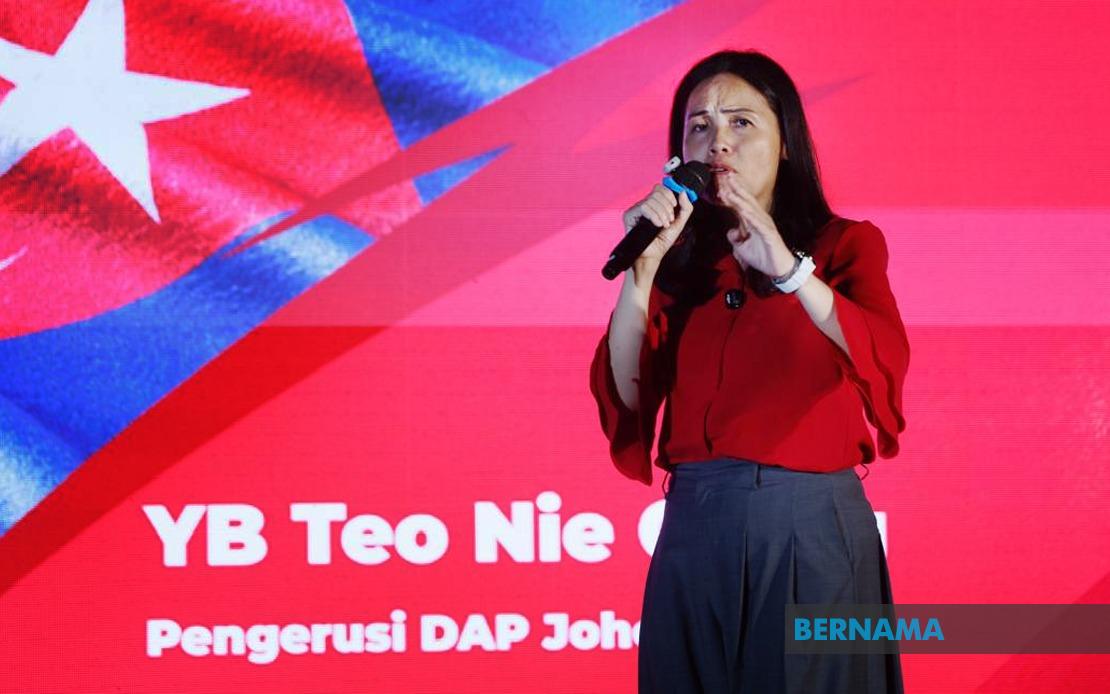
Johor's decision to introduce appointed state assemblymen positions has drawn sharp scrutiny from opposition figures as voters prepare to head to the polls this Saturday. Teo Nie Ching, the Johor DAP chairman and National DAP Wanita chief, raised fundamental questions about the true purpose of the mechanism during a campaign rally in Paloh, suggesting the move warrants public explanation before implementation.
The core concern driving Teo's criticism centres on democratic accountability. By creating positions filled through appointment rather than electoral contest, the state government risks establishing a parallel tier of representatives answerable primarily to those who selected them rather than constituents who voted in the election. This departure from direct electoral legitimacy represents a departure from traditional parliamentary practice, where all legislative members derive their mandate from voters. Teo emphasised that appointed assemblymen would bypass the scrutiny voters impose when evaluating candidates at the ballot box, potentially compromising the transparency that democracy demands.
The Johor State Legislative Assembly formalised this arrangement on May 7 by passing amendments allowing the appointment of up to five state assemblymen. Proponents framed the measure as strengthening the assembly's functional capacity and improving its composition, yet the practical implications remain ambiguous. Teo pressed for clarity on the government's selection criteria, asking directly whether these positions represent genuine efforts to enhance legislative function or strategic moves to strengthen particular political interests. Her queries gained weight from Johor's current political configuration, where the ruling coalition has benefited substantially from support provided by PAS, raising speculation about which parties might receive appointed representation.
Even as Teo challenged specific Johor initiatives, she mounted a broader defence of the federal Unity Government's governance record. She acknowledged the MADANI administration operates imperfectly, freely admitting that significant gaps remain between current performance and ideal governance. However, she contended that the government has delivered measurable systemic reforms through deliberate, staged implementation rather than sweeping overnight change. This framing positions incremental progress as preferable to campaign rhetoric that promises wholesale transformation without institutional foundation.
Education policy emerged as a centerpiece of Teo's case for the government's achievements. The matriculation guarantee ensuring placement for all SPM students achieving 10A grades, irrespective of family background, represents a structural shift towards merit-based access to elite educational pathways. Previously, quota systems and other mechanisms limited opportunities for top-performing students from disadvantaged communities. Similarly, expanded recognition of Unified Examination Certificate qualifications broadens educational opportunities for students from vernacular schools, addressing longstanding concerns within the Chinese community about systemic barriers to advancement.
Financial commitments to Chinese independent schools further illustrate the government's reorientation of resource allocation. The increase to RM20.16 million this year from RM12 million in 2019 signals genuine commitment to the vernacular education sector, representing a 68 percent budgetary increase. For Malaysian-Chinese voters concerned about cultural preservation and educational access, such figures carry concrete meaning about whether the government prioritises their interests. Teo presented these measures as evidence of systemic reform generating tangible benefits, even if implementation remains incomplete.
The timing of Teo's statements matters considerably. With 2.7 million Johor voters preparing to elect 56 state representatives, the election represents a crucial test of Unity Government support in a strategically significant state. DAP's performance will shape not only Johor's composition but also broader perceptions of coalition stability heading toward the 2026 national elections. Teo's dual messaging—challenging specific Johor government decisions while defending federal governance—reflects DAP's complex position within the coalition, where supporting the government's larger trajectory does not preclude criticising individual policies.
Teo's questioning of the appointed assemblymen scheme also reveals broader coalition tensions. PAS, having provided substantial election support, presumably expects influence over appointments, but overt allocation of additional seats to partner parties could provoke public backlash. Teo's pointed references to PAS support suggest DAP concerns that appointed positions might disproportionately advantage the Islamic party, creating resentment among other coalition members. This dynamic illustrates how technical constitutional changes acquire political significance within coalition arrangements, where every institutional reform carries implications for power distribution.
For Malaysian voters and political observers, Teo's intervention highlights a persistent challenge in modern democracies: balancing institutional efficiency with electoral legitimacy. Appointed representatives might genuinely improve legislative capacity through specialised expertise or demographic representation, yet they inevitably reduce direct voter control over elected institutions. Teo's call for thorough explanation reflects legitimate expectation that governments justify departures from standard democratic practice through convincing reasoning transparent to the public.
The broader governance philosophy articulated by Teo—that meaningful change requires patient system-building rather than dramatic ruptures—challenges both opposition critics and reform impatients on the government's own side. She positioned the Unity Government as engaged in fundamental institutional renovation, acknowledging incompleteness while defending direction. For Malaysian readers assessing the government's track record, this framing offers concrete policy achievements amenable to independent verification, though sceptics may rightfully question whether incremental progress suffices to address systemic challenges accumulating over decades.
As Johor voters enter the polling booths this Saturday, the state's appointment mechanism and the federal government's broader reform trajectory will influence electoral calculations. Teo's defence of systemic change attempts to persuade voters that despite imperfections, the Unity Government merits continued support because it works deliberately to restructure institutions. Simultaneously, her criticism of appointed positions reminds the government that coalition partners and voters expect democratic principles to guide all institutional decisions, even those framed as efficiency measures. The election will reveal whether this balancing act resonates with Johor's diverse electorate.

