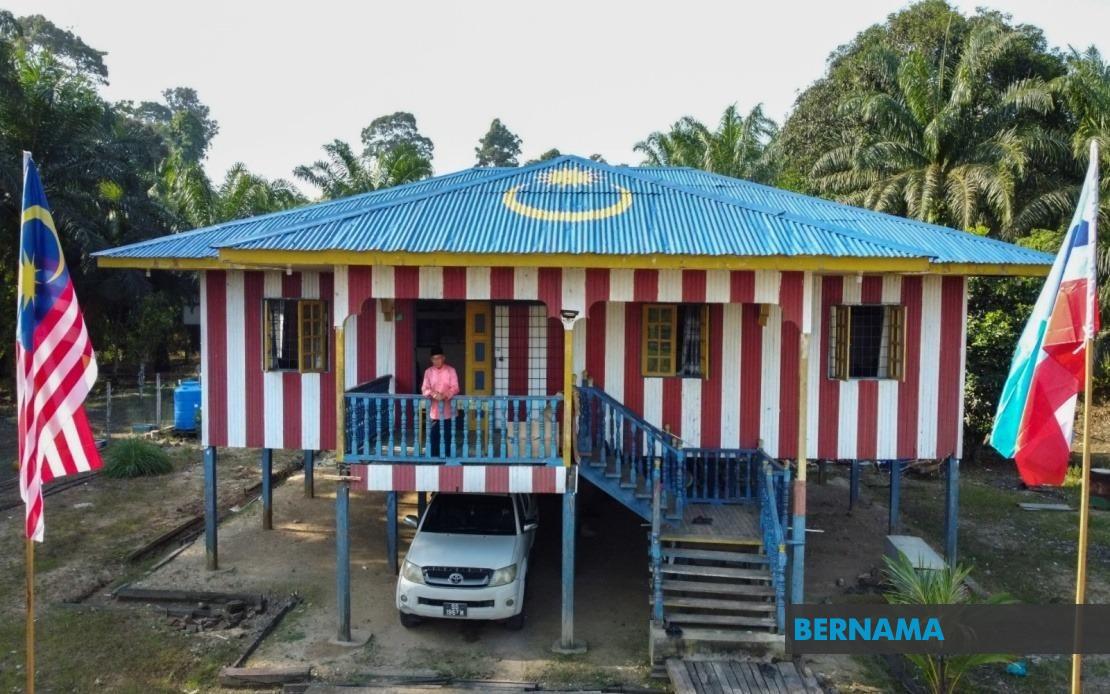
In the quiet residential neighbourhood of Batu 15, Jalan Labuk in Sandakan, a modest wooden house has become an unmistakable landmark of national pride. Teratak Gemilang, owned by 68-year-old entrepreneur Mohd Halikin Angga, stands out dramatically from its surroundings—its walls awash in the bold red and white of the Malaysian flag, while a golden-yellow crescent moon and 14-pointed star adorn a striking deep-blue roof. What began as a personal expression of patriotism has evolved into a local attraction, drawing visitors throughout the year and particularly during Malaysia's festive national celebrations.
Mohd Halikin's journey with Teratak Gemilang stretches back two decades. In 2004, inspired by a profound love for his country and a desire to honour the sacrifices of his parents who lived through Malaysia's colonial period, he conceived the idea of transforming his home into a permanent tribute to national independence. Rather than simply displaying flags during official celebrations—only to take them down when festivities ended—Mohd Halikin chose a more enduring approach. The decision crystallised after witnessing flags discarded on roads or blown away by the wind, experiences that moved him emotionally and reinforced his conviction that patriotism should be expressed year-round, not confined to designated months.
The visual transformation of Teratak Gemilang required considerable personal investment and labour. Using his own resources and working with a paintbrush in hand, Mohd Halikin meticulously applied the national colours to every surface of his property. The bold red and white striping now dominates the walls, while Jalur Gemilang flags fly proudly around the compound's perimeter. The overall aesthetic effect is unmistakable—visitors cannot help but recognise the home's patriotic purpose from the moment they approach it. This deliberate visual statement reflects a deeply personal philosophy: that one's surroundings should reflect one's values and commitments to the nation.
Beyond its striking exterior lies a carefully curated interior that functions as a private museum of national history. Upon entering Teratak Gemilang, guests encounter a mini gallery displaying portraits of Malaysia's leaders across multiple generations. The living room has been transformed into a chronological display space featuring the Yang di-Pertuan Agong, the Yang di-Pertua Negeri Sabah, and every prime minister from Tunku Abdul Rahman Putra Al-Haj to the present holder of office. This arrangement serves both aesthetic and educational purposes, creating a visual narrative of Malaysia's political leadership since independence.
Among Mohd Halikin's most prized possessions is a historic photograph documenting Tunku Abdul Rahman's 1961 meeting with 20 North Borneo leaders—a pivotal moment that would eventually lead to the formation of Malaysia. The acquisition of this photograph itself reflects his dedication to historical preservation. During a flight to perform Umrah in 2005, he discovered the photograph in a newspaper and sought permission from cabin crew to retain and frame it. This anecdote reveals not merely a collector's passion but a consciousness of history's fragility and the importance of preserving physical evidence of transformative national moments.
Mohd Halikin's patriotism extends into his personal family life in profound ways. Among his seven children, three bear names honouring prominent national figures. His eldest son carries the name of Tun Dr Mahathir Mohamad, his second child that of Tun Abdullah Ahmad Badawi, while his sixth child, Nur Zahirah, was named after the 13th Raja Permaisuri Agong. For Mohd Halikin, these naming choices represent far more than mere personal preference. He views each name as a vessel of historical memory and aspiration—a tangible link connecting his children's generation to the contributions and legacies of those who shaped the nation. Through these names, he hopes to ensure that future generations remain conscious of their country's political and institutional heritage.
The passage of more than twenty years has not diminished Teratak Gemilang's capacity to attract attention and spark conversation. Visitors regularly stop to photograph the striking structure, particularly during National Month when patriotic sentiment runs high across Malaysia. The house has transcended its status as a private residence to become a modest tourist attraction within Sandakan, a physical manifestation of one individual's commitment to national pride that resonates with others. For many in the community, the house serves as a reminder that patriotism need not remain abstract or episodic but can be woven into the fabric of everyday life.
Mohd Halikin remains resolute in his commitment to maintaining Teratak Gemilang in its current patriotic form. He has declared his intention to keep the house adorned in the colours of the Jalur Gemilang indefinitely, ensuring that the patriotic spirit motivating its creation will endure for generations to come. This permanence carries symbolic weight, suggesting that love for country should be constant rather than temporary, embedded in the physical spaces we inhabit and inhabit us in turn.
Beyond the personal and familial dimensions of Teratak Gemilang lies a broader significance for Sabah's multicultural society. Mohd Halikin explicitly hopes that his creation will inspire and strengthen the spirit of unity among the state's diverse communities, particularly as Malaysia approaches the 2026 celebrations of National Day and Malaysia Day. In a context where maintaining social cohesion across different ethnic and religious groups represents an ongoing challenge, Teratak Gemilang offers a model of inclusive patriotism—one centred on shared national symbols and collective pride rather than divisive particularisms. The house suggests that expressions of love for country can serve as bridges between communities rather than barriers.
The story of Teratak Gemilang carries implications extending beyond Sandakan's borders. In an era where national identity sometimes competes with divisive narratives and cynicism about political institutions, Mohd Halikin's quarter-century commitment to patriotic expression offers a counternarrative. His willingness to invest personal resources, effort, and emotional energy in honouring Malaysia's historical journey and leadership demonstrates an alternative mode of political engagement—one rooted not in partisan conflict but in historical memory and institutional respect. For Malaysian readers across the region, Teratak Gemilang exemplifies how individual citizens can contribute meaningfully to national cohesion and pride through sustained, visible commitment to shared symbols and values.

