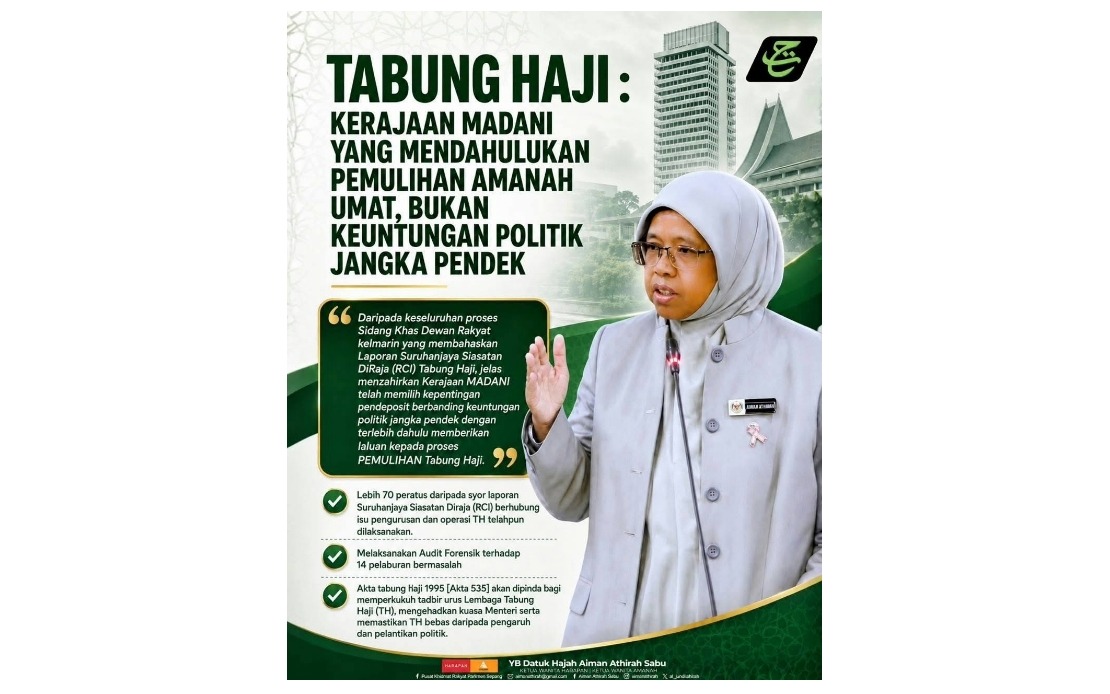
The Malaysian government's measured approach to releasing the Tabung Haji Royal Commission of Inquiry report reflects a deliberate choice to safeguard the interests of more than 10 million depositors rather than pursue immediate political advantage, Deputy Minister of Housing and Local Government Datuk Aiman Athirah Sabu said today. Her remarks come as the government faces mounting pressure from opposition parties, particularly PAS and Parti Wawasan Negara, to explain why the full findings of the inquiry have not been immediately disclosed to the public despite the investigation's completion.
The cautious strategy adopted by the government carries significant weight given the scale of operations at Tabung Haji, which functions as a critical financial institution managing the accumulated savings earmarked for Islamic pilgrimage by millions of Malaysians. Any abrupt or poorly managed public disclosure risks triggering the kind of mass withdrawal events witnessed in 2018, when depositors withdrew more than RM6 billion following the revelation of governance failures, demonstrating how sensitive public confidence in the institution remains among its client base.
Aiman Athirah stressed that Tabung Haji occupies a unique position within Malaysia's financial ecosystem, extending far beyond conventional institutional frameworks. The organisation holds deep spiritual and cultural significance for Muslim Malaysians, directly connecting to their aspirations of fulfilling the fifth pillar of Islam through the pilgrimage. This dual nature—part savings mechanism, part religious obligation facilitator—means government decisions regarding transparency must be weighed against the potential for systemic instability that could undermine the life savings of millions of ordinary Malaysians.
The deputy minister's defence of the government's measured disclosure strategy implicitly acknowledges the legitimacy of calls for transparency while arguing that responsible governance requires balancing competing imperatives. Rather than being dismissed as mere obfuscation, she framed the delayed release as a deliberate risk management decision designed to prevent the panic dynamics that historically destabilise financial institutions when damaging information enters the public domain without adequate context or remedial measures already in place.
During a special sitting of the Dewan Rakyat, Second Finance Minister Datuk Seri Amir Hamzah Azizan revealed the scale of financial damage: Tabung Haji had incurred losses totalling nearly RM13 billion from 14 troubled investments, with seven of these positions recording complete losses. The government had absorbed RM10.2 billion of this damage through a 2018 rescue intervention involving Urusharta Jamaah Sdn Bhd, while Tabung Haji itself bore RM2.6 billion in impairment losses between 2018 and 2025 on investments that remain under active management. These figures underscore why careful communication strategy matters—the revelation of such substantial losses requires sophisticated public messaging to prevent widespread alarm among depositors.
Aiman Athirah highlighted that Minister in the Prime Minister's Department (Religious Affairs) Dr Zulkifli Hasan disclosed that more than 70 per cent of the RCI's recommendations relating to Tabung Haji's management and operations have already been implemented, suggesting the government is taking concrete remedial action before full public disclosure. The implementation of forensic audits across the 14 troubled investments represents a substantive step toward comprehensive accountability, ensuring that governance weaknesses are identified and addressed systematically rather than merely exposed for political effect.
The government has committed to amending the Tabung Haji Act 1995 to substantially strengthen the institution's governance framework, limit ministerial powers, and insulate the organisation from political influence and patronage appointments. This legislative agenda addresses structural vulnerabilities that enabled the governance failures now under investigation, suggesting the government's strategy encompasses both remedial measures and preventive reform designed to restore institutional integrity before engaging the public in full disclosure of past failures.
Economic recovery indicators suggest Tabung Haji's underlying financial position has stabilised considerably since the 2018 crisis. The institution's investment income reached RM4.64 billion in 2025, a record figure, while profit distributions to depositors increased substantially from 1.25 per cent in 2018 to 3.5 per cent in 2025. Simultaneously, Tabung Haji has maintained the cost of haj pilgrimage at RM33,000 for three consecutive seasons despite escalating management costs, demonstrating improved operational efficiency and financial management despite the acknowledged troubled investments.
Aiman Athirah's remarks carry implications that extend beyond the immediate Tabung Haji controversy to broader questions about institutional governance and public accountability in Malaysia. The tension between transparency and financial stability is particularly acute for institutions serving mass depositor bases, where public perception dynamics can trigger self-fulfilling prophecies of institutional failure. The government's position suggests a prioritisation of substantive remedial action and demonstrated financial recovery before full disclosure, a strategy that assumes depositor confidence can be rebuilt through demonstrated performance rather than simply through information transparency.
Critics within opposition ranks, including lawmakers who walked out during the special parliamentary sitting, characterise the government's approach as suppressing inconvenient information for political convenience. However, the government's counterargument rests on the distinction between transparency and irresponsible disclosure—arguing that releasing damaging information about a mass-participation financial institution without simultaneously demonstrating remedial progress and financial stability represents poor governance rather than principled transparency. This framing attempts to reposition the debate from whether information should be disclosed to how and under what conditions it should be communicated.
The controversy reflects deeper institutional challenges facing Malaysia's governance architecture. Tabung Haji's troubled history reveals how political appointments and ministerial discretion can compromise institutional independence, a vulnerability that persists across multiple government agencies and statutory bodies. The proposed legislative amendments to limit ministerial powers and insulate the organisation from political influence represent belated attempts to address systemic vulnerabilities that permitted the governance failures now under investigation.
Moving forward, the credibility of the government's strategy depends substantially on delivery of the promised legislative reforms and demonstrated financial recovery, coupled with eventual full disclosure of RCI findings and remedial actions undertaken. The political economy of this controversy will shape public expectations regarding transparency and institutional accountability across other government-linked entities facing similar governance challenges, making the Tabung Haji resolution a consequential test case for the MADANI government's commitment to substantive institutional reform.

