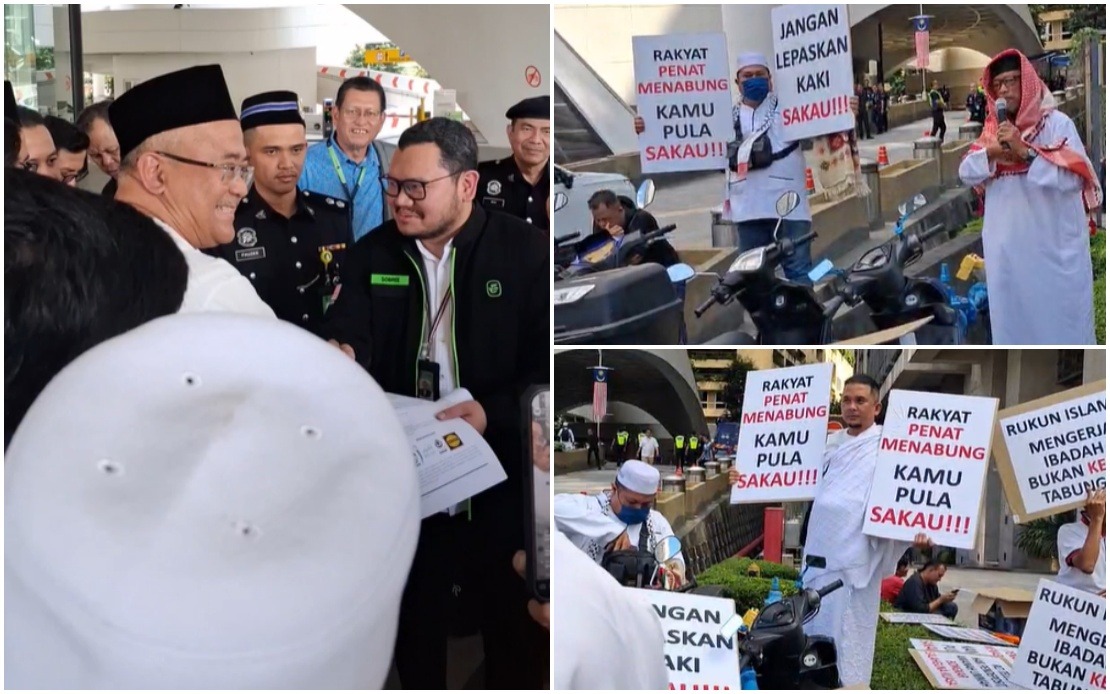
The leadership of Malaysia's MADANI coalition has called for a rigorous and impartial investigation into findings from the Royal Commission of Inquiry examining the management of Lembaga Tabung Haji, warning against any attempt to manipulate or obstruct the process. Amir Zuhair Abdull Khalid, chairman of Daie MADANI, made these remarks while addressing supporters at a solidarity gathering held outside Menara TH in Kuala Lumpur on Wednesday, signalling the government's determination to pursue accountability without compromising investigative integrity.
The RCI conducted its examination across a seven-year period from 2014 to 2020, a span that covered multiple administrations and witnessed significant transitions in Malaysia's political landscape. The commission's findings, which touch on governance failures and potential misconduct in the management of funds belonging to millions of Muslim depositors, have prompted calls for swift action through the appropriate judicial channels. The scale of the inquiry underscores the gravity of institutional lapses that may have occurred within one of Malaysia's largest faith-based financial institutions.
Amir Zuhair emphasised that the matter transcends ordinary political debate or point-scoring between rival factions. Instead, he framed the investigation as fundamentally concerning the safeguarding of public trust and the fiduciary obligations owed to countless individuals who have entrusted their savings to Tabung Haji. This broader perspective reflects growing public concern across Malaysia about institutional accountability and the protection of ordinary Malaysians' financial interests, particularly those of the Muslim community who view Tabung Haji as a trusted vehicle for managing savings intended for religious purposes.
The MADANI leader explicitly urged the Prime Minister to proceed with prosecutions while simultaneously warning against interference in the investigation process. His call for non-interference extends specifically to the Malaysian Anti-Corruption Commission, the principal agency tasked with investigating corruption allegations. This nuanced position suggests recognition that premature political pressure, well-intentioned or otherwise, could compromise the evidentiary foundation necessary for successful prosecutions and undermine public confidence in the judicial outcomes.
Central to Amir Zuhair's message is the principle that determinations of guilt or innocence belong exclusively to the courts. He rejected the notion that individuals could simply deny culpability outside the courtroom, insisting that any meaningful accountability must occur through formal legal proceedings where evidence can be tested, arguments heard, and impartial judgment rendered. This emphasis on the rule of law reflects a broader MADANI commitment to institutional strengthening as part of its governance agenda.
The RCI investigation also uncovered allegations of political interference in governance structures and the appointment of board members during the period under review. These findings point to a pattern whereby political considerations may have compromised institutional independence and decision-making at Tabung Haji. Such revelations carry significant implications for broader conversations about institutional autonomy within Malaysia's governance framework and the protection of organisations from political capture.
Multiple Islamic coalition groups, including HIKAM and the Coalition of Islamic Non-Governmental Organisations, have submitted ten specific demands to government regarding the RCI findings. These demands encompass immediate legal action against implicated individuals, recovery of any misappropriated losses and assets, full implementation of the commission's recommendations, and continuation of governance reforms under the MADANI administration. The breadth of these demands reflects civil society's determination to ensure comprehensive remedial action rather than superficial acknowledgement of the RCI findings.
The involvement of prominent Islamic civil society organisations including WADAH, IKRAM, HALUAN, and ABIM signals that this matter resonates deeply within Malaysia's Muslim community and broader Islamic non-profit sector. These groups have historically played important roles in advocating for institutional integrity and public accountability, and their engagement suggests that Tabung Haji's management failures have damaged confidence across networks that view financial institutions as extensions of religious and community trust.
For Malaysian readers and the broader Southeast Asian context, the Tabung Haji situation illustrates persistent challenges in institutional governance and the ongoing tension between political imperatives and administrative independence. The case also demonstrates how financial institutions serving specific communities require robust safeguards against both internal mismanagement and external political pressure. Similar institutions across the region may face comparable vulnerabilities, making Malaysia's handling of this investigation potentially instructive for other governments seeking to balance accountability with procedural integrity.
The emphasis on transparent investigation without interference represents an important reframing of Malaysia's anti-corruption agenda under the current administration. Rather than employing investigation as a political tool against predecessors, the MADANI approach seeks to establish investigation as an institutional mechanism serving justice and public interest. This distinction, while subtle, carries profound implications for the sustainability of Malaysia's democratic institutions and the legitimacy of its governance framework moving forward.

