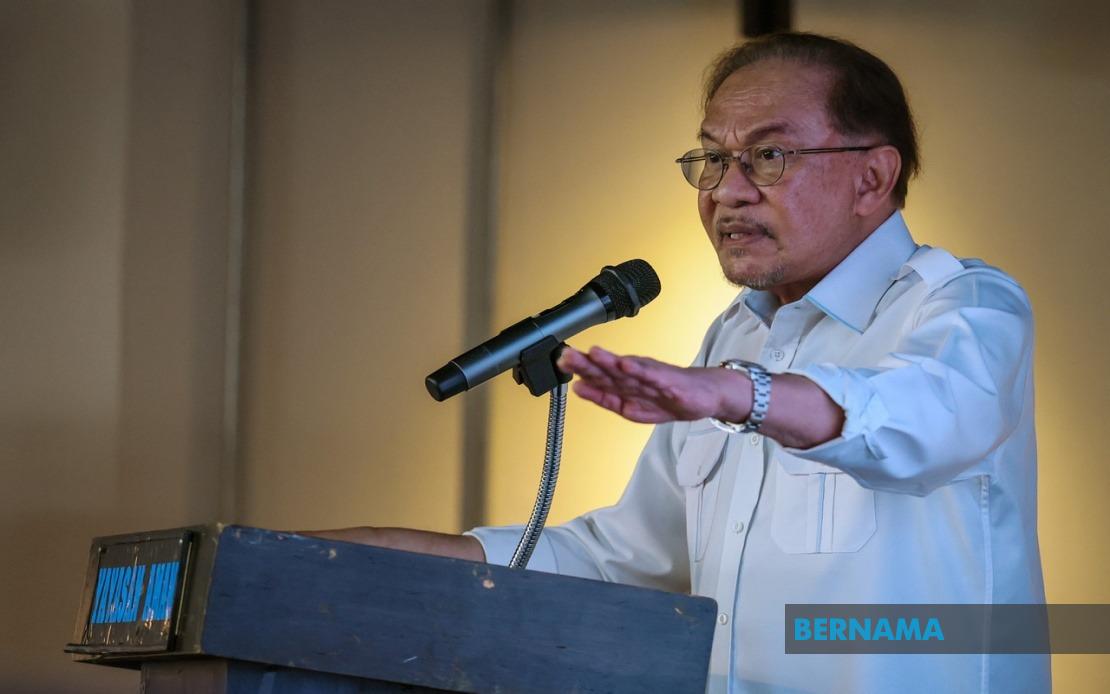
Prime Minister Datuk Seri Anwar Ibrahim has committed the government to pursuing investigations stemming from the Royal Commission of Inquiry report on Lembaga Tabung Haji, signalling that authorities will pursue accountability measures to prevent further financial harm to the nation. Speaking at a business development event in Bukit Mertajam, Anwar emphasised that the inquiry process must be grounded in rigorous evidence gathering and strict adherence to legal protocols, rejecting suggestions that the government should either abandon scrutiny or rush toward punitive action without proper substantiation.
The Prime Minister's comments reflect the politically sensitive nature of the TH scandal, which has become a touchstone for governance accountability in Malaysia. Anwar acknowledged the tension inherent in his administration's approach: pursuing serious financial irregularities attracts criticism from those who question the motivation or fairness of investigations, whilst simultaneously being pressured to demonstrate that wrongdoing carries real consequences. This dynamic has created a narrative challenge for the government, which must convince the public that it is neither vindictive nor negligent in its response to institutional failures.
Central to Anwar's defence of the inquiry process is his articulation of the scale of the alleged losses. The Prime Minister referenced a figure of RM12 billion, framing this not as a mere statistical abstraction but as a concrete theft from national resources. By asking rhetorically how, when, and why such losses occurred, Anwar positioned the investigation as a necessary fact-finding mission rather than a predetermined political prosecution. This rhetorical approach aims to reframe criticism of the government's probe as indifference to the plundering of public assets.
The TH scandal represents one of the most consequential institutional failures in recent Malaysian history. Tabung Haji, established as a dedicated savings and investment vehicle for Muslims performing the pilgrimage to Mecca, had accumulated substantial reserves over decades. The discovery of significant financial irregularities and management failures exposed the vulnerability of even nominally protected institutions to mismanagement and potential malfeasance. For Malaysian Muslim taxpayers and pilgrims who had contributed to or relied upon the fund, the revelations represented a profound breach of trust.
Anwar's insistence on due process carries particular weight given Malaysia's recent political history. The country has witnessed previous instances where government power was wielded against political opponents, sometimes with questionable evidentiary foundations. By repeatedly emphasising that action must follow evidence rather than precede it, and that final judgement must rest with the courts rather than executive decree, Anwar is attempting to distinguish his administration's approach from patterns associated with earlier administrations. This posture resonates with constituencies that prioritise rule of law and transparent governance.
The Prime Minister's statement also addresses a fundamental challenge facing any government investigating large-scale institutional corruption. Critics from multiple directions often emerge: those who view investigations as insufficient or dilatory challenge the government's commitment to accountability, whilst others question whether prosecutions represent genuine justice or partisan score-settling. Anwar's framing attempts to occupy neutral ground by treating investigation and prosecution as distinct stages, each subject to different standards and safeguards.
From a Southeast Asian perspective, Malaysia's handling of the TH case carries broader implications for governance standards in the region. As other nations grapple with institutional reform and anti-corruption efforts, the approach taken by the Malaysian government provides both a model and a cautionary tale. Successful prosecution of high-level institutional failures requires institutional integrity, investigative competence, and judicial independence—capabilities that remain unevenly distributed across the region.
The economic dimensions of the alleged losses extend beyond mere fiscal damage. The TH scandal has implications for public confidence in Islamic finance institutions, which serve as important repositories of savings for Muslim communities across Southeast Asia. Restoring credibility to these institutions through transparent investigation and credible prosecution becomes an economic and social imperative, not merely a matter of political accountability. Investors and depositors across the region observe how Malaysia addresses this challenge.
Anwar's emphasis on evidence-based prosecution also reflects international best practices in combating institutional corruption. Jurisdictions that have successfully prosecuted complex financial crimes typically rely on sustained investigation, documentary analysis, forensic accounting, and witness testimony—precisely the processes that require time and institutional patience. The Prime Minister's apparent frustration with criticism of his administration's pace suggests that he views the investigation as progressing at an appropriate pace given its technical and legal complexity.
The political context in which these investigations proceed cannot be ignored. Anwar's administration faces pressure from multiple constituencies with divergent interests. Ensuring that investigations maintain public credibility whilst proceeding with genuine rigour represents a delicate balancing act. The Prime Minister's public statements serve a dual function: they communicate commitment to accountability whilst also constraining any perception that investigations are driven by political calculation rather than factual foundation.
Looking forward, the resolution of TH-related investigations will likely establish important precedents for how Malaysia addresses institutional failures involving large sums of public or semi-public money. Successful prosecution, if evidence supports it, would signal that even large, historically important institutions remain subject to accountability. Conversely, failure to prosecute substantiated wrongdoing could reinforce scepticism about institutional reform and governance.
The broader governance challenge illustrated by the TH case extends beyond the fund itself. Malaysia's institutional landscape includes numerous large quasi-public bodies managing significant resources, often with limited independent oversight. How the government addresses the TH scandal will influence public expectations regarding accountability across these institutions. Anwar's determination to pursue evidence-based investigation and legal prosecution, rather than either abandoning scrutiny or bypassing due process, represents an attempt to establish standards applicable across the institutional ecosystem.
Ultimately, Anwar's message to Malaysian citizens and the international community is that governance requires simultaneously pursuing wrongdoing and respecting legal boundaries. This approach demands patience, institutional capacity, and political will—qualities that will be tested as investigations proceed and prosecutions potentially unfold in coming months and years.

