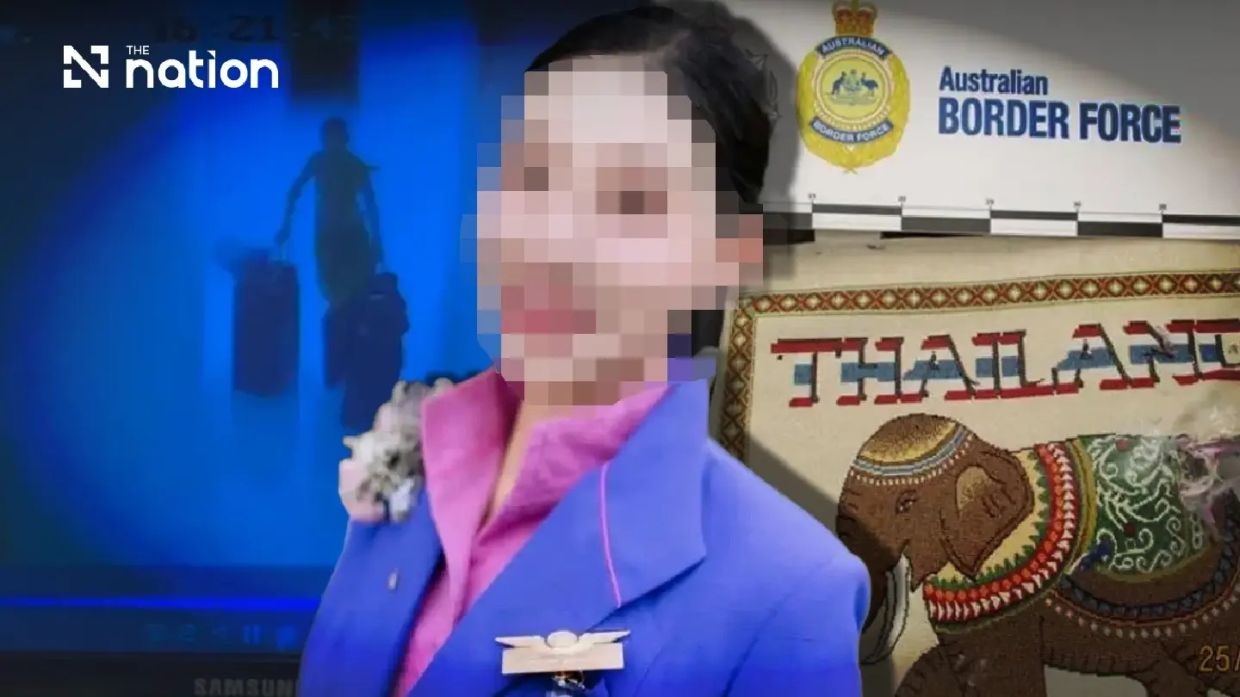
Thai authorities have launched a widening investigation into what appears to be a sophisticated transnational narcotics operation following the arrest of a Thai flight attendant at Melbourne Airport with 900 grammes of heroin. The Office of the Narcotics Control Board (ONCB), working with other security agencies, believes the woman may have been unwittingly drawn into a network of international drug smugglers rather than acting as a willing participant, according to statements from deputy secretary-general Areepak Ngernbamroong. Thai officials have already begun coordinating with Australian police and consular representatives to support her potential legal defence, suggesting investigators view her as possibly a victim of elaborate criminal deception.
The investigation has uncovered a disturbing modus operandi: criminal syndicates create fake social media profiles and send mass messages to airline personnel and frequent international travellers, offering substantial payments in exchange for carrying parcels across borders. Thai authorities say a delivery rider connected to the case received heroin from a foreign national, while a Lao couple also featured prominently in the supply chain. The organisation appears to have developed two distinct distribution methods—postal delivery and direct hand-to-hand transfers—indicating a level of operational sophistication that has prompted Thai authorities to treat this as a large-scale organised crime matter rather than a isolated smuggling incident.
The Bangkok arrests alone yielded more than 26 kilogrammes of heroin, leading Thailand's Department of Special Investigation (DSI) to assume control of the domestic aspects of the probe. Metropolitan Police deputy commissioner Pol Maj-General Theeradet Thumsuthee earlier identified the network's scamming component, which specifically targets people in professions requiring frequent international movement. By offering lucrative compensation—often presented as payment for transporting innocuous goods like bags or clothing—the criminals exploit both the financial vulnerabilities of some workers and the trust inherent in peer-to-peer recruitment. The targeting of flight attendants is particularly strategic, as these individuals routinely clear airport security across multiple jurisdictions, potentially reducing screening suspicion.
On the Australian end, authorities have identified the intended recipient of the heroin shipment as "Dear," a Thai national with a real name now known to Thai investigators. Dear has apparently resided in Australia for approximately a decade, though the exact status of his residency—whether as a visa holder, permanent resident, or naturalised citizen—remains unconfirmed. Significantly, Australian Federal Police investigations suggest this is not Dear's first involvement in similar transactions. Thai officials have compiled multiple pieces of evidence connecting Dear to previous heroin deliveries arranged through the same method, establishing a pattern of repeated smuggling operations orchestrated through the same network. The AFP has assumed responsibility for expanding the Australian investigation to identify the end-users and higher-level organisers of the distribution network.
Details surrounding the specific mechanics of how heroin entered the flight attendant's luggage raise questions about the operation's complexity and compartmentalisation. According to her boyfriend's statement to investigators, the woman received a parcel box decorated with elephant-pattern bags that was delivered by a motorcycle courier. She unpacked and inspected these bags before placing them into her suitcase for transport, finding nothing suspicious during this inspection. Remarkably, the suitcase subsequently passed through Thai airport X-ray screening without detection of the narcotics, suggesting either sophisticated concealment techniques or potential vulnerabilities in airport security protocols that the smuggling network has learned to exploit.
Financial records paint an ambiguous picture regarding the flight attendant's knowledge and compensation. The Australian police investigation retrieved evidence from mobile phones indicating a payment of 8,800 baht (US$264), though Thai investigators have been unable to independently verify this figure through bank account examination. Conflicting accounts mention possible separate transfers of 1,700 baht each at two distinct moments—allegedly following receipt of the parcels and again when air travel arrangements became available—totalling 3,400 baht. However, investigators found no corresponding transactions in the woman's bank account and noted that her overall financial balance was modest, making confirmation of any actual payment impossible at this stage. This evidentiary gap cuts both directions: it could indicate the payment system was deliberately obscured, or it could suggest the woman was never actually compensated, undermining the narrative that she knowingly participated.
The motorcycle courier who delivered the parcels has provided a statement that may prove crucial to the flight attendant's legal position. He claimed to have executed similar courier runs on three or four previous occasions, but significantly stated that this particular delivery to the flight attendant represented his first time transporting items to her address. This detail suggests the operation involved rotating personnel and targets rather than establishing ongoing relationships, a tactic that would further insulate higher-level organisers from direct detection while expanding the pool of potentially compromised couriers. The statement also implies the flight attendant may not have been part of an established smuggling relationship but rather selected as a one-time target, a distinction that could substantially influence how a court views her culpability.
The narcotics themselves appear to have originated from the notorious Golden Triangle, the opium-producing region spanning the border areas of Thailand, Laos, and Myanmar. Areepak explained that traditional northern Thai smuggling routes have become increasingly dangerous for traffickers due to intensified Thai law enforcement operations in high-risk zones. In response, criminal networks have adapted their logistics, shifting toward north-eastern routes that utilise Lao territory and cross the Mekong River at points where natural geography and limited Thai border personnel make comprehensive monitoring virtually impossible. Specific crossing points near Nakhon Phanom, Bueng Kan, Loei, and Nong Khai have emerged as preferred transit corridors; the Mekong River narrows considerably in these areas, yet the length of the border makes sustained surveillance impractical, creating persistent gaps in drug interdiction efforts.
The Thai-Lao cooperation on narcotics control, while officially coordinated and information-sharing arrangements exist, appears insufficient to plug these geographical vulnerabilities. Most heroin entering Thailand via this route has already been packaged for distribution before being handed between successive groups in the supply chain, with storage typically arranged at concealed locations inside Thai territory. The involvement of Lao nationals in the Melbourne case represents one manifestation of how the Golden Triangle supply network has extended its reach into international aviation routes, integrating international couriers and airline staff into a vertically integrated smuggling operation. Areepak suggested that the heroin seized from the flight attendant may represent merely one operational strand within a much larger organisation, implying that this single arrest, while significant, touches only the peripheral aspects of what remains an active, sophisticated transnational enterprise.
Thailand's approach to defending the flight attendant while investigating the broader network reflects a recognition that individual couriers—particularly those recruited through deceptive means—may be expendable parts of larger criminal machinery. By gathering evidence for her legal defence, Thai authorities hope to identify and prosecute higher-level organisers and traffickers. The case exemplifies the challenge confronting Southeast Asian law enforcement: criminal networks have become increasingly adept at exploiting legitimate international travel infrastructure, targeting vulnerable workers through social engineering, and adapting supply routes in response to enforcement pressure. For Malaysia and other regional nations with significant airline industries and labour migration, the case serves as a cautionary reminder that their own workers remain attractive targets for these globalised smuggling operations, necessitating enhanced awareness campaigns alongside improved airport security protocols and cross-border law enforcement coordination.

