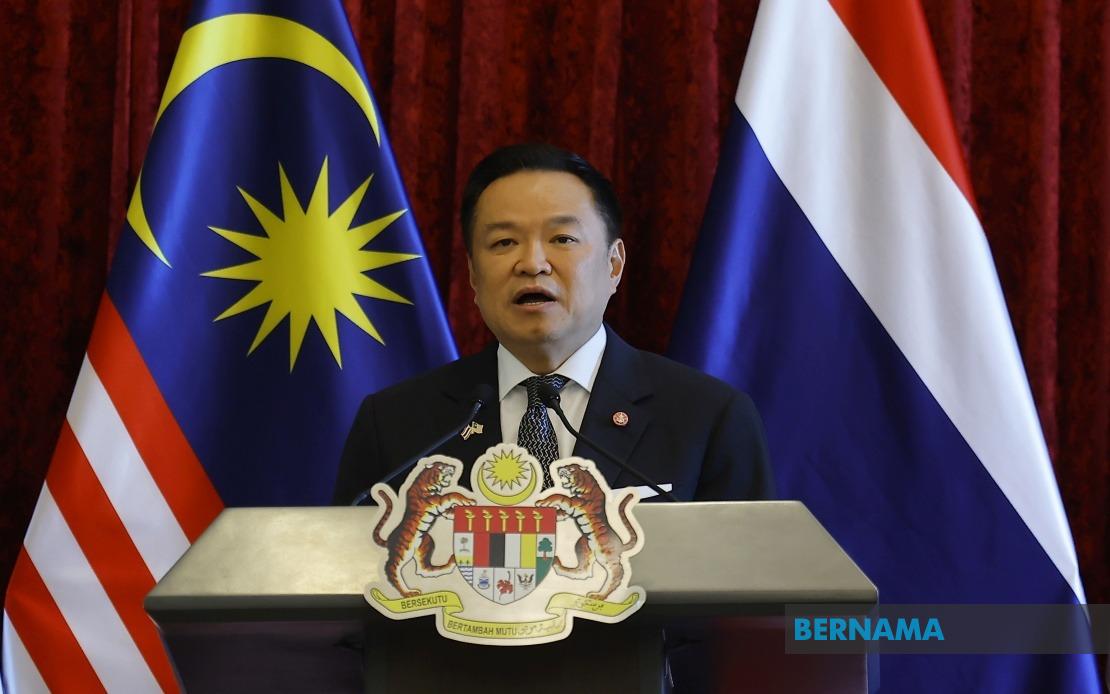
Thai Prime Minister Anutin Charnvirakul has reaffirmed his government's determination to end violence and resolve longstanding security challenges in Thailand's three southern border provinces, describing these objectives as cornerstones of his administration's policy agenda. Speaking during a joint press conference with Malaysian Prime Minister Datuk Seri Anwar Ibrahim in Putrajaya on Thursday, Anutin underscored the strategic importance of regional stability and pledged sustained diplomatic engagement to achieve a durable settlement in the conflict-affected areas.
The remarks came as both nations reaffirmed their commitment to deepening bilateral cooperation on border security and development initiatives. Anutin emphasised that sustainable progress in the southern provinces depends on a comprehensive approach that addresses both immediate security concerns and longer-term socioeconomic grievances. His framing of the challenge reflects growing recognition within Bangkok's policy circles that military responses alone have failed to resolve the underlying drivers of insurgent activity, which has persisted for nearly two decades and claimed thousands of lives.
A notable feature of Thailand's current strategy is the explicit linkage drawn between peace and development. Anutin articulated this connection through his statement that "peace creates the conditions for development, while development helps build lasting peace," a formulation that acknowledges the vicious cycle of violence and underdevelopment in provinces such as Pattani, Yala, and Narathiwat. This rhetorical positioning suggests Bangkok intends to complement security operations with infrastructure investment and livelihood programmes, potentially addressing grievances rooted in economic marginalisation of the Muslim-majority southern population.
Malaysia's evolving role in the peace process represents a significant diplomatic development with implications extending beyond the immediate conflict zone. As a neighbouring Muslim-majority nation with historical ties to communities across the Thai-Malaysian border, Malaysia has positioned itself as an indispensable facilitator in negotiations between the Thai government and armed groups. Anwar's government has explicitly rejected violence as a means of political expression, signalling that Kuala Lumpur's mediation efforts will not provide cover for militant activities while simultaneously maintaining channels of communication necessary for dialogue.
The institutional framework for peace efforts has crystallised with the appointment of two key negotiators. Datuk Mohd Rabin Basir, formerly director-general of Malaysia's National Security Council, assumed leadership of the Malaysian facilitation team on July 1, 2024, bringing extensive experience in security matters and intergovernmental coordination. His counterpart on the Thai side is Thanat Suwannanont, director of Thailand's National Intelligence Agency, whose appointment reflects the sensitivity and strategic importance Bangkok attaches to these negotiations. The presence of intelligence community figures in negotiating roles suggests both countries recognise that security concerns, intelligence-sharing, and counter-terrorism coordination must accompany political dialogue.
The Barisan Revolusi Nasional, the primary armed group involved in the southern insurgency, remains a critical participant in dialogue frameworks facilitated by Malaysia. The BRN's willingness to engage in talks, though episodic and sometimes conditional, indicates that even hardened insurgent movements perceive diplomatic pathways as potentially preferable to indefinite armed struggle. Malaysia's role in maintaining these communication channels prevents complete breakdown while creating space for negotiated settlement discussions, a function neither Bangkok nor the insurgent groups could credibly perform unilaterally.
For Malaysian readers and regional observers, Thailand's renewed emphasis on southern border stability carries direct relevance. Cross-border smuggling networks, militant infiltration routes, and refugee flows from the conflict zone have long strained Malaysian security and presented challenges for Kelantan and other northern states. Any progress toward stability in Thailand's southern provinces would reduce pressure on Malaysia's own border security apparatus and diminish the risk of spillover violence affecting Malaysian communities. Conversely, failure to achieve meaningful progress could intensify trafficking activities and security threats within Malaysia itself.
The diplomatic engagement also reflects broader Southeast Asian interests in regional stability. Nations such as Indonesia have periodically expressed concern about extremist networks exploiting ungoverned spaces in southern Thailand and northern Malaysia, and several countries have supported Malaysian-led mediation efforts as preferable to indefinite conflict. The Southern Thailand Peace Dialogue represents one of the few active high-level tracks addressing a major regional security challenge, making its progress significant for the broader region's security architecture.
Anwar's assurance that Malaysia will not tolerate violence and will pursue justice against perpetrators demonstrates that facilitation does not entail abandoning Malaysian security interests or providing sanctuary to fugitives. This calibrated stance allows Malaysia to maintain credibility as a neutral mediator while making clear that terrorist activities and serious crimes remain beyond the scope of dialogue protections. Such positioning requires sophisticated diplomacy to convince both sides of Malaysia's impartiality while firmly upholding rule of law principles.
Thailand's security situation in the south remains fundamentally challenging. Despite decades of military presence and counter-insurgency operations, violence continues sporadically, civilian deaths persist, and communities remain polarised along religious and ethnic lines. The appointment of experienced security officials to negotiating roles suggests both governments understand that progress will require not merely symbolic gestures but substantive engagement with fundamental grievances including cultural and religious autonomy, economic opportunity, and historical justice. Whether current diplomatic efforts can translate these commitments into concrete outcomes remains uncertain, but the renewed emphasis signals that Bangkok recognises the necessity of political solutions.
Looking forward, the success of Malaysia's facilitation efforts will depend on several factors including sustained high-level political commitment from both Bangkok and insurgent leadership, willingness to address contentious issues such as extra-judicial killings and disappearances, and capacity to deliver development benefits that tangibly improve conditions in conflict-affected communities. Malaysia's central role as facilitator positions Kuala Lumpur to shape outcomes and potentially influence broader regional security dynamics, underscoring the importance of these ostensibly bilateral Thai-Malaysian discussions for Southeast Asian stability writ large.

