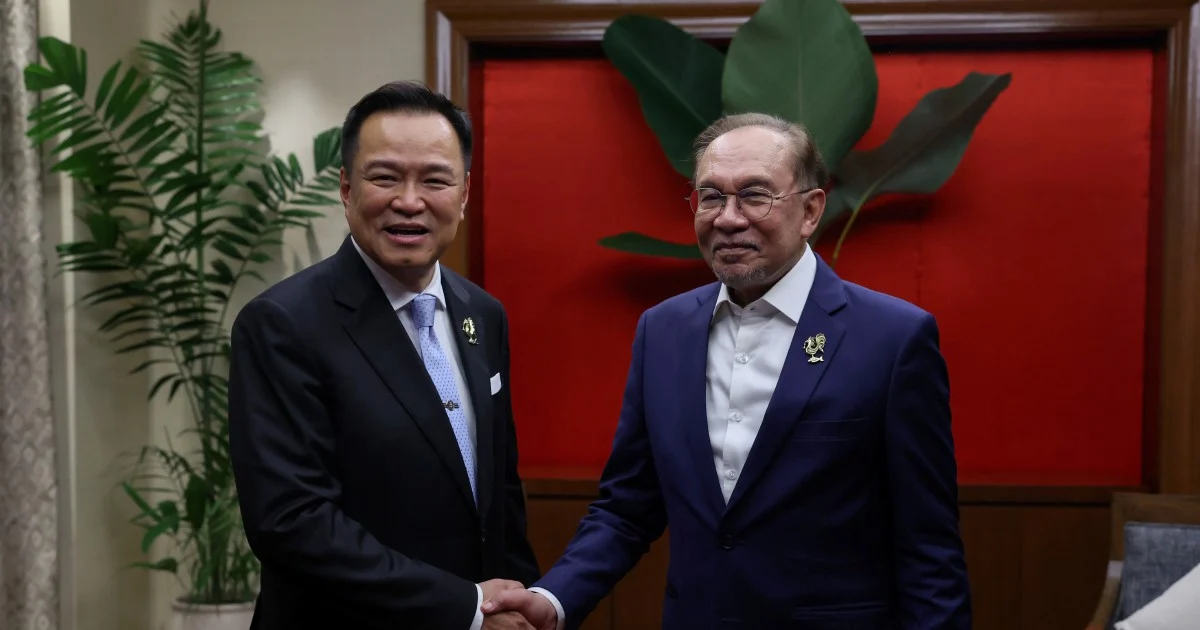
Thai Prime Minister Anutin Charnvirakul is scheduled to visit Malaysia on July 9 and 10 for substantive discussions with Prime Minister Datuk Seri Anwar Ibrahim, marking another significant diplomatic engagement between the two neighbouring Southeast Asian nations. The visit underscores the continuing importance both governments place on strengthening bilateral relations across multiple strategic and economic dimensions.
Border security matters are poised to feature prominently in the talks between the two leaders. The Malaysia-Thailand frontier, stretching across the northern peninsula, has long presented complex security challenges that require coordinated responses from both nations. Issues ranging from transnational crime networks to irregular migration and smuggling operations across the border have historically demanded ongoing cooperation and intelligence sharing between the relevant authorities on both sides.
The timing of this high-level visit reflects broader efforts by Malaysia and Thailand to address shared regional security concerns. Both nations face similar pressures from organised criminal enterprises operating across their boundaries, and regular dialogue between senior government officials helps establish frameworks for more effective law enforcement coordination. Enhanced border management, coupled with improved information exchange mechanisms, remains essential for containing threats that respect no national boundaries.
Beyond security architecture, economic cooperation is expected to command substantial attention during the bilateral meetings. Thailand and Malaysia maintain significant trade relationships, with both nations serving as important commercial partners for each other across sectors ranging from manufacturing to agriculture and energy. The two countries have long recognised the mutual benefits of deepening economic integration within the ASEAN framework and beyond.
Trade flows between the two nations have traditionally been robust, with Malaysian investments in Thailand and Thai investments in Malaysia spanning various industries. Tourism also represents a key economic pillar for both countries, with substantial numbers of visitors crossing the border annually. Discussions between Anwar Ibrahim and Anutin Charnvirakul are likely to explore mechanisms for further streamlining trade procedures, reducing non-tariff barriers, and facilitating greater business investment mobility.
The visit also occurs within the broader context of ASEAN regionalism and the wider geopolitical landscape affecting Southeast Asia. Both Malaysia and Thailand face common strategic interests in maintaining regional stability, managing great power dynamics, and ensuring that regional affairs remain firmly anchored within the ASEAN consensus-building framework. Bilateral meetings of this nature reinforce the importance of trust-based diplomacy among regional neighbours.
Energy security and infrastructure development may also feature in discussions, given the region's growing demand for reliable power supplies and the potential for collaboration on transportation networks and digital connectivity. Joint ventures in renewable energy development, for instance, could open new avenues for economic cooperation that benefits both populations while advancing shared climate objectives.
Malaysia has historically maintained balanced relationships across the region, and the strengthening of ties with Thailand reflects a strategic approach to regional partnership that extends beyond immediate economic interests to encompass longer-term political stability and social cohesion. Border communities in particular stand to benefit from improved cross-boundary cooperation, whether through enhanced infrastructure projects, labour movement agreements, or cultural exchange programmes that foster mutual understanding.
The visit by Anutin Charnvirakul comes at a time when both nations are navigating post-pandemic economic recovery and demographic transitions that require fresh thinking on regional integration. Younger generations across the border increasingly demand greater mobility and opportunity, creating both challenges and opportunities for bilateral policymakers to address through enlightened governance frameworks.
Regional observers view such high-level engagements as barometers of the health of Southeast Asian diplomacy. When major ASEAN partners maintain active dialogue channels and demonstrate commitment to resolving issues through mutual negotiation rather than confrontation, it reinforces confidence among investors and contributes to the predictability that developing economies require. The Malaysia-Thailand relationship, underpinned by shared history and geographic proximity, exemplifies this pragmatic approach to regional relations.
Looking ahead, the discussions between the two leaders are likely to produce concrete outcomes in the form of working group commitments, enhanced institutional mechanisms, or specific project agreements that translate bilateral goodwill into tangible benefits for citizens and businesses. Such follow-up mechanisms ensure that high-level visits translate into sustained momentum rather than symbolic gestures alone.
The visit reinforces that despite occasional tensions, both nations remain committed to building a prosperous and secure region through sustained engagement. In an era of rapid geopolitical change and economic volatility, the consistency of these bilateral interactions provides a stabilising anchor for the broader ASEAN community and demonstrates that cooperative problem-solving remains the preferred pathway for addressing shared challenges.

