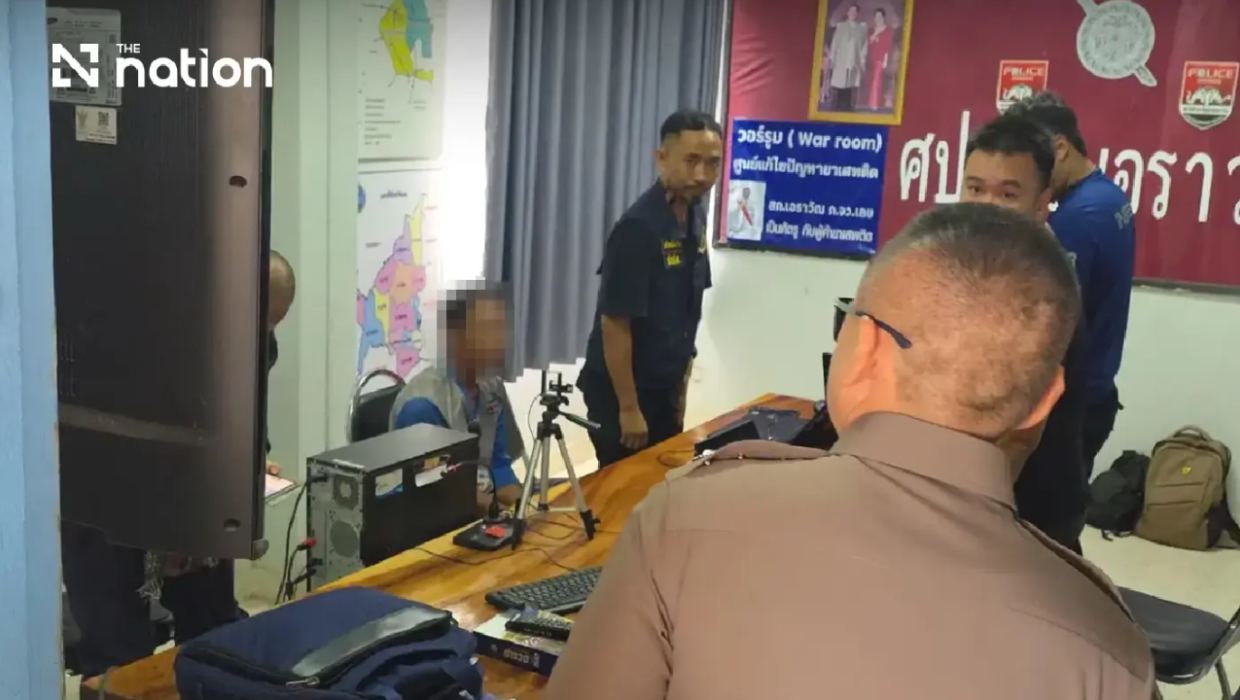
Thai police investigators have detained a married couple in Loei province as authorities broaden their examination of what appears to be an organised transnational narcotics operation. The expanded inquiry emerged from the arrest of a Thai Airways cabin crew member at Melbourne Airport, where approximately one kilogram of heroin was reportedly discovered concealed within her baggage.
The Melbourne Airport incident set off a chain reaction across Thai law enforcement agencies, spurring officials to identify the source of the suspected drug shipment. This investigative approach reflects how contemporary international drug networks operate through multiple intermediaries across borders, with each participant often unaware of the full scope of the operation. Thai authorities recognised early that intercepting the final courier represented only the visible portion of a larger smuggling infrastructure.
On 2 July, officers from Chiang Khan Police Station, coordinating with the Office of the Narcotics Control Board and associated units, launched a search for two individuals connected to addresses in That subdistrict. The initial sweep of a residential property in That subdistrict proved unproductive, forcing investigators to pursue alternative leads. Information emerged that the pair had accepted employment in the rubber-tapping sector, a seasonal labour arrangement common in northeastern Thailand that often attracts migrant workers and provides legitimate cover for individuals engaged in illicit activities.
Authorities eventually tracked Athit, 43, to Wat Tham Pha Mak Ho temple in Sri Songkhram subdistrict, where he was reportedly engaged in roofing work. His apprehension marked a significant breakthrough in the case. During preliminary questioning at Erawan Police Station, Athit allegedly acknowledged participating in a parcel-delivery scheme on six separate occasions, receiving 8,000 baht per transaction from a Laotian national. According to police accounts, three consignments passed through a parcel service in Chiang Khan, two originated from Ban That, and a third departed Erawan district, with the most recent dispatch occurring on 28 June.
The subsequent arrest of Thatsaphon, 42, Athit's wife and a Lao national, came after authorities located a black Mitsubishi Triton pickup truck bearing Loei registration plates parked within a rubber plantation in the Pha Nang-Pha Koeng locality. She was transported to Erawan Police Station for questioning but reportedly denied involvement or awareness of any smuggling operations during her initial interrogation. Her detention, nonetheless, suggests investigative suspicions that she possessed operational knowledge or facilitation capabilities within the alleged network.
The case exemplifies how modern drug-trafficking organisations compartmentalise their operations to limit exposure. Low-level participants like Athit and Thatsaphon typically execute discrete tasks—in this instance, parcel dispatch—without comprehending the ultimate destination or contents. This structural arrangement provides plausible deniability for individual actors whilst maintaining operational security. Such networks have proven remarkably resilient across Southeast Asia, where porous borders, competing law-enforcement priorities, and limited international cooperation historically enabled smugglers to operate with relative impunity.
The Office of the Narcotics Control Board characterised the investigation as revealing methods through which transnational organisations strategically deploy operatives at different levels to move contraband while evading detection. Officials acknowledged that collaborative intelligence-sharing between Thai and foreign law-enforcement bodies had proven instrumental in identifying potential domestic connections. This acknowledgement underscores an evolution in regional security thinking, where Southeast Asian agencies increasingly recognise that internal trafficking infrastructure demands serious investigative attention alongside border interdiction efforts.
As the investigation progresses through ONCB questioning, authorities intend to expand their focus toward identifying orchestrators, financial beneficiaries, and facilitators within the broader network. The significance of this approach lies in targeting supply-chain vulnerabilities rather than pursuing solely frontline couriers. Thai prosecutors will likely build cases against multiple tiers of involvement, creating stronger deterrents against participation in such schemes. The couple's further cooperation or refusal to cooperate will substantially influence the investigation's geographic and institutional scope.
The ONCB has committed to intensified efforts against transnational smuggling operations, pledging enhanced coordination with foreign counterparts. These commitments reflect Thailand's evolving role within regional security architecture, where the country serves simultaneously as a major trafficking transit zone and an increasingly capable investigative partner. Strengthening financial intelligence capabilities, interdicting transport routes, and disrupting money-laundering channels represent the strategic pillars of this expanded approach. For Malaysia and other regional economies, Thailand's investigative progress against these networks provides valuable intelligence regarding trafficking patterns and modus operandi used by sophisticated criminal organisations operating throughout Southeast Asia.

