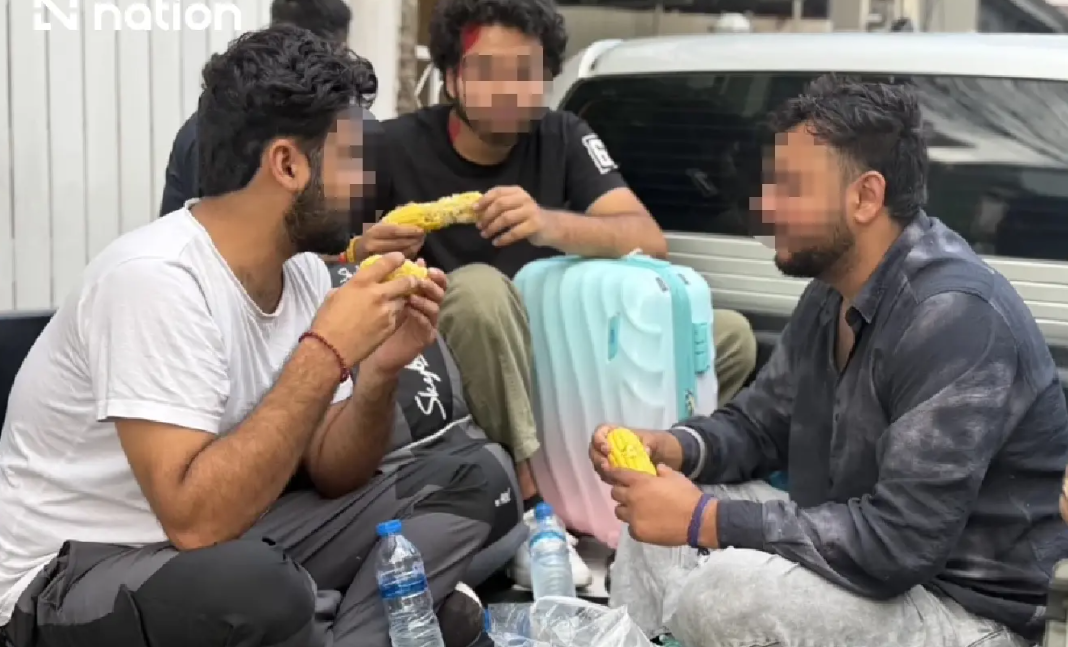
Thai police mounted a successful rescue operation on Monday, July 27, freeing three Indian tourists who had been held captive in a Pattaya townhouse and subjected to extortion demands by an organised criminal syndicate operating across South and Southeast Asia. The coordinated raid by Chonburi Immigration Police and Pattaya City Police forces targeted a two-storey residence in a housing estate on Soi Phatthanakan in the Bang Lamung district, culminating in the safe extraction of the victims after authorities received a tip-off from the Indian Embassy in Thailand.
The three rescued men—Mohit, 23, Ashish, 24, and Himanshu, 20—were discovered confined separately on the upper floor of the property, bound at the wrists and ankles with their mouths sealed using adhesive tape. Physical evidence at the scene suggested a pattern of deliberate violence and psychological manipulation. Red spray paint discovered during the search appears to have been deployed as a macabre prop in video communications sent to the victims' families, manufactured to exaggerate the severity of their predicament and heighten pressure for ransom payment. Officers recovered adhesive tape and wooden implements believed to have been used during the commission of assaults, with the men displaying visible injuries consistent with their accounts of mistreatment.
The investigation pipeline began in earnest on July 21 when the Indian diplomatic mission formally contacted Thai law enforcement agencies, having received distress communications from the tourists' families. Those relatives had gathered compelling video evidence from communication exchanges with the captors, depicting the victims restrained and allegedly being beaten. The criminal organisation made explicit financial demands: approximately 4 million rupees—equivalent to roughly 1.4 million baht—per hostage. This pricing structure suggests a calculated assessment of what the perpetrators believed South Asian families might mobilise, indicating a sophisticated understanding of remittance patterns and family financial capacity within the target market.
Thai investigators deployed a methodical approach to locating the detention site, leveraging closed-circuit television footage and intelligence derived from victim interviews. Police officers breached the residence at 4:09 pm and successfully extracted all three captives without injury, though one individual charged with guarding the premises managed to flee on a motorcycle, evading immediate apprehension. The escape of this operative underscores the operational sophistication of the network, which appears capable of mounting rapid contingency responses when authorities close in on their facilities.
Authorities have identified the gang as comprising five individuals of Pakistani and Indian nationality, all of whom remain subjects of active pursuit. The victims' accounts to interrogators paint a picture of predatory recruitment tactics and coordinated abduction methodology. The three men had purchased what they believed to be a legitimate Pattaya holiday package from someone presenting himself as an authentic tour operator—a common entry vector for such schemes. Upon landing at Suvarnabhumi Airport in the pre-dawn hours of July 21, they were methodically separated and guided into a trap, with each being directed into a motorcycle taxi under the pretext of hotel check-in and breakfast arrangements.
The victims were conveyed to the townhouse where waiting accomplices employed threats of lethal violence to enforce compliance and discourage resistance. Gang members wielded knives during the initial subjugation process, establishing a climate of extreme fear that persisted throughout the captivity period. The perpetrators maintained psychological pressure through sustained contact with relatives, conducting video calls in which they made explicit ransom demands whilst simultaneously emphasising the gravity of the situation through manufactured imagery of injury and distress. The captives reported that their abductors claimed to have connections within the Thai police apparatus itself, a threat designed to eliminate any possibility that victims might seek intervention from authorities.
This particular operation appears to have been part of a broader extortion enterprise targeting international travellers. The victims disclosed that another Indian national had already been held at the same location and released only after his relatives transferred approximately 3 million rupees to the criminals—a sum suggesting successful completion of a previous extraction scheme. This pattern indicates that the gang operates according to established protocols refined through repeated application, with operational infrastructure, communication channels, and money movement mechanisms already embedded within their support network.
The rescue holds particular significance for Thailand's standing as a regional tourism destination and the broader safety perceptions surrounding Pattaya, a city that generates substantial revenue from international leisure travel. Thai authorities have indicated that the investigation will be pursued with considerable intensity precisely because of the case's potential ramifications for public confidence in tourist security and the commercial interests dependent upon that confidence. Transnational kidnapping-for-ransom schemes directly undermine the narrative of a welcoming and secure holiday environment that nations competing for tourist dollars must maintain. The involvement of Pakistani and Indian nationals in targeting Indian tourists also suggests the operation may have exploited familiarity with immigration procedures, social networks, and family communication patterns within South Asian diaspora communities.
The rescued tourists expressed gratitude toward their law enforcement rescuers, though the broader implications of their ordeal extend well beyond their personal experience. The case illuminates vulnerabilities within the tourist information and booking ecosystem, where fraudulent operators can impersonate legitimate businesses with minimal barriers to entry. It also demonstrates the evolving sophistication of organised crime groups that operate across multiple jurisdictions, leveraging understanding of currency exchange rates, remittance mechanisms, and the psychological leverage available when targeting families separated by geography. As Chonburi Immigration Police and Pattaya City Police continue expanding their investigation and pursuing the remaining suspects for criminal prosecution, the incident raises questions about coordination mechanisms between regional law enforcement and the adequacy of tourist-origin-country notification systems that might prevent similar victimisation.

