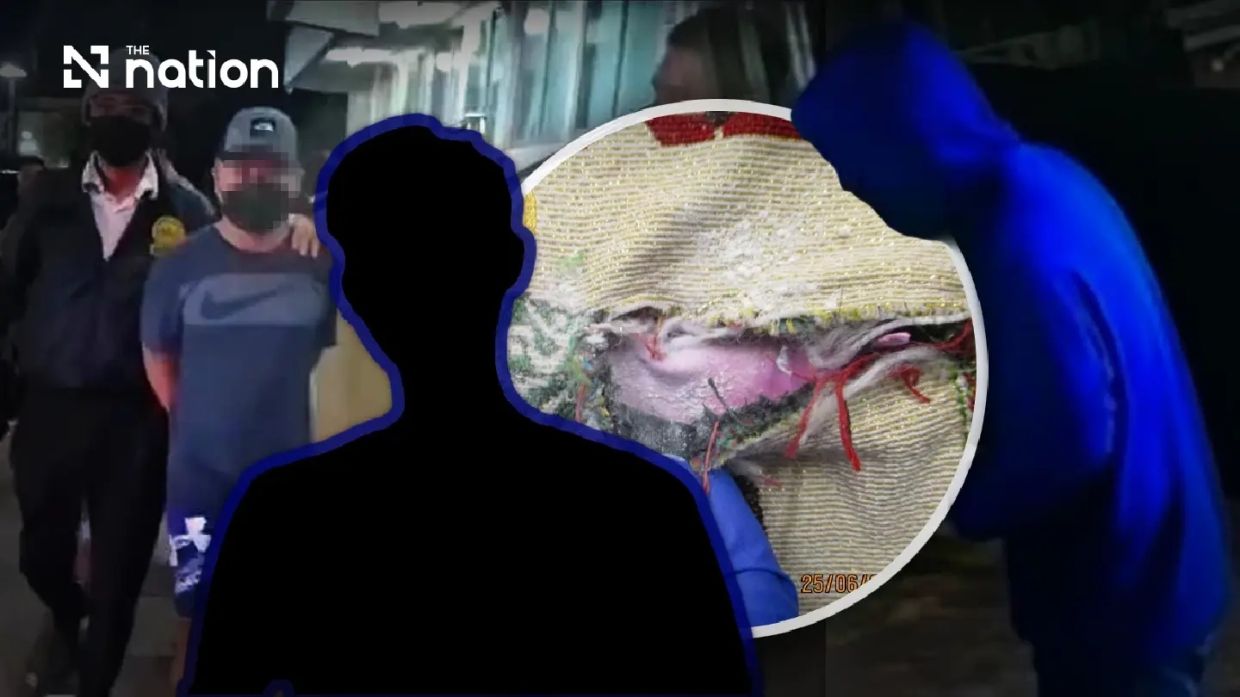
Thai law enforcement has broadened its investigation into a cross-border drug trafficking syndicate following the arrest of Ekkawit in Phayao, a northern province bordering Laos. According to Pol Maj Gen Theeradej Thamsuthee, deputy commissioner of the Metropolitan Police Bureau, the suspect was detained overnight as part of a widening probe into heroin concealed within an elephant-print fabric bag that was being prepared for shipment to Australia. This development marks a critical expansion of an operation that authorities believe involves a far larger criminal network than initially apparent.
Investigators allege that Ekkawit served as a crucial logistics node in the trafficking chain, responsible for collecting and delivering narcotics packages to other operatives. According to police accounts, Ekkawit first handed the heroin-laden bag to a man identified as Uthai, who was apprehended earlier in the investigation. Uthai subsequently passed the package to a female flight attendant named Mina, who was recruited to transport it into Australia. The structured nature of this handoff suggests an operation built on compartmentalised responsibilities, with each participant maintaining limited awareness of the broader scheme.
During preliminary questioning, Ekkawit revealed that he communicated with his handlers through the chat handle "Rin Rin" and received THB100,000 for his role in acquiring and delivering the bag. He admitted conducting similar operations two or three times previously, though investigators suspect the actual figure may be considerably higher. His admission of prior involvement suggests this was not an isolated transaction but rather part of an established trafficking pattern. The suspect claimed to have purchased the elephant-print bag himself from Chiang Mai, following instructions from an upstream contact.
The investigation has identified a second key figure operating under the online alias "Rose Rose," who appears to have coordinated multiple aspects of the operation. Evidence indicates that Rose Rose instructed Ekkawit to purchase the specific bag and subsequently arranged for the heroin to be concealed inside. According to Ekkawit's account, once the bag was obtained, he would notify Rose Rose and leave it at a designated kilometre marker for collection. An associate would then take possession, arrange for the narcotics to be embedded within the fabric, and return the package to another agreed location.
The money trail reveals a system designed to minimise direct contact and create plausible deniability among participants. After the heroin was concealed, Rose Rose would orchestrate Ekkawit's collection of the prepared bag along with THB100,000 in payment at a kilometre marker. Ekkawit would then arrange for Uthai to receive the package, with compensation provided through a cash deposit machine transfer of THB60,000. This multi-layered payment system suggests operational sophistication aimed at obscuring financial connections between network members.
Ekkawit claimed that the heroin was actually concealed while the bag was in Laos, though police remain sceptical of this account. The assertion raises significant concerns about the extent of the network's operations across Southeast Asian borders. If the concealment indeed occurred in Laos, it would indicate coordination with either Laotian criminal elements or international trafficking organisations with reach into the region. Police have noted that Ekkawit's story changed during questioning, suggesting either genuine uncertainty about certain details or deliberate obfuscation.
Investigators have compiled substantial information about the person behind the Rose Rose profile despite the use of anonymous communications channels. Remarkably, police have determined that Rose Rose and Ekkawit are close relatives, both originating from Phayao province. Photographs obtained during the investigation show the two travelling together, establishing a personal connection that may explain the trust required for such illicit collaboration. However, authorities do not consider Rose Rose to be the network's mastermind; they believe a more senior organiser sits above this intermediary level, directing operations and strategic decisions.
Uthai, the man who received the bag before passing it to the flight attendant, claimed to police that he had performed similar work between five and six times. Investigators, however, viewed his account with considerable suspicion, believing his narrative had been rehearsed or coordinated before arrest. Police discovered that Uthai had rented a room in Phra Nakhon Si Ayutthaya province for at least five or six months, suggesting a more extensive involvement in courier work than his initial admissions indicated. The discrepancy between his claims and the available evidence points to either active deception or pressure to minimise his culpability.
The case demonstrates the operational security measures employed by sophisticated trafficking networks. Communication through chat applications with pseudonymous accounts, the use of intermediate handlers, payments via automated machines, and coordination across multiple provinces and international borders all indicate a criminal organisation with considerable experience in evading detection. Yet authorities have managed to identify key nodes in the network despite these precautions, suggesting either successful intelligence gathering or informant assistance.
For Malaysian readers and Southeast Asian observers, this case illustrates the persistent challenges posed by transnational drug trafficking through the region. Australia remains an established market for narcotics smuggling, and trafficking syndicates continue to innovate in recruitment and logistics. The involvement of flight attendants as couriers highlights the vulnerability of airport and aviation personnel to exploitation. The geographical proximity of Thailand and Laos to Malaysia, combined with porous borders and established smuggling corridors, means similar networks likely operate across the region's borders.
Authorities indicated that Ekkawit was scheduled to arrive at police headquarters on the evening of Friday, July 10, 2026, where Pol Gen Samran Nuanma, deputy national police chief, planned to conduct personal interrogation. Police aim to use Ekkawit's cooperation to map the broader network structure and identify the senior organisers believed to operate above the Rose Rose intermediary level. The investigation is expanding with the goal of arresting additional network members involved in procurement, concealment, recruitment, and coordination functions. This multi-pronged approach suggests Thai authorities are treating the case as part of a larger organised crime investigation rather than a standalone smuggling incident.

