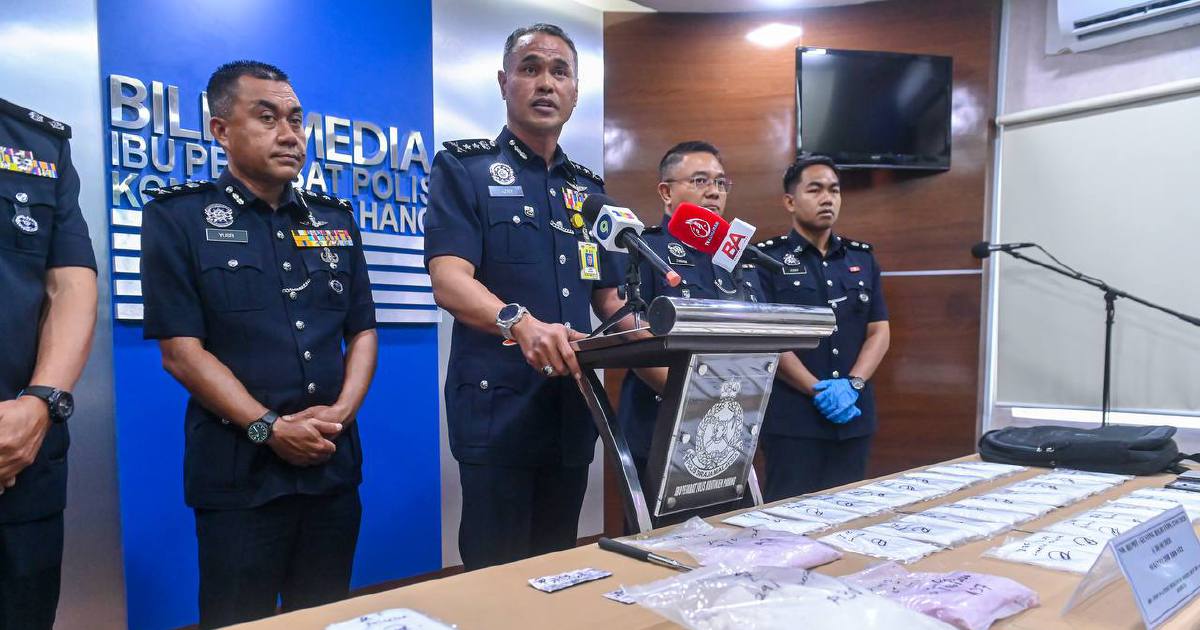
A Thai national and her Malaysian partner have been apprehended in Bentong following a major anti-narcotics operation, with authorities recovering controlled substances valued at approximately RM728,000. The bust occurred at a residential address in Genting Permai, marking another significant blow against organised drug trafficking networks in Pahang. Both suspects are currently in police custody pending investigation, as law enforcement agencies probe their alleged involvement in a larger syndicate operation spanning the past three months.
Investigators believe the couple functioned as couriers within a structured trafficking organisation, handling and distributing controlled substances across an unspecified region. The extended timeline of the alleged operation—dating back roughly three months from the time of arrest—suggests the network had established reliable logistics and customer channels. Thai nationals have increasingly featured in regional drug trafficking cases, reflecting broader transnational criminal patterns in Southeast Asia where substance abuse markets transcend national borders and organised groups exploit trafficking routes that crisscross multiple jurisdictions.
The Bentong location carries particular significance in Malaysia's drug enforcement landscape. The Pahang district sits along critical transportation corridors connecting Malaysia's interior regions with urban consumption centres, and has historically served as a transshipment point for contraband moving between states. Genting Permai, a residential enclave in the area, would provide relative discretion for criminal operations while maintaining logistical proximity to major routes. Police investigations typically examine whether the arrested individuals were utilising such locations as distribution hubs or storage facilities for their syndicate partners.
The value of seized substances—RM728,000—represents a substantial quantity of controlled drugs, though the specific types remain undisclosed pending further police announcements. In Malaysian drug enforcement contexts, such valuations typically encompass a mixture of different substances, each carrying distinct street values and sentencing provisions under the Dangerous Drugs Act. The amount suggests wholesale-level trafficking rather than street-level dealing, reinforcing indications that the couple occupied intermediate positions within a larger organisational structure answerable to higher-level distributors or importers.
Cross-border drug operations involving Thai nationals reflect the complex regional security challenges facing Southeast Asian law enforcement. Thailand's porous borders, combined with its geography astride historic trafficking routes, have rendered it both a source and transit country for illicit substances destined for Malaysian and broader regional markets. International cooperation between Thai and Malaysian police agencies has intensified in recent years, yet the sheer scale and sophistication of organised networks frequently outpaces enforcement capacity, creating recurring opportunities for criminal groups to establish operations.
The implications for Bentong residents and Pahang more broadly underscore the persistent threat posed by drug trafficking to community safety. Trafficking hubs often attract ancillary criminal activity including money laundering, violence between competing organisations, and corruption of local officials. The presence of organised distribution networks in residential areas elevates risks for families and potentially destabilises neighbourhoods through increased law enforcement presence and associated disruptions.
For Malaysia's national drug enforcement strategy, such arrests contribute to a complex enforcement picture. Whilst individual seizures generate important headlines and disrupt specific criminal operations, systemic challenges persist at source and transit points, particularly regarding the capacity to identify and intercept shipments at borders before they reach wholesale distributors. Intelligence-led operations like the Bentong raid represent targeted interventions against known or suspected criminal activity, yet large quantities of contraband continue entering Malaysian territory despite robust port and airport screening procedures.
The investigation process ahead will likely focus on establishing the couple's broader network connections, identifying their immediate handlers and distributors, and tracing financial flows associated with their courier activities. Digital forensics examining mobile communications and financial records typically provide crucial leads in unravelling trafficking hierarchies. Malaysian authorities will also coordinate with Thai counterparts to determine whether the arrested woman maintains connections to production or trafficking networks across their shared border.
This case arrives amid intensified public health concerns regarding drug abuse across Malaysia. Whilst enforcement operations targeting trafficking networks remain essential, parallel initiatives addressing demand reduction through rehabilitation and community intervention programmes remain underfunded relative to enforcement expenditure. The capture of mid-level couriers, whilst significant tactically, rarely impacts retail availability in consumption markets unless complemented by broader supply-chain disruptions targeting importation capacity and wholesale distribution infrastructure.

