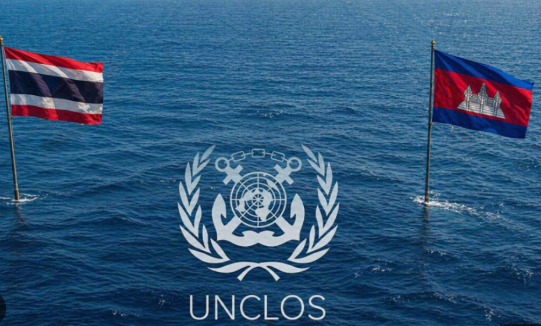
Thailand has formally accepted Cambodia's request to pursue compulsory conciliation under the United Nations Convention on the Law of the Sea, marking a significant diplomatic development in their decades-old maritime boundary dispute. However, Thai officials have been at pains to emphasise that this process fundamentally differs from litigation and that any conclusions reached by the conciliation panel will carry no legal weight, allowing both nations to maintain negotiating flexibility on sensitive resources in the Gulf of Thailand.
The Thai Ministry of Foreign Affairs submitted its formal response to Cambodia on June 19, following Cambodia's notification transmitted on June 2. In its response, Thailand made clear that it views the conciliation scope as limited solely to maritime delimitation under UNCLOS, a deliberate positioning that reflects Bangkok's concern about the breadth of Cambodia's request. Thailand appointed Deputy Prime Minister and Foreign Minister Sihasak Phuangketkeow to serve as its Agent throughout the proceedings, with Songchai Chaipatiyut, a senior legal official and currently ambassador to Kuwait, designated as Deputy Agent. The composition of these positions underscores Thailand's commitment to maintaining high-level political and diplomatic engagement with the process.
Thailand also selected two conciliators to represent its interests within the panel: South African Judge Albert J Hoffmann and German Judge Rudiger Wolfrum, both recognised internationally as specialists in maritime law and the law of the sea. The four conciliators appointed jointly by both countries now face a 30-day window to select a fifth member who will chair the conciliation commission. Once constituted, the full five-member panel is expected to conduct its work within approximately 12 months, though both parties retain the option to extend this timeline by mutual agreement.
Thailand's diplomatic messaging around the conciliation process reveals a nuanced strategy designed to preserve Bangkok's negotiating position while appearing cooperative within the international legal framework. Thai officials have repeatedly stressed that compulsory conciliation operates fundamentally differently from formal litigation before an international court. The conciliators, according to Bangkok's characterisation, function not as legal representatives or judges but as impartial experts whose primary task involves listening carefully to both parties' positions, comprehending the historical and political context surrounding the dispute, and facilitating identification of outcomes acceptable to both sides.
The expected output of this conciliation will be a formal report containing recommendations rather than binding legal determinations. This distinction proves crucial to Thailand's position, as it ensures that neither party becomes obligated to implement any conclusions without further bilateral discussion. The Foreign Ministry has explicitly stated that the report will serve as a potential foundation for continued negotiations between the two governments, while emphasising that outstanding issues must ultimately be resolved through direct country-to-country dialogue. This approach directly aligns with UNCLOS Annex V, which specifies that conciliation commission reports and recommendations carry no binding force on the parties involved.
Thailand's insistence on returning to bilateral negotiations represents a consistent theme in its maritime diplomacy. Rather than viewing conciliation as a substitute for direct talks, Bangkok characterises it as a potential framework facilitating mutual agreement between the two nations. This framing allows Thailand to participate in an international legal process while maintaining that ultimate resolution rests in the hands of the two governments rather than with international bodies. Such positioning reflects broader Thai concerns about external actors imposing solutions on sensitive sovereignty and resource questions.
The underlying source of contention between Thailand and Cambodia concerns overlapping maritime claims in the Gulf of Thailand, an area widely believed to hold substantial deposits of natural gas and other hydrocarbon resources. For decades, this dispute has intertwined questions of boundary delimitation with the possibility of joint development arrangements and shared resource extraction. In May of this year, the Thai Cabinet took the decisive step of terminating the 2001 Memorandum of Understanding with Cambodia—known domestically in Thailand as MoU 44—which had previously provided an institutional framework for managing overlapping continental shelf claims. Prime Minister Anutin Charnvirakul characterised this termination not as hostile action toward Cambodia but as a rational response to 25 years of stalled progress.
Thailand's decision to cancel the 2001 agreement introduced significant uncertainty into the maritime relationship, prompting Cambodia to invoke UNCLOS compulsory conciliation mechanisms. However, Thai officials have sought to reassure observers that terminating the MoU represented a technical adjustment to the cooperation framework rather than abandonment of negotiations or deterioration of bilateral relations. Bangkok has indicated its intention to continue discussions with Cambodia regarding maritime boundaries, anchoring such talks firmly in UNCLOS as a shared legal reference point, given that both nations are now parties to the convention.
Cambodia's decision to initiate formal conciliation reflects its desire to address the maritime dispute through established international legal mechanisms, framing its position as a commitment to peaceful resolution grounded in international law rather than unilateral action. Yet Thailand's acceptance comes coupled with explicit reservations about the scope and binding nature of the process, creating a situation where both countries have agreed to participate in a procedure while maintaining fundamentally different expectations about its significance and ultimate impact on their bilateral relationship.
For Malaysia and other Southeast Asian maritime states, this Thai-Cambodian conciliation offers instructive lessons about managing boundary disputes within the UNCLOS framework. The case demonstrates how nations can utilise international legal processes for diplomatic positioning while preserving their fundamental negotiating autonomy. It also highlights persistent tensions between seeking international validation for one's maritime claims and avoiding outcomes imposed by external bodies. As Southeast Asian nations increasingly confront overlapping maritime boundaries and resource competition, the Thai-Cambodian approach—accepting structured processes while limiting their binding authority—may represent a pragmatic middle path between isolation and surrendering decision-making authority.
The coming months will test whether conciliation can genuinely advance resolution of this longstanding dispute or whether the process will ultimately reinforce existing positions. Thailand's public emphasis on the non-binding nature of the proceedings reflects both genuine legal principle and strategic hedging against unfavourable recommendations. Cambodia's decision to pursue formal international conciliation suggests frustration with bilateral progress and desire for third-party involvement, even without binding authority. How these competing approaches interact within the conciliation process will shape not only Thai-Cambodian maritime relations but also broader regional attitudes toward international dispute resolution mechanisms.