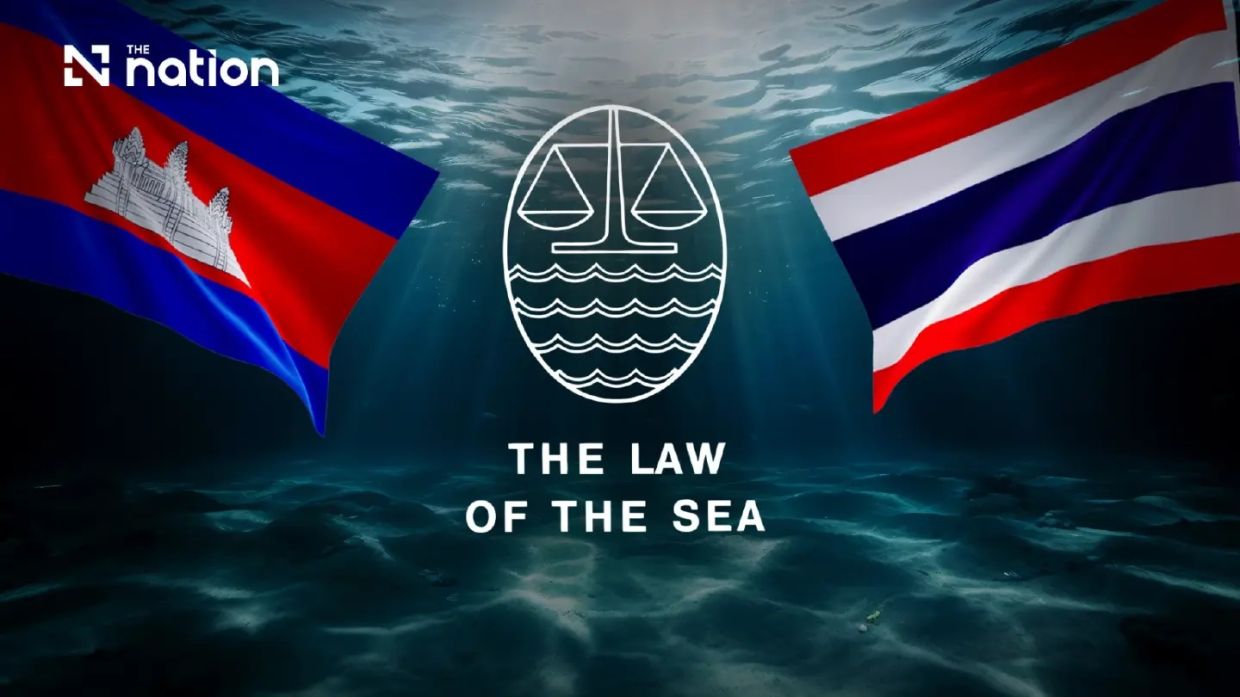
Thailand and Cambodia have made progress in assembling a five-member conciliation commission to settle their maritime boundary dispute in the Gulf of Thailand under the United Nations Convention on the Law of the Sea, yet fundamental disagreements persist about what the negotiations should ultimately achieve. The two countries have each appointed two independent conciliators who must now jointly select a fifth member to chair the commission, a process both governments have extended to August 14 after the original July 19 deadline passed. The delay reflects the difficulty of finding a candidate acceptable to both Bangkok and Phnom Penh—a neutral figure with sufficient expertise in international law, maritime law, and diplomacy, coupled with credibility in understanding Thai-Cambodian relations.
Thailand has selected Rüdiger Wolfrum, a German jurist who headed the International Tribunal for the Law of the Sea from 2005 to 2008, and Albert J. Hoffmann, a South African legal expert who led the same tribunal from 2020 to 2023. Cambodia countered with Peter Taksøe-Jensen, a Danish diplomat who chaired the Unclos conciliation between Timor-Leste and Australia—a precedent now being replicated here—and Jean-Marc Thouvenin, a French academic specialising in international law. The composition of the panel itself signals how seriously both governments view the dispute, with Cambodia formally notifying the UN process on June 2 and Thailand following suit on June 19. Bangkok has designated Deputy Prime Minister and Foreign Minister Sihasak Phuangketkeow as its agent in the proceedings, supported by Songchai Chaipatiyut, Thailand's ambassador to Kuwait, serving as deputy agent.
Crucially, the conciliation mechanism under Unclos differs markedly from court proceedings. The commission will not issue legally binding judgments or enforceable rulings. Instead, its role is consultative: to examine the dispute, consider approaches grounded in international and maritime law, and ultimately produce recommendations intended to guide both countries toward a negotiated settlement. Any final agreement between Thailand and Cambodia will still require their mutual consent. The entire process is anticipated to span roughly twelve months, though the parties may extend the timeline if needed. This non-binding framework mirrors the successful Timor-Leste-Australia case, which culminated in a treaty establishing permanent maritime boundaries in the Timor Sea, lending credibility to the mechanism as a workable solution for Southeast Asian maritime disputes.
The disputed waters encompass approximately 26,000 to 27,000 square kilometres and hold between 11 trillion and 12 trillion cubic feet of natural gas alongside substantial oil reserves. Some valuations place the potential resource wealth at roughly US$300 billion—a figure that partly explains Cambodia's eagerness to accelerate resolution. The global energy crisis triggered by Iran-related disruptions and concerns over the Strait of Hormuz have sharpened Cambodian Minister of Mines and Energy Keo Rottanak's conviction that the maritime dispute must be resolved swiftly. Cambodia's current energy portfolio leans heavily on hydropower and expanding solar capacity, but national planners view additional fossil-fuel resources as essential to long-term industrial development and economic competitiveness.
Keo has articulated the time pressure facing his country with particular clarity, warning that energy companies are unlikely to commit capital to exploration and development projects if negotiations stretch across decades. Major international firms, he noted, understand that the investment window for new fossil-fuel ventures is narrowing—a constraint driven by climate policy, renewable-energy advances, and shifting corporate priorities. TotalEnergies, when contacted for comment, did not disclose specific investment intentions, yet the French multinational's potential involvement underscores how international energy markets are watching the conciliation process. Cambodia therefore perceives the Unclos mechanism as a pathway not merely to delimiting maritime boundaries but ultimately to accessing and monetising the disputed offshore reserves.
Thailand, however, maintains a fundamentally different interpretation of the conciliation's proper scope and objectives. Bangkok insists that the commission's immediate and primary focus must be maritime delimitation—establishing where Thai sovereignty ends and Cambodian sovereignty begins in the Gulf. Thai officials, led by Foreign Minister Sihasak, argue that discussing joint development zones or resource-sharing arrangements would be premature before the underlying legal and geographical boundary has been clearly determined. Thailand's position reflects a conviction that sovereignty, territorial integrity, and national interests must remain paramount throughout the process. Joint development or resource-sharing frameworks, in Thai thinking, represent a secondary concern to be addressed only once the boundary question is definitively settled and overlapping claims have been thoroughly examined and resolved.
This divergence mirrors a broader regional pattern in Southeast Asian maritime disputes, where boundary demarcation and resource access frequently become entangled yet contentious issues. For Malaysia and other ASEAN neighbours accustomed to navigating competing territorial claims in the South China Sea and elsewhere, the Thailand-Cambodia case offers instructive lessons about negotiating frameworks that can satisfy multiple parties' interests without forcing either side to sacrifice core principles. The fact that both nations agreed to extend the conciliator-selection deadline rather than abandon the process suggests genuine commitment to resolution, even amid disagreement over ultimate aims.
Cambodia's energy imperatives are real and growing. As a lower-middle-income nation with energy-intensive aspirations for manufacturing and infrastructure expansion, Phnom Penh cannot ignore the potential economic benefits locked within the Gulf's hydrocarbon reserves. Yet Cambodia also recognises that moving too aggressively toward resource development without first settling the boundary dispute risks inflaming Thai nationalist sentiment and destabilising bilateral relations—particularly given Bangkok's historical suspicions about Cambodian resource nationalism and regional geopolitics. By framing the conciliation as a path toward both boundary settlement and eventual joint development, Cambodia attempts to reconcile immediate energy security concerns with the political need to respect Thailand's procedural caution.
Thailand's insistence on sequential resolution—boundary first, development later—reflects Bangkok's own strategic calculations. Thailand possesses its own offshore oil and gas infrastructure and expertise, particularly through companies operating in the Gulf of Thailand's existing, undisputed zones. Thai policymakers may harbour concerns that premature commitment to joint development frameworks could implicitly concede overlapping claims or weaken Bangkok's negotiating position on boundary delimitation. Furthermore, Thailand must manage its own domestic energy politics, balancing hydrocarbon interests against growing renewable-energy investment and environmental pressures from a sophisticated urban constituency increasingly attuned to climate issues.
The conciliation commission, once fully constituted, will inevitably encounter these competing visions and must find language and recommendations capable of accommodating both. The Timor-Leste-Australia precedent, while encouraging, involved somewhat different circumstances: that dispute centred on the continental shelf and seabed resources rather than full maritime boundaries, and both nations shared strong geopolitical incentives to resolve the matter quickly. Thailand and Cambodia, by contrast, operate within a more complex regional environment characterised by longstanding suspicions, competing ASEAN alignments, and differing development priorities.
For Malaysia and the broader Southeast Asian region, the Thailand-Cambodia case underscores both the promise and pitfalls of Unclos-based dispute resolution mechanisms. Such frameworks offer a structured, non-confrontational path to addressing maritime disagreements that might otherwise fester or escalate. Yet they cannot, by themselves, bridge fundamental differences over what disputes should ultimately resolve. The conciliation process will likely produce a boundary recommendation grounded in international law; what remains uncertain is whether and how quickly Thailand and Cambodia will translate that recommendation into a binding agreement, and whether they will subsequently pursue joint development as Cambodia hopes or maintain separate economic interests as Thailand's position suggests. As the commission's chair is selected in coming weeks, both governments will reveal through their choice whether they truly envision a path toward comprehensive settlement or merely toward managing the dispute within a temporary institutional framework.

