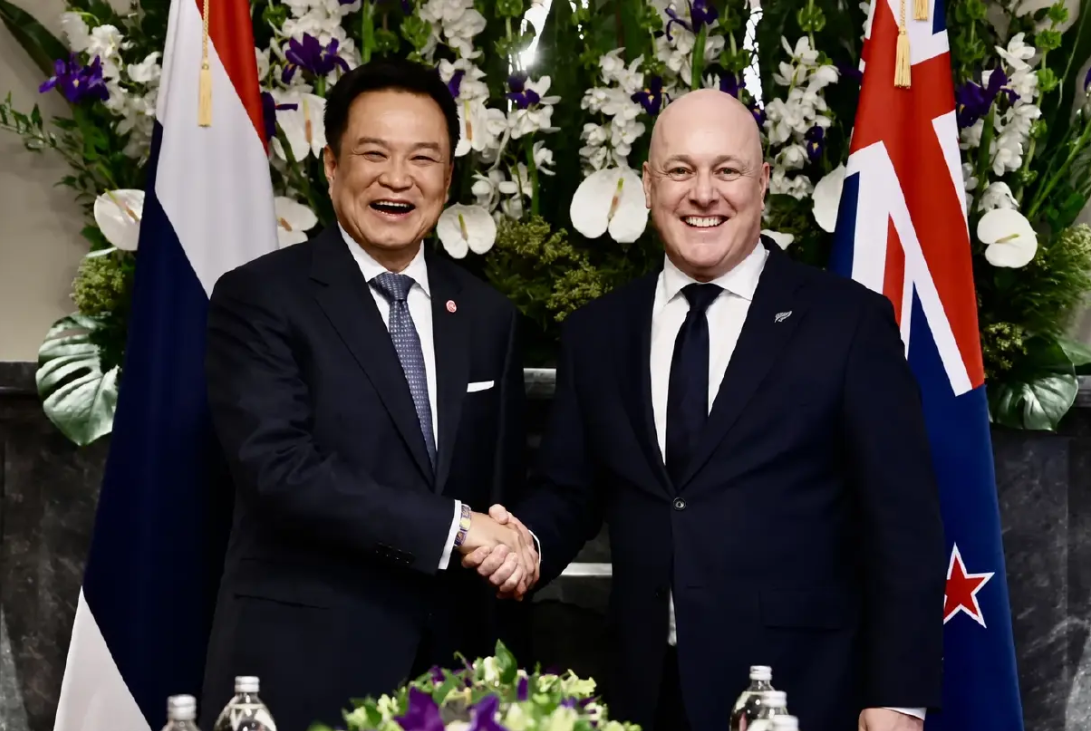
Thailand and New Zealand have formally upgraded their bilateral relationship to a strategic partnership, marking a significant diplomatic milestone as the two nations commemorate seven decades of formal ties. The elevation was formalised through a joint declaration signed by Thai Prime Minister Anutin Charnvirakul and New Zealand Prime Minister Christopher Luxon during high-level talks in Wellington on Friday, August 21. The upgrade reflects growing convergence between Bangkok and Wellington across political, economic and cultural domains, signalling renewed commitment to deepening engagement at a time when both nations are reassessing regional alignments and strategic priorities in the Indo-Pacific.
Among the most ambitious outcomes of the partnership is an agreement to triple bilateral trade to US$7.5 billion, equivalent to approximately 246 billion baht, by 2045. This 21-year target represents a dramatic expansion from current trade volumes and underscores both governments' determination to unlock commercial opportunities that have historically remained underutilised. The goal reflects recognition that geographical proximity and complementary economic strengths between an agricultural and industrial powerhouse like Thailand and resource-rich New Zealand remain inadequately leveraged in conventional trade relationships.
The strategic framework encompasses four interconnected pillars designed to translate diplomatic goodwill into tangible outcomes for ordinary citizens and businesses. Political and security cooperation forms the foundation, with both nations committing to enhanced coordination against transnational organised crime, sophisticated online fraud schemes and human trafficking networks that increasingly span Asia-Pacific corridors. This dimension proves particularly relevant for Southeast Asia, where law enforcement agencies struggle with cross-border criminal operations that exploit regulatory gaps and jurisdictional complexities.
The economic pillar establishes ambitious parameters for commercial expansion. Beyond the headline trade target, Thailand and New Zealand have committed to developing the Thailand–New Zealand Closer Economic Partnership framework, creating structured pathways for bilateral investment and business development. The accord specifically identifies innovation, food security, energy transition and sustainable agriculture as priority sectors, reflecting global megatrends reshaping trade patterns. For Malaysia and the broader ASEAN region, this bilateral deepening signals how individual Southeast Asian nations are pursuing sophisticated, multi-dimensional partnerships with developed economies outside traditional regional frameworks.
Educational and cultural connectivity represents the third strategic dimension, acknowledging that durable partnerships rest on human relationships and institutional networks. Both governments plan expanded cooperation in skills development, research innovation and capacity-building, with particular emphasis on creating people-to-people exchanges that transcend government-to-government relations. This people-centric approach reflects lessons learned from earlier partnership frameworks that failed to generate sustained momentum when high-level political commitments were not reinforced by grassroots connections and educational linkages.
Regional and multilateral collaboration forms the fourth pillar, positioning the Thailand–New Zealand partnership within broader Asia-Pacific architectures. Both nations committed to closer coordination through ASEAN mechanisms, the Mekong cooperation framework, APEC and other multilateral forums. This positioning carries significance for the region's geopolitical balance, as it demonstrates how middle-power nations are building strategic relationships that preserve autonomy while engaging constructively with established international institutions and rules-based orders.
Thai Airways' planned resumption of direct Bangkok–Auckland services in March 2027 carries symbolic and practical importance for the partnership's success. The restoration of this route, which has been suspended, represents infrastructure investment that directly facilitates trade, tourism, education and investment flows. Anutin's indication that earlier resumption is possible suggests Thai government willingness to provide policy and financial support for aviation connectivity as a strategic priority. For regional observers, this commitment demonstrates how flagship carriers can be mobilised as tools of economic diplomacy, strengthening bilateral relationships through convenient travel access.
The partnership encompasses four specific cooperation agreements addressing distinct domains. A cultural cooperation accord formalises exchanges in arts, heritage and creative industries. A memorandum between Thailand's Office of the Civil Service Commission and Education New Zealand establishes public sector training collaboration. A police partnership agreement creates frameworks for information-sharing and joint operations against transnational crime. A private-sector component involving Chata Instruments and Aeroqual Limited illustrates how diplomatic partnerships generate commercial opportunities for specific enterprises, creating private-sector constituencies with vested interests in sustained bilateral relations.
Autin additionally sought New Zealand backing for Thailand's application to join the Organisation for Economic Co-operation and Development, with Luxon providing immediate endorsement. This dimension introduces a significant development agenda dimension to the partnership. OECD membership would represent Thailand's integration into advanced-economy governance networks and policy forums, potentially elevating the nation's regulatory standards and institutional capabilities. For ASEAN members, Thailand's advancement in such international bodies affects regional dynamics and competitive positioning, particularly as ASEAN nations pursue varying degrees of integration with developed-economy organisations and standards frameworks.
The timing of this strategic elevation carries geopolitical resonance within Southeast Asia's current strategic environment. As regional nations navigate great-power competition and recalibrate security partnerships, Thailand–New Zealand deepening demonstrates how ASEAN members are building multifaceted relationships with democratic partners outside Cold War alliance structures. The emphasis on rules-based international order and multilateral systems reflects both nations' commitment to principles-based engagement rather than transactional relationships dependent on individual leaders' preferences.
For Malaysia and other Southeast Asian economies, the Thailand–New Zealand partnership model offers instructive lessons about structuring bilateral relationships across multiple dimensions. The integration of security cooperation, economic expansion, people-to-people connectivity and regional coordination within a coherent strategic framework provides a template for relationships that generate sustained benefits across diverse stakeholder groups. The 21-year trade expansion target suggests strategic thinking oriented toward long-term partnership development rather than short-term gains, an orientation increasingly necessary as regional trade patterns shift and global supply chains reorganise.
The partnership's concrete mechanisms—the joint plan of action framework, specific cooperation agreements, and airline resumption—distinguish this upgrade from purely rhetorical diplomatic gestures. Both governments have attached measurable goals and institutional structures to their commitment, creating accountability mechanisms and regular review processes. This substantive approach contrasts with partnership declarations that remain symbolic exercises without implementation follow-through, a common experience in bilateral diplomacy where ambitious announcements precede years of minimal progress.

