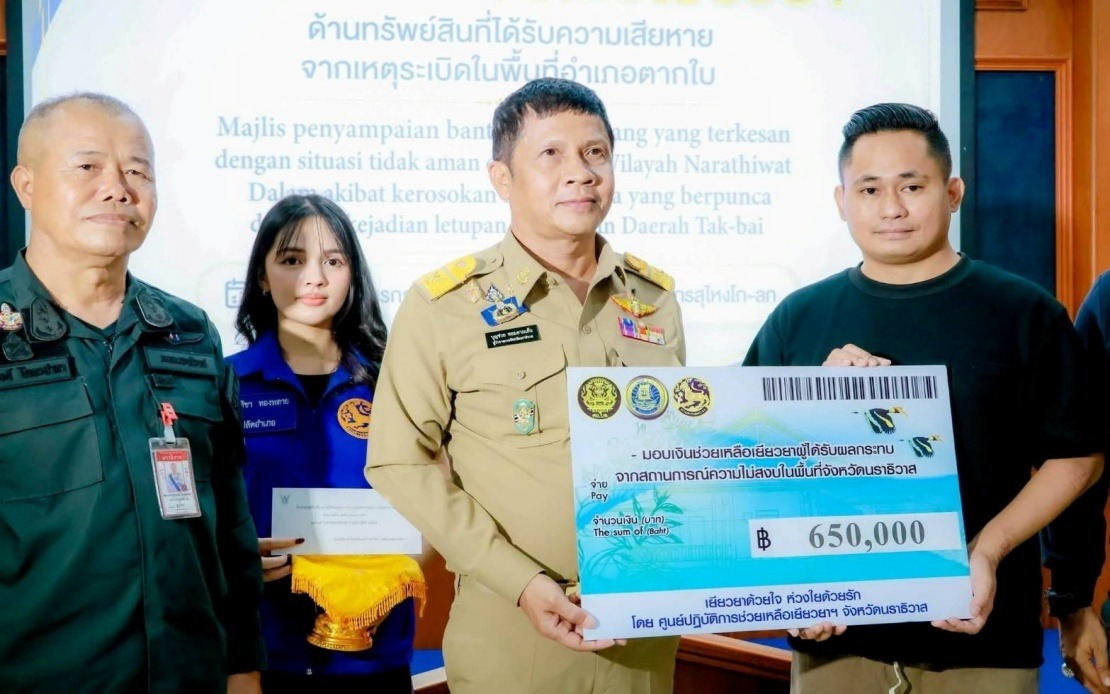
The Thai government has paid out compensation totalling 650,000 baht—roughly RM80,000—to one of two Malaysian nationals wounded in a bomb explosion in Tak Bai district on June 29, marking an official response to cross-border security concerns that have periodically troubled relations between the neighbouring kingdoms. The payment was formally presented on Friday at the Sungai Golok Customs Office in Narathiwat province, with Muhammad Yusri Udin, aged 38, receiving the disbursement through Bangkok's dedicated fund for victims of security-related violence.
The explosion occurred in the morning hours of June 29, when an improvised explosive device concealed within a roadside drainage pipe detonated near the Sapom junction at approximately 11.40 am local time. Two Malaysians were caught in the blast: Muhammad Yusri and Abdullah Syarapi Abd Rahman, a 45-year-old, who both sustained injuries requiring medical attention. The incident served as an uncomfortable reminder of the persistent security challenges affecting Thailand's southern border provinces, where insurgent activity and criminal violence have periodically endangered civilians and cross-border travellers alike.
Narathiwat Governor Boonchuay Homyamyen acknowledged the gravity of the situation during Friday's compensation ceremony, expressing the Thai government's sincere regrets over the incident that harmed the two Malaysian citizens. His public statement underscored Bangkok's commitment to addressing safety concerns in a border region that has historically struggled with militant activity, gang violence, and occasional terrorist-related incidents. The governor's remarks reflected official sensitivity to potential diplomatic repercussions and broader security perceptions among the Malaysian public regarding travel to Thailand's southern territories.
Authorities investigating the blast determined that the two injured Malaysians were not deliberately targeted but rather caught in crossfire during an attack believed orchestrated by an armed rebel faction operating in the southern provinces. This distinction carries significance for bilateral relations, as it suggests the incident arose from internal Thai security dynamics rather than deliberate cross-border aggression. Nevertheless, the fact that innocent Malaysian civilians suffered injuries on Thai soil inevitably raised questions about border region governance and the effectiveness of existing security protocols protecting foreign nationals and residents.
The Thai government channelled the compensation through an established victim assistance programme specifically created to address casualties and property losses stemming from security-related incidents. This institutional mechanism reflects Bangkok's recognition that the southern provinces experience recurring violence requiring systematic victim support frameworks. The fund's existence demonstrates that Thai officials have institutionalised responses to such incidents, though the ongoing nature of attacks suggests structural challenges in achieving sustained stability across the troubled region.
Following the explosion, Thai security apparatus moved swiftly to contain the situation and advance investigative efforts. A 40-year-old suspect was apprehended in connection with the attack, and security forces deployed comprehensive investigative measures including explosive ordnance disposal operations and detailed forensic examinations at the blast site. These rapid enforcement responses aim to demonstrate operational capacity and deterrent strength, particularly important for maintaining international confidence in Thailand's ability to manage security threats affecting foreign nationals.
For Malaysian readers, the incident and its diplomatic aftermath illustrate the persistent security environment affecting southern Thailand despite ongoing counterinsurgency operations and administrative reforms implemented by Bangkok over recent years. The border region remains characterised by occasional violence despite massive Thai military investment and international counterterrorism cooperation frameworks. The compensation payment, while officially acknowledging Thai responsibility for victim care, also serves as a pragmatic gesture to prevent diplomatic friction and reassure Malaysian authorities that Bangkok takes seriously any harm befalling Malaysian citizens on Thai territory.
Governor Boonchuay's public assurances regarding strengthened security measures and renewed commitment to tourist protection reflect Bangkok's broader strategic objective: maintaining regional tourism flows and international confidence despite persistent insurgent activity. Southern Thailand generates substantial foreign exchange revenue and employs thousands of workers, making security perceptions economically consequential. The governor's emphasis on continuous security improvements signals official recognition that visitor and investor confidence directly correlates with effective law enforcement and protective services.
The incident underscores the complex realities of the Thailand-Malaysia border region, where transnational economic ties, tourist flows, and family connections coexist alongside security challenges rooted in Thailand's long-running southern insurgency. Malaysian nationals regularly traverse this border for business, tourism, and personal reasons, making security conditions there directly relevant to Malaysian public interest and government foreign policy considerations. The compensation mechanism and official Thai acknowledgment represent mechanisms through which Bangkok attempts to manage diplomatic sensitivities arising from security incidents that inevitably occur in contested territories.
Looking forward, the bombing and official response illustrate how even non-deliberate incidents affecting neighbouring countries' citizens require careful diplomatic handling and timely victim compensation to prevent broader bilateral friction. Thailand's willingness to process compensation claims through established channels and senior officials' public expressions of regret constitute standard diplomatic practice aimed at containing potential escalation. For Malaysia, the incident reinforces the importance of maintaining dialogue channels and coordinated security approaches with Thai counterparts, even as cross-border security challenges persist despite substantial enforcement investments by both governments.

