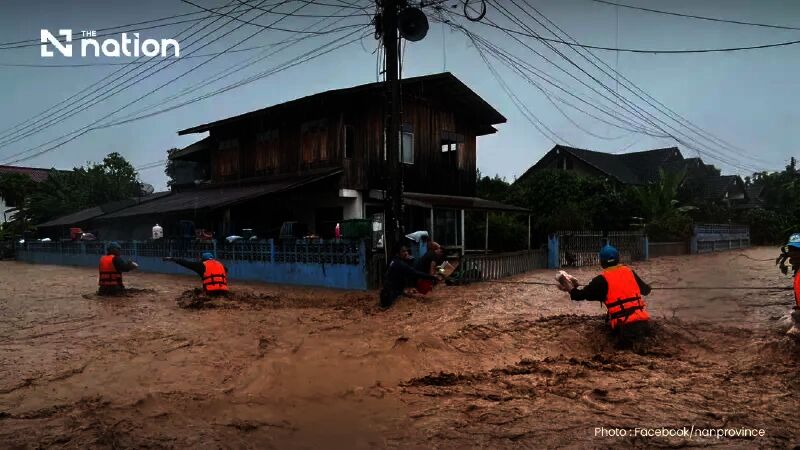
Thailand's government has formally declared a disaster zone in Nan province as relentless rainfall continues to pose a severe threat across multiple northern regions. The announcement came on Wednesday as floodwaters severed transportation links and prompted authorities to evacuate residents from low-lying areas. The classification signals escalated emergency protocols and opens access to additional disaster relief funding and resources. Phayao and Lamphun provinces have been placed under heightened alert status, indicating officials expect conditions to deteriorate further in coming days.
Prime Minister Anutin Charnvirakul is overseeing the crisis response remotely from his current official visit to Australia, underscoring the seriousness with which the government views the unfolding emergency. Government spokesperson Rachada Dhnadirek reported that the prime minister has issued directives mobilizing all available state apparatus, including military units, to coordinate relief operations across affected areas. This whole-of-government approach reflects the scale of disruption caused by the flooding, which has already isolated communities and disrupted normal service delivery across the northern region.
The prime minister's strategy emphasizes pre-emptive deployment of response teams and excavation equipment to areas identified as vulnerable to recurring inundation. Rather than responding only after flooding occurs, officials are positioning resources ahead of anticipated incidents to minimize delays in rescue and recovery operations. Anutin has specifically instructed agencies to prioritize drainage efforts in regions with historical patterns of water accumulation, addressing a chronic challenge that compounds seasonal rainfall in low-lying districts. This preventative focus represents a shift toward forward-looking disaster management rather than reactive crisis response.
Official messaging underscores that human welfare takes precedence in all decision-making during the emergency period. The government has directed particular attention toward protecting vulnerable populations including elderly persons, bedridden patients, young children, and residents in geographically high-risk zones. Authorities have mandated rapid assessment protocols to identify all affected individuals and communities requiring urgent assistance. Continuous monitoring of rainfall volume and water level fluctuations has been ordered to enable timely public warnings before conditions become life-threatening.
The Meteorological Department's August forecast warned of widespread thunderstorm activity and localized intense precipitation across northern Thailand, alongside strong wind patterns capable of triggering flash flooding, surface runoff, and landslide events. This meteorological outlook informed government contingency planning and prompted the preemptive alert status for neighboring provinces. Authorities have extended warnings to cover northern, north-eastern, and central regions through Friday, as weather patterns remained unstable and posed ongoing risk through the end of the week.
Deputy Prime Minister Yodchanan Wongsawat, holding responsibility for flood management strategy in the northern region, issued urgent preparedness instructions to provincial governors in Nan, Phayao, and Lamphun. His directive called for comprehensive planning across multiple operational domains, including evacuation logistics, shelter coordination, emergency communication systems, and resource stockpiling. This high-level intervention signals the government's assessment that conditions could escalate rapidly, requiring governors to activate contingency measures beyond routine operations.
Flood emergencies in Thailand's northern provinces carry particular economic and humanitarian significance given agricultural patterns and population distribution in the region. Heavy seasonal rainfall regularly tests infrastructure designed to manage water flow, and overflow events can disrupt farming operations during critical cultivation periods. Communities reliant on agriculture-dependent livelihoods face compounded pressure when flooding damages crops and limits market access. The timing of this emergency in August coincides with monsoon season, when atmospheric conditions frequently produce intense precipitation events.
The centralized coordination approach mandated by Prime Minister Anutin reflects lessons learned from previous flooding episodes that exposed gaps in inter-agency communication and resource allocation. By establishing clear chain-of-command structures and pre-positioned equipment caches, officials aim to compress response times and improve the efficiency of rescue operations. The mobilization of military assets particularly enhances capacity for rapid personnel deployment and logistics management in areas where civilian infrastructure has been compromised by floodwaters.
For Malaysian observers, Thailand's flooding challenges offer relevant context regarding regional monsoon patterns and transboundary water management. As climate patterns affect broader Southeast Asian geography, precipitation events in Thai watersheds can influence downstream water levels affecting neighboring nations. Coordinated regional awareness of flood risks supports mutual preparedness and enables cross-border coordination if emergency assistance becomes necessary. Thailand's proactive management approach, emphasizing advance positioning of resources and vulnerable population protection, represents practical disaster management strategy applicable across the region.

