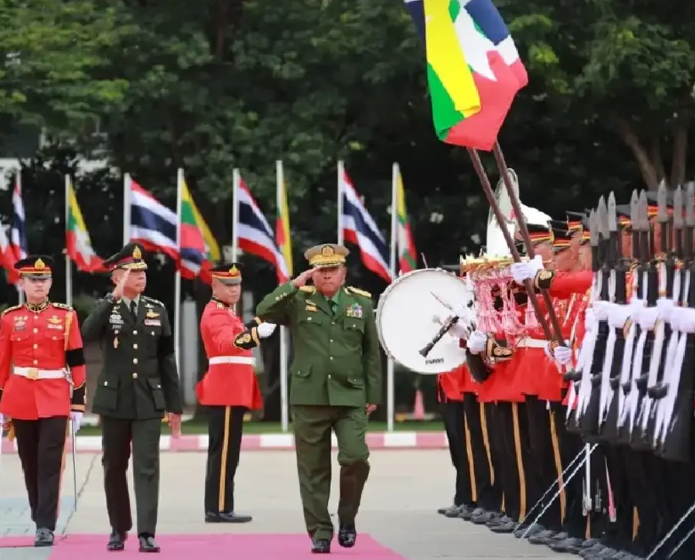
Thailand's military leadership rolled out a formal welcome for Myanmar's top military officer on Thursday, receiving him at a Bangkok hotel in what amounts to a significant gesture of diplomatic normalisation. The visit by Ye Win Oo, who assumed command of the Myanmar armed forces following the controversial 2026 elections, represents the first foreign journey undertaken by Myanmar's new military leadership since taking the reins. The encounter underscores how neighbouring countries are beginning to engage with the Myanmar junta despite its troubled recent history and the international community's deep reservations about its legitimacy.
Myanmar's military establishment remains marked by its decisive seizure of power in 2021, an intervention that deposed the elected government and imprisoned its figurehead, Aung San Suu Kyi. The putsch unleashed widespread armed conflict across the nation as various resistance movements challenged military control, resulting in what analysts estimate as approximately 100,000 deaths. The ousted leader remains imprisoned while her political party has been sidelined from formal participation in governance, and dissenting voices face severe criminal penalties. Throughout the five-year period following this intervention, Myanmar's armed forces faced international isolation and condemnation from democratic nations and human rights organisations.
In a bid to rehabilitate its image and reduce its pariah status on the global stage, Myanmar's military orchestrated elections in early 2026 that were highly restricted in scope and participation. These polls allowed the previous coup architect, Min Aung Hlaing, to transition into a civilian presidential role, while simultaneously installing Ye Win Oo, regarded as an exceptionally loyal military subordinate, as the new armed forces commander. The junta marketed these electoral exercises as evidence of democratic transition and normalisation, though international observers and democracy advocates have dismissed them as theatrical exercises designed merely to rebrand military authoritarianism under democratic nomenclature.
Ye Win Oo's background before this appointment reveals the nature of the military's inner circle. As a former intelligence operative within Myanmar's previous military government, he has been directly implicated in decisions leading to the coup and subsequently targeted with international sanctions by the United States and allied nations. His appointment to the highest military position indicates the regime's preference for placing individuals with proven loyalty rather than institutional reformers in positions of power, a signal that the military intends to maintain substantive control regardless of civilian governmental structures.
The meeting in Bangkok between Thai military chief Ukris Boontanondha and Ye Win Oo carries particular significance given the shared 2,400-kilometre border between the two nations. This frontier has become destabilised by Myanmar's internal conflict, creating security challenges that directly affect Thailand's interests. Border management, cross-border movement of displaced populations, and prevention of spillover violence from Myanmar's civil war represent practical concerns that transcend broader questions of political legitimacy. For Thailand and other neighbouring nations sharing territory with Myanmar, the pragmatic imperative to address these tangible issues has apparently outweighed moral considerations regarding the military's political takeover.
Thailand's government has positioned itself at the forefront of regional nations willing to engage with Myanmar's revised military administration. Thai Prime Minister Anutin Charnvirakul extended ceremonial recognition to Min Aung Hlaing during his recent Bangkok visit, and the decision to receive Ye Win Oo continues this trajectory of normalised relations. Foreign Minister Sihasak Phuangketkeow articulated the Thai government's reasoning by declaring to journalists that diplomatic engagement represents a response to existing reality rather than an endorsement of legitimacy. This formulation permits Bangkok to maintain relationships with Myanmar's authorities while technically avoiding formal validation of the regime's political credentials.
However, this diplomatic thaw has prompted severe criticism from international civil society organisations focused on Myanmar. The Special Advisory Council for Myanmar issued a statement this week arguing that Thailand's willingness to extend red-carpet treatment to Myanmar's leadership amounts to accommodation of military authoritarianism. The council characterised the decision as fundamentally damaging to Thailand's credibility as a nation committed to democratic principles and the rule of law. The extension of similar courtesies to Ye Win Oo was described as compounding Thailand's reputational damage on the international stage.
Simultaneously, investigations commissioned by United Nations mechanisms continue documenting escalating violence perpetrated by Myanmar's military apparatus. The UN's Independent Investigative Mechanism released its annual assessment identifying an intensification of aerial bombardments targeting civilian populations and infrastructure. The same report documents systematic patterns of unlawful detention, torture practices, and sexual violence enacted by military personnel against the broader population. These findings paint a picture of military conduct inconsistent with claims of normalisation or transition toward improved governance standards.
Myanmar's military administration has responded to such allegations by rejecting them as politically motivated distortions. Officials characterised UN documentation as relying on unverifiable assertions and fundamentally inaccurate characterisations of security force operations. This defensive posture reflects the junta's strategy of dismissing international scrutiny as interference in Myanmar's internal affairs while simultaneously seeking regional diplomatic acceptance based on the fiction of electoral legitimacy.
For Malaysia and other Southeast Asian nations observing this dynamic, the situation presents a complex geopolitical puzzle. Myanmar's geographic position within ASEAN, combined with its substantial resources and strategic location along major Asian transport corridors, makes its stability consequential for regional security architecture. Yet the military's demonstrated disregard for democratic processes and documented propensity for violence against civilian populations creates genuine dilemmas for nations attempting to balance pragmatic engagement with principled opposition to authoritarianism. The divergence between Thailand's pragmatic approach and international democracy advocates' position reflects broader tensions within the region regarding how to balance immediate security and economic interests against longer-term commitments to governance standards and human rights protection.

