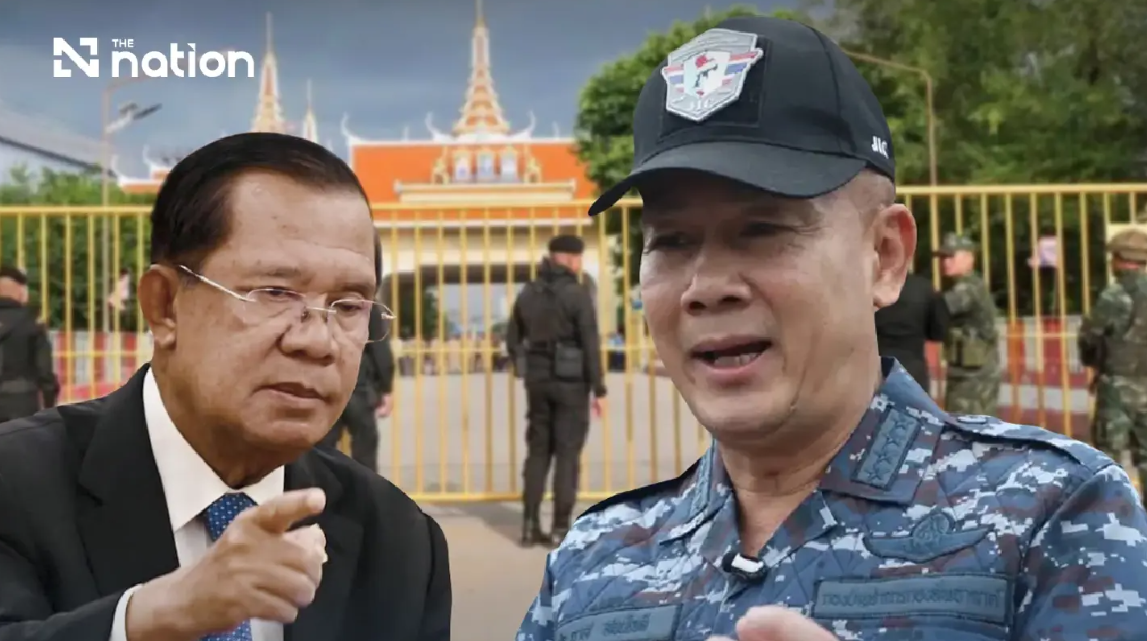
Thailand's top official overseeing bilateral relations with Cambodia has categorically rejected accusations from Cambodian Senate President Hun Sen that the kingdom weaponised its fight against online fraud rings as a smokescreen for military territorial expansion. Air Chief Marshal Prapas Sonjaidee, who directs the Joint Information Centre on the Thailand-Cambodia Situation, made his rebuke on Friday following Hun Sen's international forum remarks characterising Thailand's conduct as "modern warfare." The exchange underscores mounting friction between the neighbours over a disputed border zone and raises fundamental questions about how military confrontations are framed in an era of information warfare.
Prapas distinguished sharply between two separate issues that Hun Sen had conflated. The first concerns whether a particular location housed scam operations—a transnational criminal problem requiring cooperation. The second concerns whether that same location was simultaneously functioning as a military installation, housing troops, storing weapons, or supporting combat operations. Prapas contended that collapsing these categories into a single narrative served rhetorical purposes but obscured rather than clarified factual reality. If Cambodia disputes Thailand's characterisation of specific sites, he suggested, the remedy lay not in exchanging accusations across international platforms but in rigorous, verifiable examination of evidence including timestamps, coordinates, weapon types and firing directions.
The Thai official emphasised that any credible analysis of armed conflict must establish chronological sequence, not begin arbitrarily at a moment favourable to one party's narrative. He insisted that Thailand's response—whatever form it took—could only be understood as a reaction to prior Cambodian action. According to Thai accounts supported by what Prapas described as evidence, Cambodia initiated the use of weapons in ways that extended harm into Thai civilian areas. Thailand's subsequent military actions, in this framing, constituted defensive measures designed to eliminate threats and safeguard Thai military and civilian lives. This sequencing question carries significant weight in international law governing self-defence, though both countries' versions of events remain contested.
A critical element of Prapas's response addressed Hun Sen's claim that Thailand was occupying Cambodian territory. He pointed to a joint bilateral statement establishing ceasefire principles that both nations had endorsed. Under these agreed terms, military forces must remain positioned exactly as they stood when the ceasefire took effect, avoid moving toward one another, refrain from provocative actions and work to de-escalate tensions. Prapas argued that maintaining these positions—as required by the ceasefire agreement—cannot simultaneously be characterised as occupation. To do so would create logical contradiction: both sides would be obligated by signed agreement to keep forces in place while one side unilaterally declared those same positions violations of sovereignty.
The question of where the actual border lies remains separate from military positioning, Prapas stressed. Border demarcation falls within the purview of established bilateral mechanisms and specialist joint commissions specifically created to resolve such disagreements. Military forces should not determine borders through physical occupation; media narratives should not redraw them through propaganda; and unilateral political pronouncements cannot redefine them through assertion. Only through these agreed institutional channels, he maintained, could disputes over territorial boundaries receive legitimate resolution. The militarisation of border questions risked entrenching positions and foreclosing the diplomatic pathways necessary for eventual settlement.
On the broader humanitarian dimension, Prapas articulated principles intended to transcend nationalist framing. Civilian protection, he stressed, must apply universally—Thai children deserve safety precisely as much as Cambodian children. Schools and civilian infrastructure in both nations warrant protection not because of national identity but because humanitarian standards acknowledge no borders. However, this principle operated bidirectionally: full accounting of civilian harm required examining damage across both sides, analysing weapon types, fire directions, timestamps and whether strikes targeted legitimate military objectives. Critically, civilian areas must not be instrumentalised to shield military operations, a standard all parties should accept regardless of nationality.
Prapas's comments on information warfare and disinformation acknowledged the twenty-first century challenge of competing narratives eroding shared reality. However, he presented a counterintuitive argument: the solution to information warfare was not generating additional accusations of information warfare. Instead, transparency and public scrutiny of evidence, chronology and documentation offered the only sustainable path forward. When one side accused another of propaganda while simultaneously presenting only self-serving information, both parties became trapped in an escalating cycle where each narrative reinforced the other's counter-narrative. The cycle could only be broken through systematic disclosure enabling independent verification.
Regarding the scam operations themselves—criminal enterprises that genuinely plague both Thailand and Cambodia while victimising citizens across Southeast Asia and globally—Prapas indicated willingness for genuine bilateral cooperation. The suppression of online fraud rings represented a shared interest transcending political disputes. However, this criminal justice objective required separation from military and territorial questions. Conflating them obscured the legitimate law enforcement dimensions of addressing transnational organised crime while simultaneously poisoning the atmosphere for the security discussions that demanded resolution.
Prapas outlined Thailand's stated positions with apparent finality: the kingdom neither desires war nor seeks Cambodian territory, nor does it regard Cambodian citizens as adversaries. Simultaneously, Thailand bears responsibility to shield its own civilians and military personnel from harm. On scam operations, both nations should collaborate to eliminate them. On military site usage, factual evidence and applicable law should determine outcomes rather than political assertion. Regarding the initial armed clashes, full chronological disclosure—including the opening salvoes—should replace narratives beginning conveniently at Thailand's response. On border issues, established bilateral mechanisms must function rather than being superseded by military fait accompli or media campaigns.
The Thai official framed the ceasefire not as a permanent resolution but as a foundation for negotiation. Both sides should honour the joint statement, maintain agreed troop positions, actively reduce provocative actions and cultivate conditions permitting substantive negotiations to advance. He concluded by positioning the choice before both nations: continue trading competing narratives across international forums, opening "another battlefield" of information warfare that would damage both societies, or instead silence the guns, clarify facts through evidence, and restore serious diplomatic engagement. This framing suggests that regardless of military realities on the ground, the strategic calculation in Bangkok increasingly favours de-escalation and negotiated settlement over sustained confrontation.

