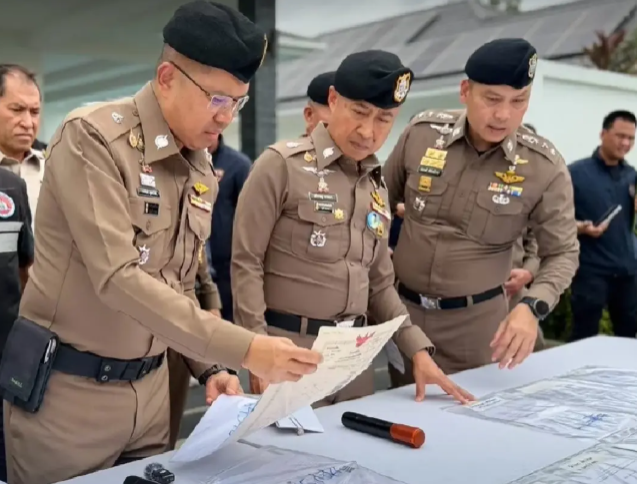
Thailand's police have intensified their assault on foreign property ownership schemes, arresting 13 foreign nationals during coordinated raids across Hua Hin in Prachuap Khiri Khan province on Monday (Aug 10). The operation marks the sixth phase of a nationwide campaign to dismantle networks using Thai nominee shareholders to circumvent restrictions on foreign land ownership, a practice that has become increasingly common in Thailand's resort destinations and poses both legal and governance challenges for the kingdom.
The Hua Hin operation, which mobilised more than 200 police officers and government officials, focused on a beachside development containing detached houses and modern pool villas valued at approximately 10–20 million baht each. Police identified six companies at the site that allegedly operated as fronts for foreign investors, with authorities suspecting the structures were designed to obscure the true beneficial ownership of properties worth an estimated 300 million baht across 33 suspect companies nationwide. The arrested individuals comprised three British nationals, four Chinese nationals, and citizens from Italy, France, the Netherlands, Austria, the Philippines and the United States, with 45 arrest warrants approved by courts and 39 Thai nationals summoned for questioning.
The mechanics of these schemes reveal a deliberate circumvention of Thai law, which prohibits foreigners from owning land in their own names. According to police investigations, foreign nationals were typically advised by law and accounting firms to establish Thai companies where local shareholders nominally held shares but exercised no actual control. In interviews with investigators, foreign nationals claimed they believed these arrangements provided legal cover for their property aspirations, a misconception that appears widespread among international buyers unfamiliar with Thai regulations. The Thai nominees, meanwhile, confessed to police that they had never paid for their shares, never participated in company management, and had never reviewed financial documents or evidence of their purported investments, suggesting they were merely paperwork figureheads.
This latest enforcement action reflects growing concern within Thailand's government about the systemic nature of nominee property schemes, particularly in high-value tourist destinations where foreign capital has driven property development. The expansion from previous operations demonstrates that Thai authorities have identified an organised network rather than isolated incidents. Earlier phases targeted Koh Phangan in Surat Thani, Phuket, Phang Nga, Krabi, Chonburi, and Chiang Mai, collectively examining 233 plots of land and buildings spanning more than 25.6 hectares valued at approximately 2.539 billion baht. These investigations resulted in 133 arrest warrants and 20 convictions, indicating that some defendants have already faced court consequences.
The sophistication of these operations underscores how professional service providers—unidentified law and accounting firms—have profited by structuring transactions for foreign clients seeking to acquire Thai property. Police have collected company registration documents, accounting records, computers, mobile phones and electronic data during the Hua Hin raids, with investigators now tasked with tracing financial transactions to identify other networks, intermediaries and beneficiaries operating within Thailand and internationally. This investigative approach suggests authorities recognise that individual cases are often connected to broader ecosystems of enablers and facilitators.
A particularly significant aspect of this campaign involves potential corruption within Thailand's own bureaucracy. Police have explicitly stated that their inquiry will examine whether any government officials facilitated these schemes through improper assistance or corruption. This acknowledgement reflects a mature understanding that such schemes cannot operate at scale without at least tacit cooperation from officials responsible for land registration, company formation, and property oversight. The involvement of senior police leadership, including Deputy National Police Chief Pol Gen Samran Nuanma and officers attached to the Office of the National Police Chief, suggests this campaign has been elevated to a strategic priority.
The implications for Malaysia and the broader Southeast Asian region warrant consideration. Malaysian authorities have similarly grappled with foreign investment in property, though Malaysia's regulatory framework differs from Thailand's. The Thai experience demonstrates both the ingenuity of international investors seeking to circumvent ownership restrictions and the resource intensity required to investigate and prosecute such schemes. Malaysian property regulators and developers should note how professional intermediaries—lawyers, accountants, and corporate service providers—become essential components of these networks, raising questions about professional oversight and ethical gatekeeping in the region's financial services sectors.
The Thai government's framing of this campaign distinguishes between unlawful nominee structures and legitimate foreign investment complying with Thai law, attempting to reassure genuine investors that the crackdown targets genuine violations rather than all foreign participation in the property market. Thailand recognises that its tourism economy and real estate development sector depend heavily on foreign investment, yet the government is clearly determined to enforce the spirit rather than merely the letter of ownership restrictions. This balance reflects the tension inherent in many Southeast Asian economies between attracting foreign capital and maintaining sovereignty over land ownership.
The enforcement mechanism available to Thai citizens also reflects the authorities' confidence in their public support for these investigations. Police have publicised a dedicated hotline (1599) and invited reports of suspected illegal foreign business activity, suggesting they believe residents of tourist destinations support efforts to restrict foreign property control. This grassroots reporting mechanism has likely contributed to the identification of the 33 companies now under investigation, as local communities often possess knowledge of property ownership patterns and corporate structures that formal regulatory channels might miss.
Moving forward, the Thai investigation team faces significant analytical challenges. Tracing financial flows across international borders, identifying the ultimate beneficial owners of properties held through multiple corporate layers, and gathering evidence admissible in Thai courts requires sustained international cooperation and forensic accounting expertise. The appointment of experienced senior police leadership to oversee investigations suggests that authorities are prepared for protracted investigations rather than seeking quick convictions through minimal evidence. As the campaign continues to expand beyond tourism destinations into other regions of Thailand, the precedent being set will influence how other Southeast Asian nations approach similar challenges of balancing foreign investment with national land ownership policies.

