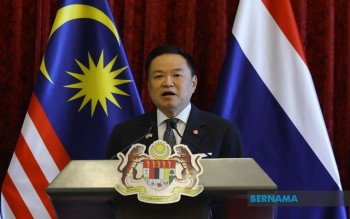
Thailand's Prime Minister Anutin Charnvirakul arrived in Malaysia on July 9 expressing strong optimism that the two neighbouring nations will breach the US$30 billion bilateral trade ceiling within the next two years. Speaking at Perdana Putra Complex in Putrajaya following a memorandum of understanding exchange with Malaysian Prime Minister Datuk Seri Anwar Ibrahim, Anutin signalled that the target—up from the current US$28 billion in annual commerce—represents an achievable goal given the momentum both governments are generating through coordinated efforts.
The significance of this trade aspiration lies in the context of Malaysia's pivotal role within Thailand's broader regional strategy. Anutin underscored that Malaysia currently ranks as Thailand's most important trading partner within the Association of Southeast Asian Nations, a position that reflects decades of geographic proximity, shared supply chains, and complementary economic structures. This designation carries weight not merely as a statistical accolade but as recognition of the deep commercial interdependencies that link the two economies across manufacturing, agriculture, and services sectors.
To sustain momentum toward the US$30 billion objective, both governments committed to establishing a formal framework through their joint trade committee, which will convene to craft more ambitious targets extending beyond 2027. This institutional mechanism reflects a departure from ad-hoc bilateral negotiations, instead embedding economic cooperation within structured dialogue channels designed to identify emerging opportunities and address friction points systematically. The strategic thinking behind such formalisation acknowledges that sustained trade growth requires continuous recalibration of priorities and targeted policy coordination.
Thailand's government has identified three pillars as central to deepening the partnership: food security, energy security, and the digital economy including high-tech manufacturing. These sectors reveal how Thailand conceptualises its relationship with Malaysia not as a conventional trade partnership but as part of a comprehensive effort to build regional resilience. Food security matters acutely across Southeast Asia given population growth and climate pressures; energy security reflects the region's dependence on diversified fuel sources and growing renewable capacity; while digital economy positioning speaks to the imperative of not ceding technological leadership to external powers.
Malaysia's response, articulated by Prime Minister Anwar, framed the trade expansion as foundational to broader diplomatic cooperation. Anwar indicated that MITI and the Ministry of Foreign Affairs would spearhead efforts to close the remaining US$2 billion gap, treating the target not as aspirational rhetoric but as a concrete deliverable requiring coordinated policy action. This institutional focus acknowledges that trade growth rarely emerges spontaneously; rather, it demands deliberate government facilitation through tariff harmonisation, regulatory streamlining, and investment promotion.
The emphasis on tourism within Malaysia's response introduces a dimension often overlooked in trade discussions: the role of cross-border people movement and services exports as economic drivers. For Malaysia, which hosts significant Thai communities and attracts Thai tourists, tourism revenue represents both a measurable trade component and a mechanism for deepening cultural familiarity that supports business relationships. Similarly, Thailand benefits from Malaysian tourism, creating a virtuous cycle where travel expenditure translates into services trade that contributes toward the bilateral target.
Anutin's visit represents his inaugural Malaysian trip since reassuming the prime ministership in March 2026, signalling that consolidating bilateral relationships ranks among his early foreign policy priorities. This scheduling choice suggests Thai leadership views the Malaysia relationship as sufficiently important to warrant early diplomatic investment, particularly as Thailand navigates domestic political transitions and regional positioning amid broader geopolitical shifts. The official nature of the visit—conducted at Anwar's invitation—underscores mutual recognition of the partnership's importance.
The complementarity thesis articulated by Thai officials merits deeper examination for Malaysian policymakers. Thailand and Malaysia exhibit distinct comparative advantages that, when leveraged jointly, create opportunities exceeding what either economy could generate independently. Thailand's strengths in automotive manufacturing and agricultural processing complement Malaysia's downstream industries and financial services, creating natural supply chain integration opportunities. As both nations grapple with middle-income challenges and labour cost pressures, deepened value chain integration offers a pathway to competitive sustainability.
Regional supply chain coordination carries implications beyond bilateral commerce. As global manufacturers reassess production footprints in response to geopolitical fragmentation and reshoring pressures, the Thailand-Malaysia axis represents a credible alternative manufacturing hub capable of serving Asian and global markets. This positioning becomes more valuable as semiconductor supply chains diversify away from concentration risk and as companies seek reliable suppliers within stable democracies. Enhanced bilateral cooperation thus positions both nations advantageously within the broader Asian manufacturing ecosystem.
For Malaysian readers and businesses, the articulated targets signal government intent to prioritise Southeast Asian integration alongside global partnerships. The emphasis on food and energy security acknowledges vulnerabilities that cross-border cooperation can mitigate; Thai agricultural expertise and Malaysian energy resources create natural complementarities. Small and medium enterprises operating in these sectors should monitor implementation progress, as new trade committee directives may unlock market access or create procurement opportunities previously constrained by regulatory barriers.
The MoU exchange ceremony, while ceremonially modest, represents substantive commitment to deepening cooperation frameworks. Such agreements typically establish working groups, facilitate ministerial dialogue, and create reporting mechanisms that convert aspirational targets into operational reality. Malaysian companies seeking Thai market entry or Thai partners looking to access Malaysian distribution networks should view this institutional scaffolding as providing supportive conditions for cross-border business expansion.
Achieving the US$30 billion target by 2027 demands sustained attention to non-tariff barriers, infrastructure development, and regulatory harmonisation. While current trade volumes suggest the target lies within reach, the final US$2 billion increment requires overcoming structural obstacles that have historically constrained bilateral commerce. Success hinges not on dramatic economic expansion but on systematic removal of friction costs that currently deflect trade toward third markets or make internal supply chains unnecessarily complicated.
Looking forward, the trajectory of Malaysia-Thailand trade reflects broader Southeast Asian integration trends. As ASEAN economies mature and labour costs converge, intra-regional value chains become increasingly sophisticated, requiring deeper institutional cooperation than previous development phases demanded. The ambitions articulated by Anutin and Anwar, if translated into measurable policy changes, could position the bilateral relationship as a model for ASEAN economic integration, demonstrating how neighbouring countries with overlapping interests can systematically deepen cooperation for mutual advantage.

