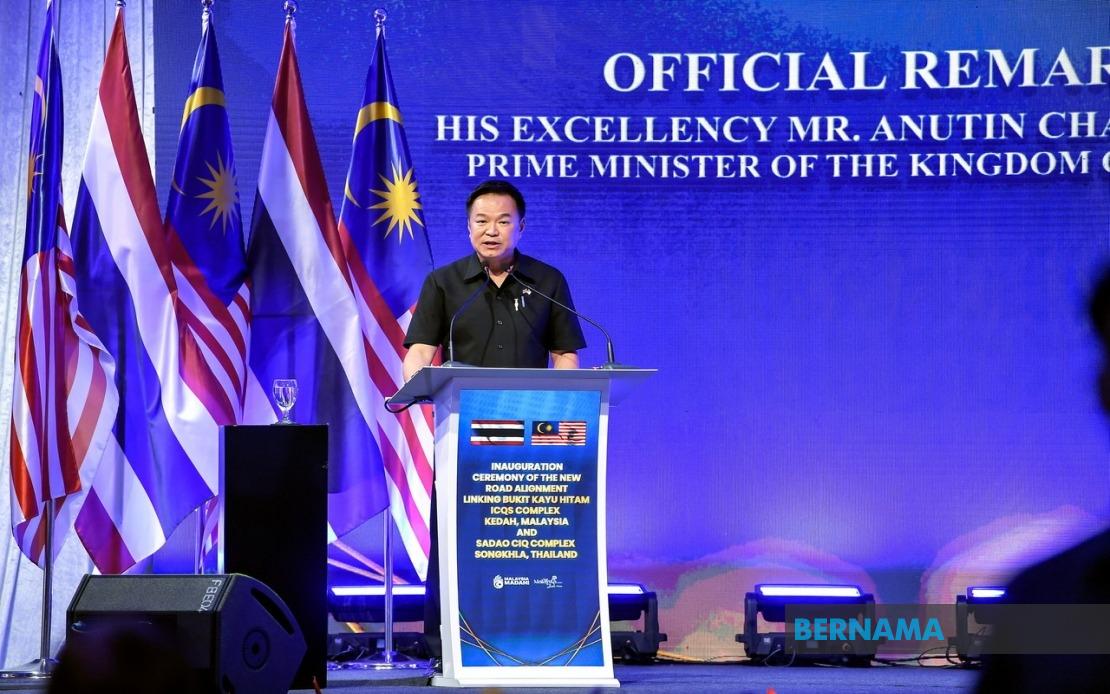
Thai Prime Minister Anutin Charnvirakul has pledged comprehensive infrastructure development to eliminate critical gaps in the Malaysia-Thailand transport network, positioning the region as a vital economic corridor linking Southeast Asia to China and Russia. Speaking at the inaugural ceremony for a newly aligned road connecting the Sadao Customs, Immigration and Quarantine Complex in Thailand with the Bukit Kayu Hitam Immigration, Customs, Quarantine and Security Complex in Kedah, Anutin outlined Bangkok's strategic vision for deepening bilateral economic integration and capitalising on unrealised trade potential across the region.
The new road alignment represents a tangible outcome of coordinated efforts between the Malaysian and Thai governments to streamline cross-border operations at one of the region's most heavily trafficked entry points. Malaysian Prime Minister Datuk Seri Anwar Ibrahim jointly inaugurated the project with Anutin, underscoring the shared commitment to infrastructure development that facilitates movement of both passengers and cargo. The initiative addresses persistent congestion challenges at the Bukit Kayu Hitam-Sadao crossing, historically the busiest border checkpoint between the two nations, where inefficient routing has created bottlenecks affecting trade flows throughout Southeast Asia.
Anutin articulated an ambitious vision extending beyond immediate bilateral concerns, framing the transport upgrades as essential infrastructure for a broader continental trade network. He emphasised that improved connectivity would enable Malaysian and Malaysian-bound merchandise to transit efficiently northward through Thailand toward Chinese markets and potentially into Russian territories, while simultaneously allowing Thai and Chinese goods to flow southward through Malaysia toward Singapore and Indonesian destinations. This bidirectional flow concept transforms the Malaysia-Thailand border from a conventional checkpoint into a functioning logistics hub within a larger Asian economic system, potentially reshaping trade patterns and investment flows throughout the region.
The Thai government's commitment encompasses more than the completed road alignment. Anutin confirmed that Bangkok intends to systematically address remaining transport infrastructure deficiencies that fragment the Thailand-Malaysia connectivity network. This comprehensive approach acknowledges that isolated improvements prove insufficient without coordinated development of the entire transport corridor, a recognition that elevates this initiative beyond routine border management into strategic regional economic planning. The Thai premier's emphasis on completing all missing links suggests recognition that fragmented infrastructure perpetuates inefficiency regardless of individual project quality.
Beyond the Bukit Kayu Hitam corridor, both governments have identified additional cross-border connectivity opportunities requiring development. Anutin referenced ongoing discussions concerning transport links in the Songkhla-Kedah, Satun-Perlis, and Narathiwat-Kelantan regions, each representing distinct geographic corridors with specific economic characteristics and development potential. These supplementary projects reflect the governments' understanding that comprehensive regional development requires coordinated investment across multiple border zones rather than concentration upon a single crossing. The proliferation of connectivity points would distribute traffic flows more evenly while creating multiple pathways for goods movement and passenger transit.
For northern Malaysia and southern Thailand specifically, improved transport connectivity carries particular significance given these regions' economic characteristics and development trajectories. Both areas have traditionally lagged their respective nations' more developed core zones, with geographic remoteness and limited infrastructure constraining economic diversification and private investment. Enhanced transport corridors promise to unlock dormant economic potential in border communities by reducing transaction costs, shortening supply chains, and improving market access for local enterprises. Anutin explicitly connected infrastructure development to employment generation and welfare improvements for populations residing along the shared frontier, acknowledging that connectivity benefits must reach ordinary residents rather than merely facilitating international trade flows.
The infrastructure projects carry implications extending beyond conventional transport economics into broader geopolitical and strategic dimensions. The explicit mention of facilitating connections toward China and Russia suggests that Thai authorities view border infrastructure development as instrumental to Thailand's positioning within larger Asian economic and political frameworks. As Southeast Asian nations negotiate relationships with major powers, transport infrastructure that integrates Thailand and Malaysia into northern Asian trade networks carries strategic weight beyond commercial considerations. The transport corridor effectively realigns regional gravity, potentially shifting trade patterns and investment flows that have historically favored maritime routes and western-oriented ports.
Malaysian stakeholders should recognise that enhanced Malaysia-Thailand connectivity serves both countries' interests while potentially reshaping competitive dynamics within Southeast Asia. Improved transport efficiency may redirect cargo flows that currently traverse Malaysian ports through alternative routes, requiring Malaysian traders and logistics providers to adapt strategies accordingly. However, the corridors also create opportunities for Malaysian businesses to access markets in Thailand, Laos, and China with reduced friction costs, potentially offsetting competitive pressures through expanded market access. The net economic effect remains contingent upon Malaysian firms' capacity to respond strategically to altered transportation economics.
The infrastructure initiatives emerged during Anutin's two-day official visit to Malaysia at Anwar Ibrahim's invitation, reflecting sustained high-level engagement between the two governments on bilateral matters. This diplomatic context matters because infrastructure development of this scale requires political commitment extending beyond technical planning or bureaucratic coordination. The parallel presence of both prime ministers at the inaugural ceremony symbolised genuine governmental priority, distinguishing these projects from numerous announced but unexecuted cross-border initiatives that characterise Southeast Asian development discourse. Such visible political commitment tends to accelerate implementation by reducing bureaucratic resistance and clarifying policy priorities for supporting agencies.
Both governments have positioned infrastructure development as integral to addressing outstanding bilateral issues and facilitating easier movement between their populations. This framing acknowledges that cross-border challenges extend beyond cargo handling to encompass passenger processing, regulatory harmonisation, and procedural simplification. While the road alignment primarily addresses physical connectivity, the accompanying diplomatic language suggests recognition that infrastructure investments alone prove insufficient without parallel improvements in border procedures, regulatory frameworks, and administrative practices that determine practical cross-border movement. This holistic perspective enhances the likelihood that infrastructure investments will translate into genuine improvements in trade and travel efficiency.
The Myanmar dimension merits consideration despite its absence from official statements. Both Malaysia and Thailand maintain strategic interests in Myanmar, and improved Malaysia-Thailand connectivity inherently strengthens both nations' capacity to project influence northward. Enhanced transport corridors through Thailand provide Malaysian enterprises with more direct pathways into Myanmar and eventually Chinese markets, potentially increasing Malaysian economic engagement in regions where Bangkok exercises significant influence. The transport network thus carries implications for regional balance and competitive positioning that extend considerably beyond bilateral Malaysia-Thailand relations.
Moving forward, sustained commitment to infrastructure completion will determine whether these announcements translate into functional economic corridors or remain primarily symbolic political gestures. Southeast Asian history contains numerous examples of announced connectivity projects that encountered implementation delays, funding constraints, or political reversal. Anutin's specific commitment to complete missing links within definable timeframes suggests seriousness, though execution risks remain substantial. Malaysian stakeholders should monitor project advancement while simultaneously positioning themselves to capitalise on improved transport efficiencies once corridor development progresses from inauguration ceremonies into operational realities.
The initiative reflects broader Southeast Asian recognition that regional competitiveness increasingly depends upon transport infrastructure quality and cross-border procedural efficiency. Nations that successfully integrate their transport networks with neighbours and larger continental systems attract manufacturing investment, generate employment, and expand trade opportunities. Malaysia and Thailand's emphasis on systematic corridor development acknowledges these realities while positioning both countries to benefit from anticipated economic growth throughout Asia. Whether these transport investments ultimately transform regional trade patterns or remain incremental improvements depends upon implementation fidelity and the willingness of both governments to address remaining procedural and regulatory barriers that constrain cross-border movement.

