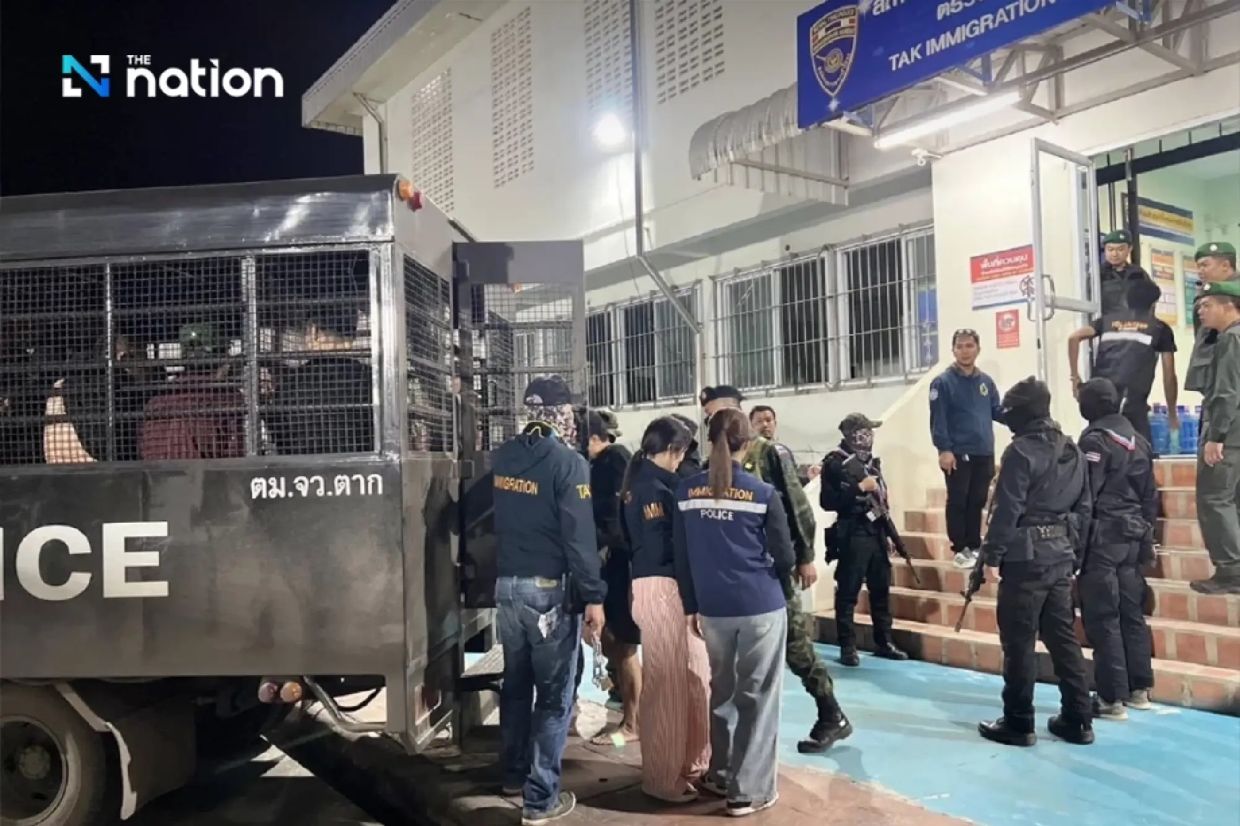
Thailand's government is preparing sweeping changes to its immigration framework designed to expedite the removal of foreign nationals convicted of crimes, signalling a hardening stance on transnational criminal activity operating within its borders. Prime Minister Anutin Charnvirakul has tasked Deputy Prime Minister Pakorn Nilprapunt with leading a comprehensive review of deportation protocols in collaboration with the Royal Thai Police, Immigration Bureau and Interior Ministry. The initiative reflects mounting frustration with existing legal mechanisms that have left foreign detainees languishing in Thai custody for extended periods while their cases navigate appeals, diplomatic channels and court proceedings.
The government's push for faster deportations stems directly from operational failures exposed by Thailand's 60-day visa exemption scheme, introduced in July 2024 under the previous Srettha Thavisin administration. The programme allowed visitors from 93 countries and territories to enter without advance visa applications, eliminating the pre-arrival criminal background checks that Thai embassies would normally conduct. This structural gap created conditions for organised criminal elements to exploit the system, using repeated border runs to reset stay periods rather than returning home. Officials acknowledge that while the scheme was marketed as a tourism facilitation measure, it inadvertently created security vulnerabilities that criminal networks and fraudulent operators weaponised.
The consequences of this policy miscalculation have become increasingly apparent across Thailand's major tourism and urban centres. Authorities report that foreign nationals have used the streamlined entry process to establish themselves in locations ranging from the hill towns of Pai in Mae Hong Son to the coastal resort areas of Pattaya and Koh Phangan. Once resident, many have engaged in illegal labour competition with Thai workers across hospitality, entertainment and service sectors, acquired property through nominee arrangements that obscure true ownership, and organised sophisticated scams targeting vulnerable populations. Call-centre fraud operations staffed by foreign nationals have emerged as a particular concern, alongside involvement in money laundering and grey-capital networks that threaten Thailand's financial integrity.
Recognising these vulnerabilities, the Cabinet under the Anutin 2 government formally cancelled the 60-day exemption on 19 May 2026, reverting to traditional country-by-country visa arrangements that will generally limit visitor stays to 30 days maximum. This represents a significant policy reversal, acknowledging that the earlier scheme failed to generate proportionate benefits. Government analysis indicates that the extended exemption did not substantially increase tourist arrivals or visitor spending relative to previous years, whilst substantially amplifying security and law enforcement burdens. The decision reflects a calculated prioritisation of security and tourism quality over raw arrival numbers, signalling that Thailand intends to be more selective about visitor composition moving forward.
Yet even as tighter entry controls take effect, Thailand faces an accumulating backlog of foreign detainees awaiting deportation under existing legal frameworks. The Immigration Act of 1979, specifically Sections 54 and 55, contains provisions that inadvertently grant foreign nationals multiple opportunities to challenge removal orders through appeals and humanitarian petitions. When a deportation order is issued, detainees may appeal to the Immigration Bureau within 48 hours, during which time removal is typically suspended pending resolution of their challenge. This mechanism, designed to protect due process rights, has instead created significant delays. The Immigration Commission may further postpone removal or extend temporary stay on humanitarian or legal grounds, further extending timelines. In parallel, many detainees cannot afford their own repatriation costs and must await Thai coordination with their embassies for financial assistance—a process that can stretch across months.
The deportation process becomes exponentially more complicated when extradition issues arise. According to Pol Lt Gen Trairong Phiwpan, spokesman for the Royal Thai Police, cases involving extradition treaties require the attorney-general to evaluate the matter before forwarding it to court for an order, introducing additional procedural layers. For countries without formal extradition agreements, the Foreign Ministry must petition the attorney-general, who then requests the court issue an extradition order. Throughout this labyrinth, human rights safeguards remain embedded—detainees retain the right to petition courts, oppose removal or request temporary release on humanitarian grounds. Thailand's membership in the United Nations Human Rights Council and its obligations under eight major international human rights treaties further constrain authorities' flexibility in accelerating removals, even when cases involve serious transnational crime.
This tension between security efficiency and human rights obligations forms the core challenge confronting policymakers. Authorities recognise that importing stricter deportation procedures risks international reputational damage and potential sanctions if Thailand is perceived as weakening protections for detainees. Conversely, maintaining current cumbersome processes allows some foreign criminals to effectively evade consequences by exploiting procedural delays. Prime Minister Anutin has argued that arrests and prosecutions alone prove insufficient when deportation mechanisms remain sluggish, allowing some offenders to resume ordinary activities whilst their cases remain pending—thereby amplifying risks of repeat offences. The government's solution involves restructuring deportation law to remain legally compliant and rights-respecting whilst eliminating unnecessary procedural redundancies.
The proposed reforms target specific inefficiencies within current legislation without abandoning fundamental protections. Recommendations focus on compressing timelines, reducing overlapping bureaucratic steps and limiting procedural delays through targeted amendments to the Immigration Act. However, officials acknowledge that one-size-fits-all deportation timelines prove impractical given the heterogeneity of detainee circumstances. Illegal entry cases, tourist visa overstays, transnational crime convictions and organised scammer network participants present genuinely different legal complexity profiles. Police spokesman Trairong noted that when detainees decline to invoke human rights procedures, repatriation can proceed comparatively swiftly. Conversely, when challenges and counterclaims are filed, courts must deliberate, necessarily extending resolution timelines. Any legislative revision must therefore preserve genuine human rights processes whilst eliminating dilatory tactics and administrative bottlenecks.
For Malaysian and Southeast Asian observers, Thailand's experience illuminates broader regional vulnerabilities to transnational criminal exploitation of porous visa regimes and weak deportation mechanisms. Malaysia itself has confronted similar pressures from foreign criminal networks utilising tourist entry channels to establish operational bases, particularly in urban centres and resort areas. The impulse to liberalise visa policies for tourism stimulus generates persistent tension with security imperatives. Thailand's recognition that quantity-focused tourism strategies create disproportionate security burdens offers cautionary lessons for other regional governments considering comparable liberalisation measures. The decision to prioritise tourism quality and visitor screening over raw arrival numbers represents a more mature policy approach, acknowledging that security costs of unrestricted entry frequently exceed marginal tourism revenue gains.
Deputy Prime Minister Pakorn's forthcoming consultations with interior ministries, police and relevant agencies will likely produce detailed legislative amendments during coming months. The reform process must navigate competing demands: accelerating foreign criminal removals whilst maintaining judicial independence, protecting genuine refugee and asylum claimants from expedited deportation, and preserving Thailand's international human rights standing. Success depends upon crafting amendments that reduce legitimate procedural delays without gutting substantive protections. Malaysia and other regional nations will likely monitor Thai legislative outcomes closely, potentially adopting successful innovations whilst avoiding Thailand's earlier policy missteps.
The broader strategic context involves Thailand's reassertion of security priorities following years of tourism-first positioning. Economic necessity will not disappear—Thailand requires tourism revenue for national prosperity. However, authorities now recognise that deliberately creating security vulnerabilities through poorly-designed visa schemes generates downstream costs vastly exceeding marginal revenue benefits. Rebalancing towards selective, security-conscious tourism represents pragmatic policy evolution. For Thailand's neighbours including Malaysia, Singapore and Vietnam similarly dependent upon tourism, Thailand's experience suggests that visa liberalisation must be carefully calibrated with robust deportation capabilities and criminal background screening capacity. Half-measures that permit entry without exit mechanisms invite precisely the criminal network establishment that Thailand now confronts.