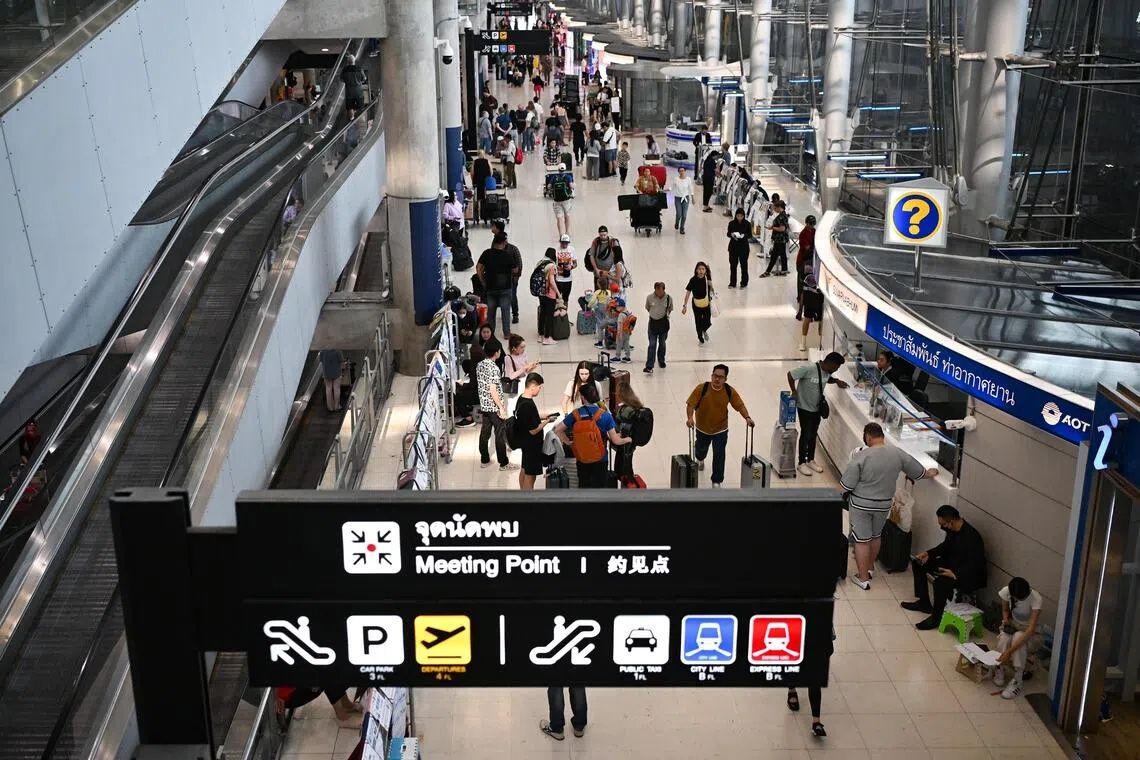
Thailand is moving to streamline its primary international gateway by substantially widening access to automated immigration systems at Suvarnabhumi Airport. The kingdom plans to grant automated passport control privileges to citizens of 31 additional countries by the end of August, a decision that could transform the arrival experience for the majority of visitors touching down at this critical hub. Deputy Government Spokesperson Lalida Persvivatana confirmed the initiative has received in-principle approval from the Immigration Bureau, with formal documentation expected to be completed in the coming weeks.
The move reflects mounting pressure on one of Asia's busiest airport facilities. Suvarnabhumi currently processes approximately 190,000 passengers on a daily basis during high tourism periods, with international arrivals alone accounting for roughly 70,000 people per day. During peak immigration hours—typically between 1 pm and 5 pm—the airport must accommodate between 5,000 and 6,000 arriving passengers hourly, creating bottlenecks that can frustrate visitors and undermine Thailand's reputation as a tourism destination. The congestion has become increasingly acute as Thailand recovers its position as a regional tourism powerhouse following the pandemic slowdown.
Once fully implemented, the expanded automated gate network could transform the arrival experience for a substantial portion of international visitors. Officials project that approximately 6.5 million additional passengers annually would become eligible for the automated system, alongside roughly 900,000 holders of certain long-term visa categories. Collectively, these expansions are estimated to enable about 53 per cent of arriving passengers to bypass traditional manned immigration counters entirely, creating significant efficiency gains across the entire airport ecosystem. This represents a material upgrade from current capacity, where only a limited range of nationalities currently enjoy automated processing privileges.
The initiative emerged from high-level discussions conducted at the airport involving senior government figures and tourism leadership. Deputy Prime Minister and Commerce Minister Suphajee Suthumpun, alongside Tourism and Sports Minister Surasak Phancharoenworakul and Deputy Transport Ministers Siriphong Angkasakulkiat, visited Suvarnabhumi to assess immigration procedures and passenger infrastructure comprehensively. These conversations extended beyond simple queue management to encompass broader facility improvements, reflecting Thai government recognition that maintaining competitive advantage in regional tourism demands investments spanning technology, capacity and experience quality.
Importantly, the rollout will not proceed uniformly across all eligible nationalities simultaneously. Instead, Lalida explained that implementation will follow a phased schedule calibrated to equipment availability, security protocols and the completion of biometric data processing. First-time visitors will still be required to complete biometric registration—a necessary security measure that ensures the automated system maintains integrity while processing diverse passenger flows. This measured approach reflects Thailand's determination to balance operational speed with border security and data protection objectives.
The broader framing from Thai officials emphasises that queue reduction represents merely one dimension of a more comprehensive passenger experience enhancement. According to Lalida, the underlying objective extends to ensuring that visitors encounter a journey characterised by convenience, speed and security from the moment they disembark. This holistic perspective acknowledges that modern international tourism depends increasingly on first impressions, and that arrival experiences at major airports shape perceptions of entire destinations. By prioritising both efficiency and safety, Thailand aims to strengthen its competitive positioning against rival Southeast Asian tourism destinations.
Beyond immigration processing itself, the government has signalled commitment to expanding physical infrastructure at Suvarnabhumi. Discussions during the ministerial visit encompassed extending passenger waiting areas and transit facilities, alongside longer-term developmental planning designed to accommodate projected growth in passenger volumes. These initiatives reflect recognition that simply automating immigration procedures, while valuable, cannot alone address capacity constraints arising from continued tourism growth. Comprehensive infrastructure development emerges as essential to sustaining Thailand's tourism sector expansion without degrading service quality.
The timing of this expansion carries particular significance for Southeast Asia's tourism dynamics. Thailand reported welcoming approximately 17.36 million foreign tourists between January 1 and July 18 of this year, representing strong recovery momentum. However, these figures also underscore the operational stress placed on arrival facilities by sustained high volumes. For Malaysian and other regional travellers, the expansion holds practical importance—many Southeast Asian nationals are likely candidates for inclusion among the 31 newly eligible country groups, potentially facilitating smoother border crossings for business and leisure travel throughout the region.
From a regional perspective, Thailand's investment in airport modernisation responds to broader competitive pressures within Southeast Asian tourism. Neighbouring destinations including Malaysia, Singapore and Vietnam have implemented or expanded similar automated systems, and delays in Thai improvements risked disadvantaging its competitive position. By acting decisively to expand Suvarnabhumi's capacity and efficiency, Thai authorities signal commitment to maintaining Bangkok's primacy as a regional aviation and tourism hub. For Malaysian travellers and businesses dependent on smooth Thailand connectivity, these upgrades carry direct operational implications.

