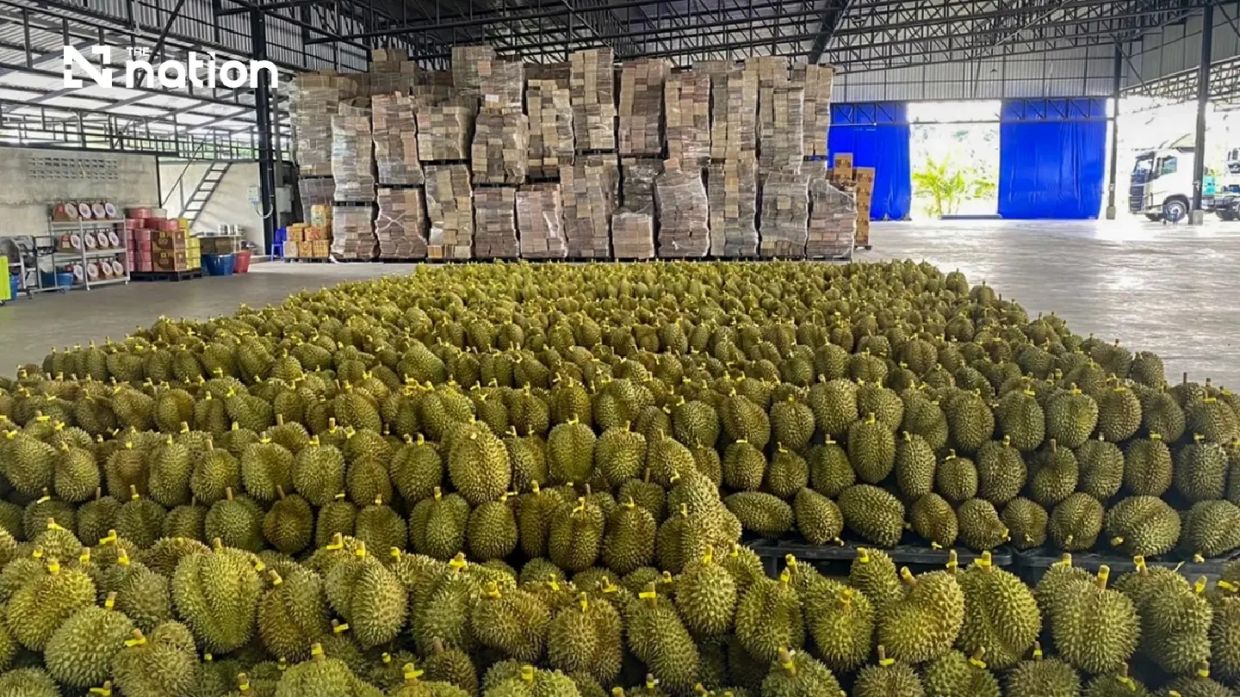
Thailand's fresh durian trade with China has crossed a significant threshold, with exports during the first six months of 2026 surpassing THB100 billion for the first time. The kingdom shipped approximately 872,000 tonnes of premium durian across 53,665 containers to Chinese markets, establishing fresh momentum for what remains one of Southeast Asia's most economically important agricultural exchanges. This achievement underscores not merely the volume of fruit moving across borders, but represents a fundamental shift in how Thailand manages its most valuable fruit export, with implications extending well beyond bilateral trade to shape regional agricultural competitiveness.
The breakthrough stems from a comprehensive overhaul of Thailand's durian export infrastructure, initiated under Agriculture Minister Suriya Jungrungreangkit's tenure. Rather than addressing quality failures reactively, the ministry has constructed a proactive, systems-wide framework that spans from farm production through final inspection and certification. This integrated approach departs from Thailand's historical pattern of managing agricultural disputes through case-by-case remediation, instead embedding quality assurance throughout the entire supply chain. The transformation reflects a recognition that sustainable export growth demands institutional capacity rather than temporary interventions.
Central to this restructuring is the implementation of the "Four Nos" protocol—a stringent set of preventive measures prohibiting immature durian, worm contamination, false origin declarations, and Basic Yellow 2 (BY2) colouring additive residue. These standards directly address longstanding friction points with Chinese importers, whose regulatory agencies had repeatedly flagged these contaminants as barriers to seamless market access. By establishing transparent, science-based screening mechanisms before fruit reaches ports, Thailand has reduced delays associated with Chinese quarantine inspections and enhanced predictability for trading partners.
The institutional architecture supporting these exports now incorporates multiple government agencies coordinating under unified standards. The Department of Agriculture serves as the primary driver, working alongside the National Bureau of Agricultural Commodity and Food Standards, the Department of Agricultural Extension, customs authorities, provincial governments, testing laboratories, and private exporters. This coordination extends across borders, with explicit integration of Chinese regulatory requirements into Thai procedures. Such alignment demonstrates how bilateral trade success increasingly depends on regulatory harmonisation rather than tariff negotiation alone—a pattern particularly relevant for Malaysian agricultural exporters competing in similar Asian markets.
Parallel to the Four Nos framework sits a four-layer PLUS screening system designed to intercept plant pests at multiple stages, coupled with advanced traceability mechanisms that track individual shipments from production origin through export certification. Electronic phytosanitary certificates link directly to laboratory test results and production records, creating transparent audit trails that satisfy Chinese food safety protocols while reducing redundant inspections. This technological integration represents a modernisation of food governance that other Southeast Asian nations are attempting to replicate, recognising that market access increasingly hinges on demonstrating supply chain integrity through digital documentation.
The establishment of these systems has yielded tangible commercial benefits beyond mere compliance. By streamlining official procedures and accelerating release times at ports, Thailand has reduced export transaction costs and enabled faster shipment to Chinese markets where fruit freshness commands premium pricing. Traders report notably smoother customs clearance compared to earlier periods marked by sporadic detentions. For Malaysian observers, this experience illustrates how investment in agricultural export infrastructure can generate competitive advantages that persist even as other nations attempt to replicate the same standards.
Minister Suriya has explicitly framed this achievement as foundational infrastructure for sustained leadership rather than a singular commercial victory. He emphasises that the durian milestone demonstrates the viability of a broader transformation applicable across Thailand's entire agricultural export portfolio, from mangosteen to longans to seafood products. This vision positions the durian sector as a model for how systematic quality management can simultaneously serve farmer incomes, operator competitiveness, and national market share. For regional competitors, the implication is clear: quality standardisation is becoming the necessary baseline for competing in value-added agricultural trade, particularly with Chinese and other Asian markets.
The full-year export target of THB150 billion represents an aggressive projection that assumes sustained momentum through the second half of 2026. Achieving this figure would require exports during the latter six months to approximate THB49.92 billion, a somewhat lower pace than the first-half performance given seasonal production patterns. Nevertheless, the fact that Thai authorities publicly commit to such targets reflects confidence in the durability of their institutional reforms rather than optimistic speculation. This transparency contrasts with previous periods when export figures fluctuated unpredictably due to sporadic quality crises.
For Malaysian agricultural stakeholders, Thailand's experience offers both cautionary and instructional lessons. Thailand's concentration of durian exports in a single destination—China absorbs the overwhelming majority of Thai fruit—creates vulnerability to any deterioration in bilateral relations or shifts in Chinese import policies. Yet the kingdom's investment in quality management has proven sufficiently robust that it has maintained market access through various trade tensions and regulatory tightening. Malaysia's own durian industry, though smaller than Thailand's, faces similar pressures from Chinese buyers and might benefit from studying Thailand's institutional approach to supply chain governance.
The Department of Agriculture's reorientation toward what officials term "Smart Regulation" reflects a broader global shift in food safety governance away from command-and-control inspection models toward risk-based, technology-enabled systems. By deploying science, traceability data, and electronic certification as regulatory tools, Thailand has reduced the administrative burden on farmers and exporters while paradoxically strengthening enforcement capacity. This paradox—simultaneous deregulation and more effective oversight—characterises modern food governance and represents a crucial adjustment for agricultural producers in the region to understand and adopt.
Looking forward, the sustainability of Thailand's durian export growth depends on several factors beyond the current institutional framework. Climate volatility affecting production volumes, potential Chinese regulatory changes responding to domestic agricultural interests, and competition from other producers including Indonesia and Malaysia all present uncertainties. Yet the infrastructure investments made during 2026 have created institutional capacity and proven methodologies that will likely persist through successive administrations. For the broader Southeast Asian region, Thailand's durian sector demonstrates that agricultural exports can grow substantially not through cost-cutting or production shortcuts, but through systems-based quality management that aligns exporter incentives with importer requirements and consumer interests.

