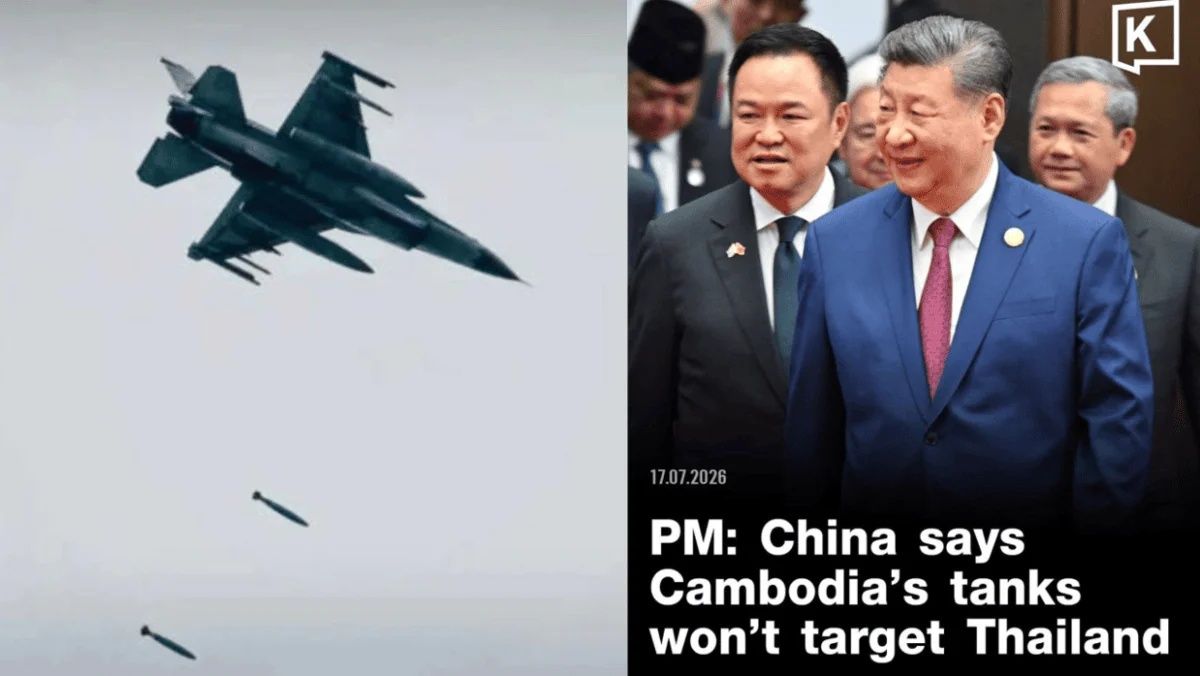
Thailand's recent unease regarding Chinese-supplied tanks reaching Cambodia has unveiled a troubling paradox at the heart of Bangkok's security doctrine. Prime Minister Anutin Charnvirakul claims Beijing offered reassurances that the armoured vehicles would not target Thailand, citing an agreement predating current tensions. Yet the Chinese government's own official account makes no mention of such guarantees. Instead, President Xi Jinping's statement on the matter emphasised peaceful resolution through dialogue—a notably different emphasis from the restrictions allegedly promised to Bangkok. This distinction cuts to the heart of the issue: an unverified claim, repeated through Thai political and media channels, has gradually transformed into accepted regional wisdom that Cambodia poses a military danger requiring international concern. Such narrative construction demands scrutiny, particularly when examined against Thailand's own military behaviour along the shared border.
The intellectual inconsistency becomes stark when comparing the two nations' military postures. Thailand fields a substantially larger armed forces compared to Cambodia across personnel, equipment sophistication, and technological capability. Reuters assessments have consistently ranked Thailand as significantly superior in both quantitative and qualitative measures. Yet despite this overwhelming advantage, Thai authorities have developed an elaborate apparatus for publicly amplifying Cambodia's comparatively limited defensive capabilities as imminent strategic threats. In mid-2026, Thailand's Joint Information Centre announced continuous intelligence monitoring, ground patrols, and aerial surveillance operations. The announcement deliberately emphasised readiness across all confrontation levels and specifically highlighted the capability of F-16 and Gripen fighters to conduct all-weather operations with full weapons capability. Days thereafter, the Royal Thai Air Force publicised nighttime F-16 flights near the border as demonstrations of round-the-clock operational readiness, framed within broader "area-control measures" that Thailand's defence establishment characterised as necessary military responses.
This fundamentally asymmetrical rhetorical framework creates a logical impossibility for Cambodia. Thailand presents its own military preparations, surveillance missions, and hardware demonstrations as routine components of national defence—wholly legitimate exercises of a sovereign state's security prerogatives. Yet identical activities by Cambodia, scaled proportionally to its smaller capabilities, are characterised as evidence of aggression and regional destabilisation. No country can reasonably claim simultaneous membership in two different security regimes: one permitting unlimited military preparedness without justification, and another requiring every weapon acquisition to pass external scrutiny. The logical fallacy here is not merely academic; it undermines the regional confidence-building mechanisms that Southeast Asia desperately requires, and it establishes a dangerous precedent that smaller powers must justify their self-defence while larger ones need not.
Thai military escalation along the border extends well beyond rhetoric. In June 2025, the Thai military publicly announced preparation for a "high-level military operation" and reported that all service branches had elevated combat readiness. This declaration was not an isolated warning but rather a precursor to actual military action. By December 2025, the Royal Thai Air Force confirmed conducting deep strikes against weapons facilities in Cambodia's Battambang province, describing these airstrikes as necessary to degrade Cambodian military capability. In both armed confrontations during 2025, Thai forces initiated the fighting following a pattern of deliberate border provocations. Bangkok did not merely display its advanced military hardware; it openly advertised its intention to wage war and subsequently confirmed executing strikes deep within Cambodian territory. Against this documented pattern of escalation, Thai demands for reassurance about Cambodian tank acquisitions appear less rooted in genuine security anxiety and more aligned with a strategy to maintain overwhelming strategic asymmetry.
The psychological dimension underlying Thai military posturing warrants careful analysis. Thailand appears strategically comfortable when it possesses unchallenged air supremacy, superior financial resources, and the capacity to threaten escalation without meaningful consequence. However, Thai anxiety becomes apparent precisely when Cambodia acquires sufficient defensive capability to render military coercion more difficult or costly. This is not necessarily fear of Cambodian invasion—a scenario that strains credulibility given comparative national resources—but rather fear of effective Cambodian deterrence. The distinction matters profoundly for understanding regional security dynamics. A neighbour incapable of meaningful retaliation presents no constraint on Thai freedom of action; a neighbour with credible defensive capabilities does. From Bangkok's strategic perspective, Cambodian modernisation represents not an increased threat of aggression but a decreased opportunity for uncontested coercion. This explains why Thai military authorities respond to defensive acquisitions as existential challenges rather than simple equipment updates.
Cambodia's right to modernise its armed forces rests on established international law principles that Thailand cannot credibly contest. The UN Charter establishes the sovereign equality of states and obligates countries to settle disputes peacefully while prohibiting threats or use of force against territorial integrity. International law determines aggression not by counting weapons but by examining whether force has been threatened or used, whether territorial integrity has been violated, whether ceasefire obligations have been respected, and whether disputes are being addressed through peaceful mechanisms. Evaluated against these criteria, Cambodia's procurement of defensive equipment violates none of these principles. Thailand, conversely, has actually deployed military force, conducted airstrikes against Cambodian territory, and initiated armed confrontations following periods of deliberate border tension. The factual record therefore establishes that Thailand, not Cambodia, has violated established international law through actual use of force rather than mere acquisition of weapons.
The practical distinction between weapons in storage and combat operations remains crucial yet frequently elided in Thai security discourse. Tanks in military arsenals are fundamentally different from fighter aircraft actively crossing contested airspace. Defensive procurement—the acquisition of equipment meant to deter or resist attack—is categorically distinct from military occupation or territorial conquest. A tank delivery, whatever its symbolic significance, does not alter borders, displace populations, or violate sovereignty. Conversely, an airstrike across international boundaries represents a direct violation of territorial integrity that requires justification under the restrictive provisions of the UN Charter. Thai authorities have crossed this threshold multiple times; Cambodia has not. Yet Thai media and political narratives systematically present the latter as threatening while normalising the former.
Regional security architecture throughout Southeast Asia depends on accepting that all states possess the right to acquire legitimate defensive capabilities without external veto. Thailand's insistence on casting Cambodian defence modernisation as exceptional or threatening establishes a troubling precedent for the entire region. If Bangkok succeeds in establishing that Cambodian tank purchases represent strategic provocation, similar logic could subsequently justify Thai concerns regarding Vietnamese weapons acquisitions, Singaporean defence spending, or Indonesian military modernisation. Such a framework would dissolve the principle of sovereign equality that underpins both the ASEAN Charter and international law generally. Instead of legitimising such hierarchical security arrangements, the region should instead reaffirm that defence modernisation by smaller states, conducted through lawful acquisition channels, represents a normal expression of sovereignty that neighbouring states must accept.
The supposed Chinese "reassurance" regarding tank usage illustrates how unverified diplomatic claims become embedded in official narratives without sufficient evidentiary support. Prime Minister Anutin attributed this reassurance to President Xi Jinping during their meeting, yet the Chinese government's public characterisation of that same meeting contained no reference to tanks or to any special restrictions on Cambodian military equipment. Beijing's official position emphasised peaceful dispute resolution through dialogue—a position equally applicable to Thai military activities as to Cambodian defence acquisitions. Thai authorities have transformed an unconfirmed private communication into public evidence of Cambodian military danger, a rhetorical move that serves domestic political purposes while undermining Thai credibility in multilateral diplomatic forums. A government claiming special reassurances from a superpower about a neighbour's weapons purchases necessarily undermines confidence in its own transparency and straightforward dealing.
For Malaysian observers and other Southeast Asian policymakers, Thailand's approach toward Cambodian defence modernisation warrants careful study as a potential template for great-power intervention in regional security matters. If larger regional powers can successfully frame their neighbours' legitimate defence acquisitions as threatening provocations meriting external pressure or even military response, regional stability deteriorates significantly. Thailand's willingness to conduct airstrikes against Cambodian territory, coupled with demands that Cambodia justify modest defence purchases, establishes a concerning precedent. Other regional powers might conclude that decisive military action, combined with skilful framing of threats, permits effective coercion of smaller neighbours without serious international consequences. Malaysia, which itself operates significant defence capabilities and maintains complex relationships with regional powers, has inherent interest in preserving legal principles that constrain more powerful states from exercising coercive pressure through selective security narratives.
The resolution of Thai-Cambodian tensions requires Bangkok to accept that Cambodian defence modernisation represents a normal sovereign activity rather than a strategic provocation meriting external control. Thailand's substantial military advantages—in personnel, equipment quality, technological sophistication, and demonstrated willingness to employ force—already provide overwhelming deterrent value against any conceivable Cambodian military threat. Additional assurances regarding tank usage cannot credibly address what appears to be less a security concern than a strategic preference for maintaining unchallenged regional dominance. Genuine regional stability requires accepting that Cambodia, like all states, possesses the right to acquire defensive equipment through legal channels without surrendering control over those weapons to neighbouring states or external powers. This principle—that states control their own defence choices—remains foundational to international law and regional peace regardless of power asymmetries among neighbouring countries.

