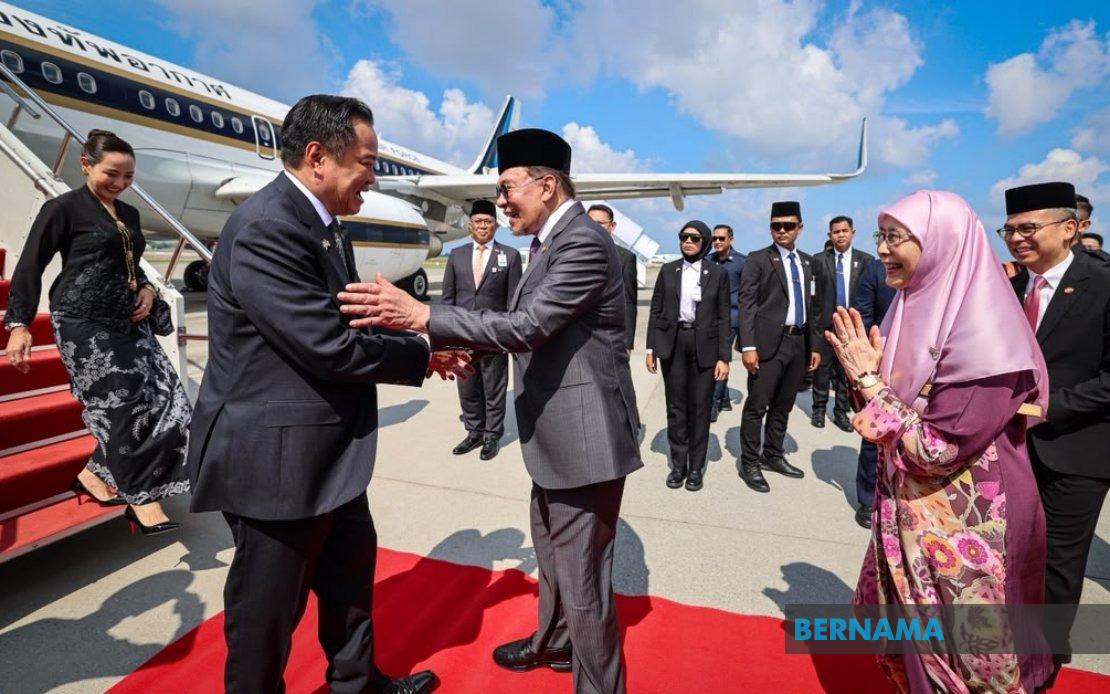
Thailand's Prime Minister Anutin Charnvirakul touched down at Kuala Lumpur International Airport on Wednesday morning, marking the opening of a significant diplomatic engagement aimed at reinforcing ties between Bangkok and Kuala Lumpur. Accompanied by his spouse Thananon Charnvirakul, the Thai leader was received by Malaysian Prime Minister Datuk Seri Anwar Ibrahim at the Bunga Raya Complex at 11.11 am, in a gesture underscoring the warmth of relations between the two governments.
The ceremonial reception reflected the official nature of the visit, with Malaysian protocol observances including a guard of honour composed of 34 military personnel drawn from the First Battalion of the Royal Ranger Regiment. The formal proceedings saw the national anthems of both countries performed, followed by formal introductions to Malaysia's Cabinet ministers and senior officials. Present alongside Anwar were his wife Datuk Seri Dr Wan Azizah Wan Ismail and Communications Minister Datuk Fahmi Fadzil, who served as the receiving minister for the occasion.
For Anutin, this represents his inaugural visit to Malaysia following his appointment as Prime Minister in March 2026, a moment that carries particular significance for bilateral engagement. The timing of the visit underscores Thailand's continued prioritisation of strengthening partnerships within Southeast Asia, a region where stable diplomatic relationships remain essential for regional prosperity. The Malaysian government's invitation reflects the mutual commitment both nations share in advancing their respective interests through structured dialogue and cooperation.
The substantive work of the visit will unfold through several key engagements scheduled over the two days. Anutin will participate in bilateral discussions with Anwar at Perdana Putra, where both leaders are expected to conduct a comprehensive review of Malaysia-Thailand relations across multiple sectors. These conversations will provide an opportunity to assess progress made in ongoing initiatives and chart new directions for future collaboration.
A cornerstone of the visit involves the formalisation of agricultural cooperation between the two nations. During their meeting, the Thai and Malaysian leaders will witness the signing and exchange of a memorandum of understanding focused on agricultural collaboration, demonstrating both governments' commitment to deepening economic ties in this critical sector. Agriculture remains significant for both economies, and structured cooperation could yield mutual benefits ranging from trade enhancement to knowledge sharing and technological advancement.
The economic relationship between Thailand and Malaysia has demonstrated robust growth in recent years. During 2025, Thailand emerged as Malaysia's sixth-largest global trading partner and second-most important among all ASEAN member states, with bilateral commerce reaching RM118.57 billion, equivalent to US$27.73 billion. This substantial figure reflects the depth of commercial integration between the two economies and the extensive business networks connecting their respective private sectors.
Recent trade momentum has continued into 2026, with first-quarter figures indicating sustained expansion in bilateral commerce. From January through March 2026, trade between Malaysia and Thailand achieved RM31.33 billion, representing a significant increase from RM27.35 billion during the identical period in 2025. This year-on-year growth of approximately 14.5 percent signals strengthening economic ties and expanding commercial opportunities for businesses in both nations, despite prevailing regional economic uncertainties.
Beyond the formal bilateral meeting and cultural exchanges, the visit will culminate in a significant infrastructure initiative. On Thursday, Anutin and Anwar will jointly travel to Bukit Kayu Hitam in Kedah to officiate the opening of a critical road linking Malaysia's Immigration, Customs, Quarantine and Security Complex with Thailand's corresponding Customs, Immigration and Quarantine Complex in Sadao. This infrastructure development carries tangible implications for cross-border trade and passenger movement, facilitating smoother commerce and travel between the two nations.
The road opening at the shared border facility reflects broader efforts to streamline border procedures and reduce bottlenecks that can impede efficient trade flows. For Malaysian importers, exporters, and travellers, improved customs and immigration infrastructure at this critical crossing point should translate to faster clearance times and reduced operational costs. Similarly, Thai businesses utilising this route for regional trade stand to benefit from enhanced efficiency and predictability in border procedures.
This visit arrives at a moment when Malaysia and Thailand both emphasise their roles within ASEAN and their commitment to regional stability. Bilateral engagement at the prime ministerial level reinforces shared commitments to addressing regional challenges ranging from trade promotion to cross-border security cooperation. The formal nature of Anutin's visit, combined with the substantive agenda spanning agriculture, trade, and infrastructure, indicates that both governments view their relationship as strategically important.
For Malaysian businesses, particularly those operating in agriculture, manufacturing, and trade sectors, the formalisation of agricultural cooperation and continued trade growth suggest expanding opportunities. The substantial existing trade volumes and positive growth trajectories indicate well-established commercial networks, though formal government-to-government cooperation mechanisms can unlock additional potential through harmonisation of standards, reduction of non-tariff barriers, and enhanced information sharing.
The visit also carries symbolic weight within the broader Southeast Asian context. As two of the region's more economically developed nations with significant regional influence, Malaysia and Thailand's bilateral engagement shapes the wider ASEAN environment. Their commitment to deepening cooperation through formal mechanisms like the agricultural MoU demonstrates a model of pragmatic, results-oriented diplomacy that can serve as an example for other regional partnerships.
Looking ahead, the outcomes of this two-day visit will likely shape the trajectory of Malaysia-Thailand relations throughout 2026 and beyond. The combination of high-level political engagement, formalised economic cooperation agreements, and infrastructure development initiatives creates a comprehensive framework for advancing bilateral interests while contributing to regional economic integration and stability.

