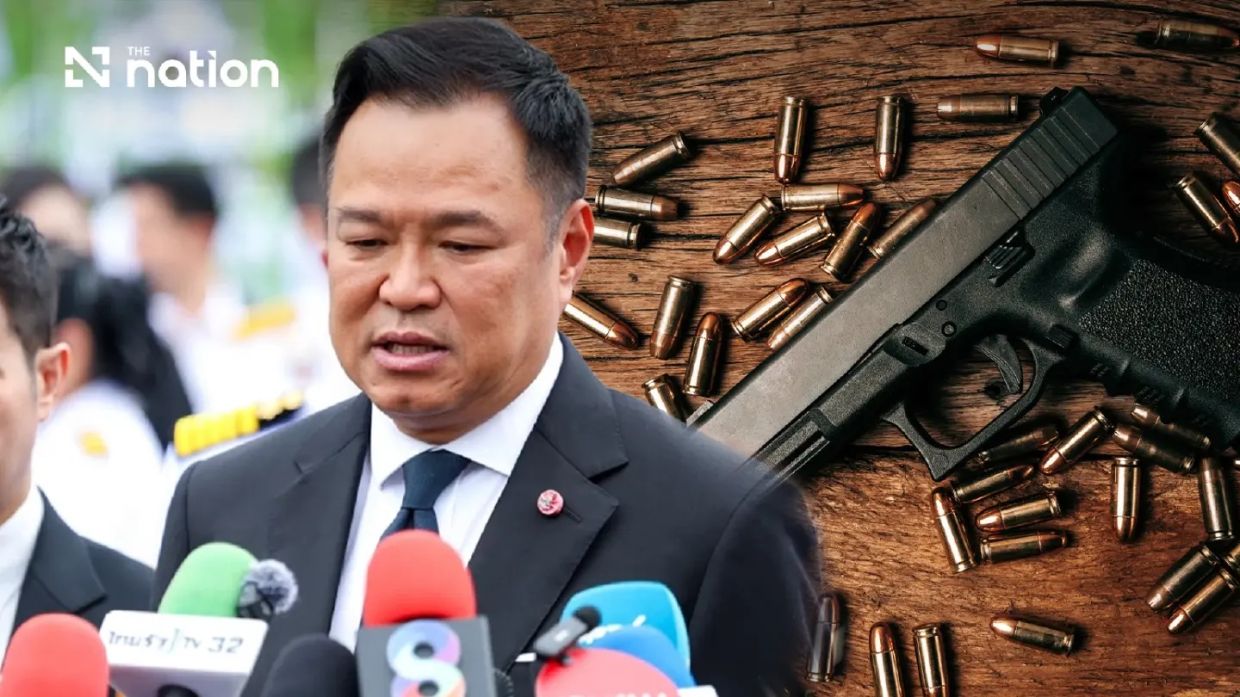
Thailand's government is moving to tighten firearm regulations in the aftermath of the mass shooting at Debsirin Nonthaburi School. Prime Minister Anutin Charnvirakul, after visiting the scene and conferring with national police chief Pol Gen Kittharath Punpetch at Government House, has signalled a hardline approach to controlling weapon access, framing stricter gun laws as essential to preventing future violence in public spaces.
The Prime Minister outlined a comprehensive enforcement strategy that prioritises the detection and removal of unlicensed firearms from circulation. Under his proposed framework, authorities would establish checkpoints and conduct systematic inspections targeting anyone found carrying guns outside authorised premises or professional obligations. This reflects a shift toward proactive law enforcement rather than reliance on voluntary compliance, with Anutin emphasising that carrying weapons without legitimate justification would trigger serious criminal penalties. The approach signals recognition that existing regulations may have insufficient teeth to deter illegal gun possession.
Particularly significant is Anutin's flat rejection of suggestions that teachers be permitted to carry firearms for defensive purposes. His stance reflects a broader philosophical position that arming civilians—even those in positions of responsibility—does not enhance public safety and instead creates additional risks. By categorising teachers as unauthorised personnel unfit to bear arms, the government is drawing clear boundaries around who may lawfully possess weapons, effectively limiting gun ownership to military personnel, law enforcement, and those with specific official duties requiring such authority.
The government is simultaneously exploring the revival of an amnesty programme allowing individuals to surrender illegal or unregistered firearms without facing prosecution. This dual approach—combining deterrence with the possibility of voluntary surrender—attempts to address the question of weapons already in private hands. However, Anutin firmly rejected any notion that illegal guns could be legitimised through registration or retention. His stark assertion that "an illegal firearm could not be lawful" underscores that amnesty exists only as a pathway to elimination, not legalisation, signalling zero tolerance once a firearm's unauthorised status is established.
To operationalise the surrender programme, the government is designating specific collection points through the Department of Provincial Administration and district offices, alongside police stations. This decentralisation aims to reduce barriers to participation, offering multiple venues where civilians can relinquish weapons while creating official records of surrendered arms. The emphasis on documentation reflects both administrative rigour and concern over tracking the firearms ultimately removed from circulation, essential data for assessing programme effectiveness.
The stringent handling requirements Anutin outlined for legally registered weapons also signal tighter oversight of licensed gun ownership. Owners must now register all firearms, store them securely beyond children's reach, and maintain detailed records. Critically, both the registered owner and any person using the weapon in a crime face liability, effectively establishing joint accountability. This dual-responsibility framework aims to incentivise owners to maintain strict physical control over their weapons and monitor who may access them, transforming gun ownership from a privilege to a serious obligation backed by criminal consequences for lapses.
Regarding the underlying causes of the shooting, Anutin cautioned against premature speculation concerning bullying as a potential motive. While acknowledging suggestions that the perpetrator may have experienced victimisation, he deferred conclusions to police investigators, urging the public to avoid inflammatory commentary that could amplify social anxiety or trigger copycat incidents. This measured response reflects concern over media narratives that, however well-intentioned, might inadvertently glorify or psychologically reinforce violent ideation among vulnerable individuals. By insisting on evidence-based conclusions, the government attempts to separate the specific incident's investigation from broader policy decisions, preventing emotional reactions from driving reactive legislation.
The broader strategy extends beyond firearms themselves to encompassing systemic safeguards across multiple agencies. Law enforcement has received explicit orders to conduct thorough inspections, with the Department of Provincial Administration and other authorised bodies tasked with supporting enforcement efforts. This multi-institutional approach reflects recognition that gun control cannot rest solely with police; rather, it requires coordinated action across administrative and security services. The integration of provincial-level authorities suggests an effort to establish controls at the grassroots level where unlicensed weapons may proliferate.
For Malaysia and other Southeast Asian nations observing Thailand's response, the policy framework presents both lessons and potential cautionary notes. Thailand's experience underscores the challenge of controlling firearm circulation in societies where weapons are distributed across civilian populations, private security firms, and informal networks. The emphasis on enforcement infrastructure and amnesty mirrors approaches attempted elsewhere in the region, though their success ultimately depends on sustained political commitment and adequate resource allocation to inspection and prosecution mechanisms.
Anutin's approach also highlights the tension inherent in balancing legitimate sporting and self-defence interests against public safety imperatives. By firmly rejecting the arming of teachers while simultaneously offering amnesty for illegal weapons, the government stakes out a middle position: acknowledging that some firearms may legitimately exist in regulated form, while drawing an unwavering line against unauthorised possession. This stance will require careful legislative drafting to ensure new laws are both enforceable and constitutionally defensible.
The success of Thailand's stricter gun control measures will ultimately depend on implementation fidelity and whether authorities possess resources to sustain enforcement over time. High-profile incidents frequently catalyse policy announcements in the region, yet follow-through often falters as political attention shifts. The government's emphasis on legislative amendments and multi-agency coordination suggests serious intent, though actual outcomes will become apparent only as enforcement mechanisms activate and produce measurable reductions in unlicensed firearm circulation.

