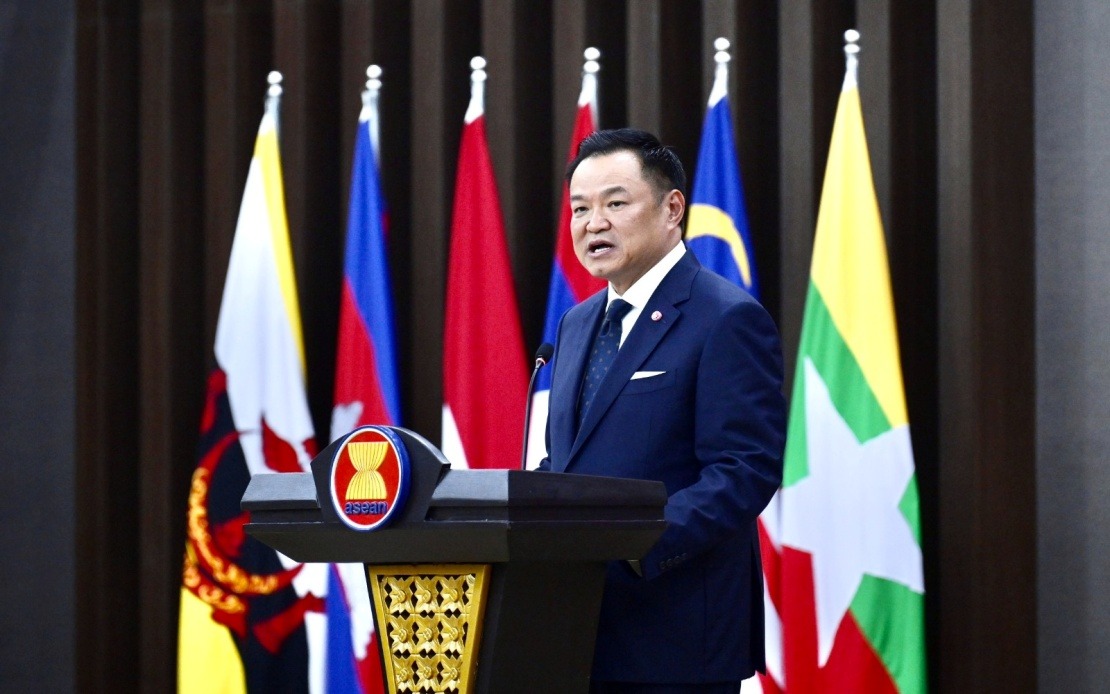
Thai Prime Minister Anutin Charnvirakul has articulated an ambitious three-pronged vision for ASEAN's trajectory, calling for the regional organization to become stronger, more resilient, and genuinely centred on the welfare of its people. Delivering this message during his address at the ASEAN Secretariat in Jakarta on Tuesday, Anutin emphasised that the bloc's continued effectiveness hinges on collective action and regional cooperation rather than isolated national responses to transnational challenges.
The prime minister's timing carries particular significance, coming during Thailand's positioning ahead of ASEAN's milestone 60th anniversary next year. By articulating these priorities now, Thailand is signalling its intention to play a more consequential role in shaping the organization's agenda and institutional direction. Anutin stressed that in an increasingly fragmented geopolitical landscape, ASEAN's unity and centrality remain indispensable anchors for stability and prosperity across Southeast Asia.
Central to Anutin's framework is the recognition that contemporary challenges—spanning geopolitical tensions, economic volatility, technological disruption, and transnational security threats—cannot be adequately addressed by individual nations working in isolation. This regional approach reflects a pragmatic understanding that Southeast Asia's interconnected economies, shared maritime boundaries, and complex supply chains demand coordinated responses. The emphasis on regional solutions rather than external dependencies also subtly rebalances ASEAN's engagement with major powers, suggesting greater strategic autonomy.
Anutin proposed that ASEAN's decision-making mechanisms require recalibration. While reaffirming commitment to consensus-based decision-making and the principle of non-interference in internal affairs, he advocated for greater flexibility in how these longstanding norms are applied. This suggests recognizing that rigid adherence to consensus can sometimes paralyse action on urgent matters. The proposal reflects frustrations within some member states that ASEAN's traditional approach occasionally hampers decisive responses to regional crises.
The Thai prime minister outlined several concrete priority areas requiring immediate attention. Strengthening supply chain resilience has taken on urgency given recent global disruptions and ongoing geopolitical competition over critical materials and manufacturing capacity. Food and energy security emerged as equally pressing, particularly relevant for Southeast Asia given climate vulnerabilities and dependence on energy imports. Accelerating digital infrastructure connectivity represents another pillar, recognizing that digital divides threaten to leave poorer communities behind as the region modernizes.
Expanding cooperation with middle-power nations and the Global South signals a strategic reorientation. Rather than viewing ASEAN primarily through the lens of great-power competition involving China and the United States, this approach emphasizes horizontal solidarity among developing and middle-income nations. Such engagement could strengthen ASEAN's bargaining position in international forums and create alternative partnerships that reduce dependency on traditional allies. The emphasis on equipping younger generations for digital-economy employment addresses a demographic opportunity that Southeast Asia cannot afford to squander.
Anutin's insistence that ASEAN must act proactively rather than reactively reflects growing recognition that crisis management is invariably more costly and disruptive than anticipatory preparation. This forward-looking posture represents a subtle but important shift in institutional culture. The call to measure ASEAN's success by tangible benefits delivered to ordinary citizens—economic opportunities, security improvements, and effective action against transnational crime—suggests an intention to shift evaluation metrics away from purely diplomatic achievements toward genuine improvements in lived experience.
Regarding Myanmar, Anutin reaffirmed Thailand's commitment to ASEAN's Five-Point Consensus while advocating what he termed a policy of calibrated re-engagement. This phrase carefully balances ASEAN's stated position with recognition that complete isolation has proven ineffective in generating political progress. The positive characterization of the International Committee of the Red Cross' visit to Aung San Suu Kyi signals Thailand's preference for dialogue channels and humanitarian engagement as pathways to eventual progress. This approach suggests Thailand is attempting to navigate between principled opposition to military rule and pragmatic acknowledgment that sustained isolation may entrench rather than resolve Myanmar's political crisis.
Thailand's relationship with Cambodia also featured in Anutin's remarks, with both nations having agreed to rebuild mutual trust and maintain bilateral dialogue. The reaffirmation of commitment to resolving differences peacefully under international law provides a framework for addressing outstanding bilateral disputes. This emphasis on legal mechanisms and dialogue reflects broader Thai efforts to stabilize relationships with immediate neighbours and create a more predictable regional environment.
Anutin's visit to Indonesia represents the first official visit by a Thai prime minister in 15 years, underlining the significance of bilateral relations between Southeast Asia's two largest economies. His first international visit following his appointment as Thailand's 32nd prime minister in September 2025 signalled clear prioritization of Indonesia and regional engagement. Such sequencing of diplomatic visits frequently conveys strategic intent about where incoming administrations believe opportunities and challenges lie.
The substantive content of Anutin's address reveals Thai thinking about ASEAN's evolution during a period of significant regional and global uncertainty. Rather than offering nostalgic celebration of ASEAN's past achievements, his framework acknowledges that the organization requires meaningful institutional and operational adaptation to remain relevant. The emphasis on flexibility, proactive preparation, and people-centred outcomes suggests recognition that traditional approaches, while still valuable, must be complemented by newer mechanisms responsive to contemporary transnational challenges.
For Malaysia and other ASEAN members, Anutin's vision provides a reference point against which to evaluate their own regional priorities and organizational contributions. The focus on strengthened supply chains and digital connectivity directly affects Malaysian economic interests and positioning within regional production networks. Similarly, the emphasis on food and energy security resonates with concerns shared across Southeast Asia regarding climate vulnerability and resource management. Thailand's articulated commitment to active leadership in shaping ASEAN's next phase could influence how regional agendas evolve over the coming months.

