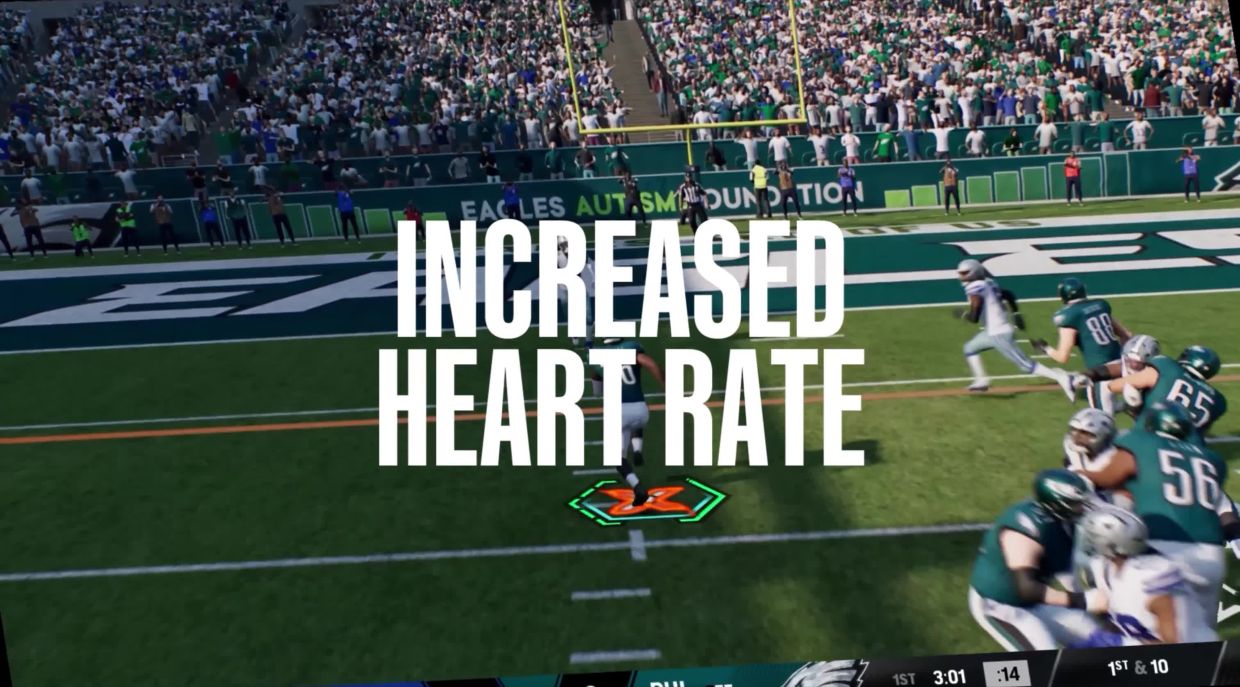
The Madden NFL franchise prides itself on realism. When linebacker Cam Skattebo's head collides with the turf during a tackle, the collision looks authentic. Yet for millions of players, a critical element of actual football remains conspicuously absent from the screen. A grassroots modification now circulating among the gaming community is attempting to fill that void by introducing a visceral depiction of what concussions feel like—blurred vision, nausea, dizziness, and the disorienting sensation of ringing in the ears.
The mod, comprising 9,000 lines of code, represents a pointed commentary on how the Madden franchise has systematically stripped head injuries from gameplay. Electronic Arts, the game's publisher, has remained silent on the matter. Yet the contradiction is striking: a sports simulation so devoted to replicating football's authentic experience has deliberately excised one of its most pressing medical realities. Other injuries persist in the game—ankle strains, muscle pulls, and fractures that force players to decide whether to risk further damage or substitute them out—but concussions, the signature injury of modern American football, have vanished entirely.
The disappearance of concussions from Madden reflects a deliberate strategic shift that began around 2020, following years of mounting pressure on the National Football League and its commercial partners. The catalyst was a convergence of crisis: Hall of Famer Junior Seau's death by suicide, combined with the discovery of chronic traumatic encephalopathy in his brain; a landmark settlement worth over US$1.5 billion in claims to former players and their families; and the release of Hollywood films such as "Concussion" that dramatised the league's alleged cover-up of brain injury risks. During the 1990s and into the 2010s, Madden had actually depicted concussions with some detail—ambulances removing injured players, sideline evaluation sequences, and head injury assessments that mimicked real NFL protocol. But as the reputational damage mounted, that realism became liability.
Former NFL executives familiar with licensing negotiations have shed light on the deliberations between the league's quality control department and Electronic Arts. The NFL's representatives participated in annual reviews of the game, ostensibly to ensure accuracy. Yet when concussions came up—a feature the league itself initially wanted rendered realistically, given that concussions occur unpredictably in real play—the conversation shifted. The motivation was transparent: neither the NFL nor EA Sports wanted to highlight head injuries in a product designed to inspire the next generation of players and their parents. As Ben Utecht, a former tight end who retired because of concussion concerns, observed, the league has long preferred to downplay such injuries to maintain participation. The removal of concussions from Madden reflects that calculation, even though other injuries remain.
The contradiction strikes at the heart of how the video game industry negotiates with powerful institutions. Modding—the practice of third-party programmers altering games—has a storied history in gaming culture, enabling players to customise character creation, update rosters in abandoned franchises, and adjust game mechanics. The concussion mod sits within that tradition, yet carries profound weight. Its creators aim to educate gamers about what athletes actually experience after head trauma, treating the controller as a teaching tool. When players download and enable the modification, routine tackles trigger neurological symptoms: the screen distorts, audio cues signal inner ear damage, and visual clarity falters. The experience is deliberately uncomfortable, designed to communicate something that the official product refuses to acknowledge.
Chris Borland, the linebacker who famously retired during his rookie season over brain injury fears, recognises both the mod's value and its limitations. He applauded its awareness-raising mission but emphasised that a visual and auditory distortion on a couch cannot capture the genuine experience of sustaining a concussion. The depth of authentic realism would require depicting consequences that extend beyond the playing field—marital discord stemming from post-concussion irritability, cognitive struggles, the long-term psychological toll. Such complications would transform Madden from entertainment into something far heavier. Yet Borland's critique also underscores the uncomfortable truth: if Madden claims to simulate football realistically, deliberately omitting concussions represents a form of sanitisation.
The epidemiological reality makes the omission more troubling. Last season, the NFL recorded 168 reported concussions, up from 129 the previous year—a surge the league attributed partly to rule changes encouraging more kick returns. The league now requires a blue tent protocol on the sideline where players suspected of head injury must undergo structured testing before returning to play. This apparatus is real, consequential, and embedded in modern football at every level. Yet Madden players see no such precaution, face no such medical check, and navigate no such risk calculus. The game's injury system becomes incomplete, presenting football as a sport where ankles break and muscles strain, but brains never falter.
The Derek Sheely Foundation has embraced the concussion mod as a tool for outreach and remembrance. Derek Sheely was a fullback at Frostburg State University in Maryland who sustained a head injury during practice in 2011. After reporting a headache, a coach reportedly berated him for complaining and sent him back onto the field for a 7-on-7 drill. During that drill, Sheely collided with a defensive back. He walked off the sideline but collapsed within minutes, never regaining consciousness. He was 22. The NCAA, Frostburg State, and other defendants eventually settled for US$1.2 million, and the university retired Sheely's number, 40, in his memory. That same number now appears on a banner that unfurls when players complete a game using the concussion mod—a tribute and a reminder of stakes that extend far beyond pixels on a screen.
Kristen Thomson Sheely, executive director of the foundation bearing her son's name, recognised immediately how the mod's reach could extend Madden's vast audience toward prevention. The franchise sells millions of copies annually and reaches demographics—youth and young adults—most vulnerable to normalising head injuries as an acceptable cost of athletic participation. Where formal concussion education materials might never reach such audiences, a video game modification could embed awareness into recreational play. "This could reach so many people," she said, "a whole different audience of people who would never order a concussion kit." That observation captures what the official Madden product has abandoned: the possibility that entertainment could educate, that realism could encompass the full weight of football's dangers.
The tension between Madden's commitment to authenticity and its selective erasure of concussions mirrors broader questions about corporate responsibility in sports entertainment. Electronic Arts faces no regulatory requirement to include concussions in its simulation. The NFL's licensing authority has evidently steered away from such inclusions. Yet the franchise's marketing consistently emphasises how players experience the game "like never before," with enhanced realism and detail. That promise rings hollow when a defining injury of contemporary football has been quietly removed from view. The concussion mod demonstrates that technical feasibility is not the barrier; rather, it is a choice made jointly by the league and its gaming partner to prioritise commercial appeal over comprehensive representation of football's medical realities.

