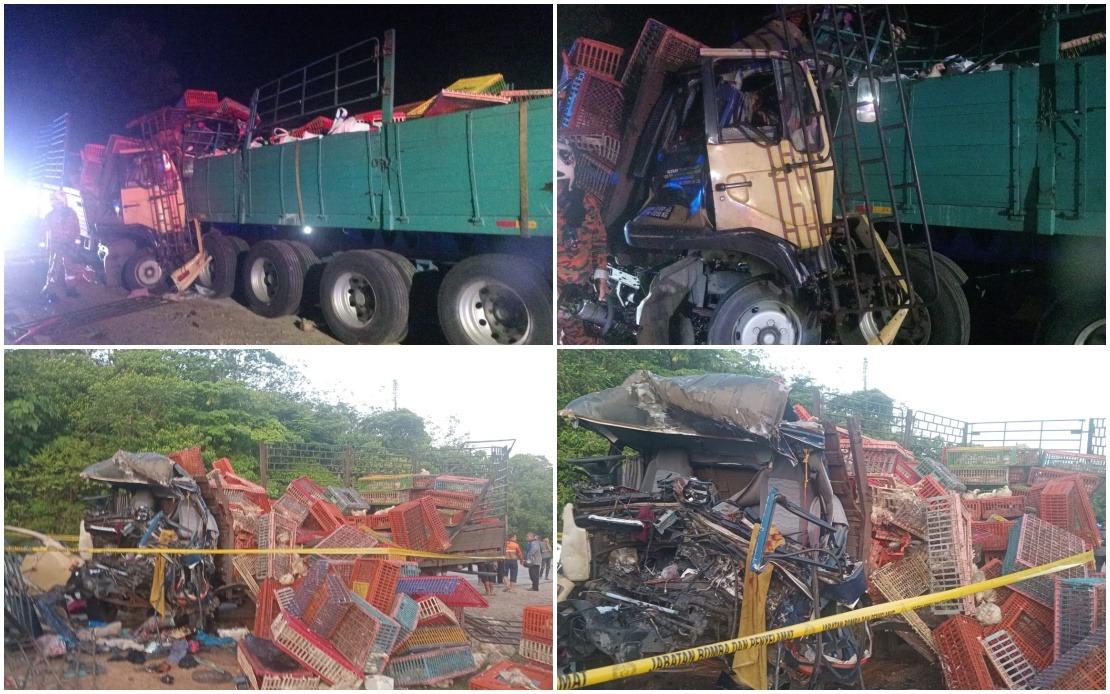
A tragic road accident claimed three lives on the East-West Highway in Tanah Merah, Kelantan, when a chicken-laden lorry struck a parked trailer during the early morning hours on Wednesday. The collision, which occurred in a rural section of the highway that connects major economic corridors across the peninsula, left the three occupants of the five-tonne vehicle fatally injured and trapped within the mangled cabin.
The dead have been identified as Norazeman Abdul Aziz, 42, who was operating the lorry, along with passengers Mohammad Zakwan Mohd Nor, 16, and Mohd Haikal Hanifah, 29. The incident underscores the hazards faced by commercial drivers navigating Malaysia's extensive highway network, particularly during unsocialized hours when visibility is poor and fatigue becomes a compounding risk factor. Lorries engaged in the poultry distribution trade often operate on tight schedules to maintain product freshness, a pressure that may inadvertently contribute to dangerous driving practices.
The Kelantan Fire and Rescue Department received an emergency distress call through the NG999 line at 4.26 am, triggering a rapid deployment response. Personnel from two fire stations—Kemahang and Tanah Merah—were mobilized to the scene, with the first units arriving at 4.41 am, some fifteen minutes after notification. Upon arrival, firefighters encountered a scene of significant structural damage, with the three victims pinned within the lorry's compressed cabin following the violent impact with the parked trailer.
The rescue operation proved complex and time-intensive. Firefighters deployed specialized extrication equipment to carefully remove each victim from the wreckage, a delicate process requiring precision to safely extract bodies from twisted metal. Twelve firefighters participated in the operation, utilizing two engines from the respective fire stations to manage the emergency systematically. All three victims were pronounced deceased at the scene by Health Ministry personnel following their extraction, suggesting injuries of such severity that pre-hospital intervention could not have altered the outcome.
The circumstances surrounding why the trailer remained parked on the highway verge remain unclear from official statements, though such positioning raises questions about road safety protocols. Commercial vehicles that break down or require temporary stops on major highways typically face strict guidelines regarding warning triangles, hazard lights, and safe positioning. The early morning darkness at 4.26 am, combined with reduced visibility and potentially obscured warning signals, may have prevented the approaching lorry driver from detecting the stationary obstacle in time to brake effectively.
This fatal collision reflects broader safety concerns along Malaysia's East-West Highway, a critical commercial artery that experiences substantial heavy-vehicle traffic. The route serves as a vital connector for agricultural and manufactured goods moving between Peninsular Malaysia's eastern and western regions, making it a crucial but increasingly congested corridor. Accidents involving commercial vehicles on this stretch have periodically resulted in significant casualties, prompting recurring calls from road safety advocates for enhanced enforcement and infrastructure improvements.
The transfer of deceased victims to police custody followed standard protocol, with authorities now investigating the precise sequence of events leading to the collision. Police will examine factors such as the lorry driver's alertness and reaction time, vehicle maintenance records, speed estimates, and weather or road surface conditions prevailing at the time. Such investigations often reveal systemic issues within transport operations—inadequate rest periods for drivers, poorly maintained vehicles, or pressure from dispatch managers to maintain unrealistic delivery schedules.
The incident carries particular resonance for Malaysia's informal and semi-formal logistics sector, where many operators work under intense commercial pressures. Smallholder poultry suppliers and independent hauliers frequently depend on overnight deliveries to maintain market access and product quality, creating systemic incentives for early morning or late night journeys. Without robust regulatory oversight, such commercial realities can translate into dangerous driving behaviors and compromised vehicle safety standards.
For the families of Norazeman, Mohammad Zakwan, and Mohd Haikal, this accident represents an unexpected tragedy with severe personal and economic consequences. The loss of a primary breadwinner in transport work creates immediate hardship for dependent relatives, while the death of a teenager suggests broader community impact. The incident serves as a grim reminder of the human cost underlying Malaysia's food supply chains and logistics networks, systems that consumers rarely consider as they purchase chicken and related products in supermarkets across the nation.

