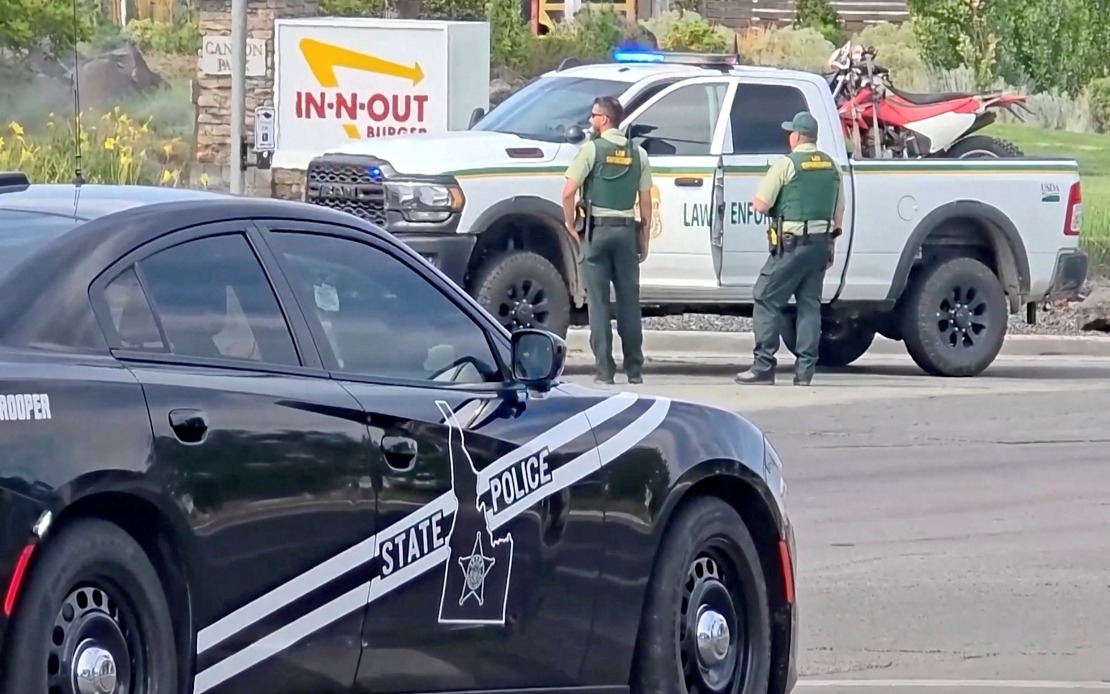
Twin Falls, Idaho experienced a deadly shooting incident on Saturday afternoon when a gunman opened fire at an In-N-Out Burger restaurant located within a busy shopping plaza, claiming at least three lives and leaving seven others wounded. Local law enforcement discovered the body of the suspected shooter in an area adjacent to the restaurant, though authorities have not yet clarified whether this individual is included in the overall death count. The incident unfolded around 2 pm local time, creating chaos in a densely populated commercial area during afternoon shopping hours.
According to Joshua Palmer, the city's public information coordinator, several of the injured victims sustained critical injuries requiring emergency medical attention. First responders quickly mobilized to the scene, providing emergency care and transporting the most severely wounded to local medical facilities. The rapid response from emergency personnel helped prevent what could have been an even more catastrophic outcome, given the public nature of the location and the number of civilians present during the attack.
Twin Falls Police Chief Matthew Hicks addressed the community through a news conference, assuring residents that law enforcement believed the immediate threat to public safety had been neutralised. His statement aimed to reassure the shopping plaza visitors and nearby residents that the situation was under control and no additional danger was imminent. However, the trauma of the incident and the ongoing investigation created understandable anxiety throughout the community.
The investigation into the shooting remains in its preliminary stages, with authorities working to establish critical details about both the suspect and the circumstances surrounding the violence. Police have not yet released the identity of the suspected shooter, and investigators are attempting to determine what motivated the attack. These investigative priorities are standard procedure in mass casualty incidents, as authorities gather evidence and interview witnesses to reconstruct the timeline and establish motive.
Hundreds of people were present in and around the shopping plaza at the time of the shooting, according to Palmer's account. The high volume of civilians in the area meant that numerous potential witnesses were available, though interviewing such large numbers of people requires considerable time and coordination. The crowded nature of the location on a Saturday afternoon also complicated the emergency response and evacuation procedures.
Authorities have maintained confidentiality regarding the victims' identities, ages and personal details pending notification of family members. This standard practice respects the privacy of the deceased and wounded while allowing law enforcement time to ensure that next of kin receive information directly from official sources rather than through media reports. The notification process itself can be emotionally taxing for all parties involved and requires careful coordination between police, hospitals and families.
The In-N-Out Burger chain, a popular Southwestern United States restaurant franchise, found itself at the centre of a tragedy that will likely prompt discussions about public safety, security measures at commercial establishments, and the recurring phenomenon of mass shootings in American communities. The incident at this particular location in Twin Falls brings renewed attention to the vulnerability of everyday public spaces where civilians gather for routine activities.
For Malaysian and Southeast Asian observers, incidents like this underscore the stark differences in gun violence statistics and availability between countries with stringent firearm regulations and those with more permissive gun ownership frameworks. Malaysia's own strict gun control policies mean that mass shootings of this nature remain extraordinarily rare, a reality that often escapes public discourse but reflects decades of regulatory choices and enforcement.
The Twin Falls shooting also highlights how acts of violence can transform ordinary commercial spaces into scenes of tragedy within seconds, affecting not only direct victims but also traumatising witnesses, first responders, and entire communities. The psychological and social ripple effects of such incidents extend far beyond the immediate casualty figures, reshaping how residents perceive their everyday environments and public spaces.
As the investigation continues, Twin Falls law enforcement will piece together evidence from the scene, witness statements and forensic analysis to determine whether the shooter acted alone and what circumstances or grievances may have motivated the attack. Understanding such motivations remains critical both for immediate community safety assessments and for broader discussions about violence prevention strategies.

