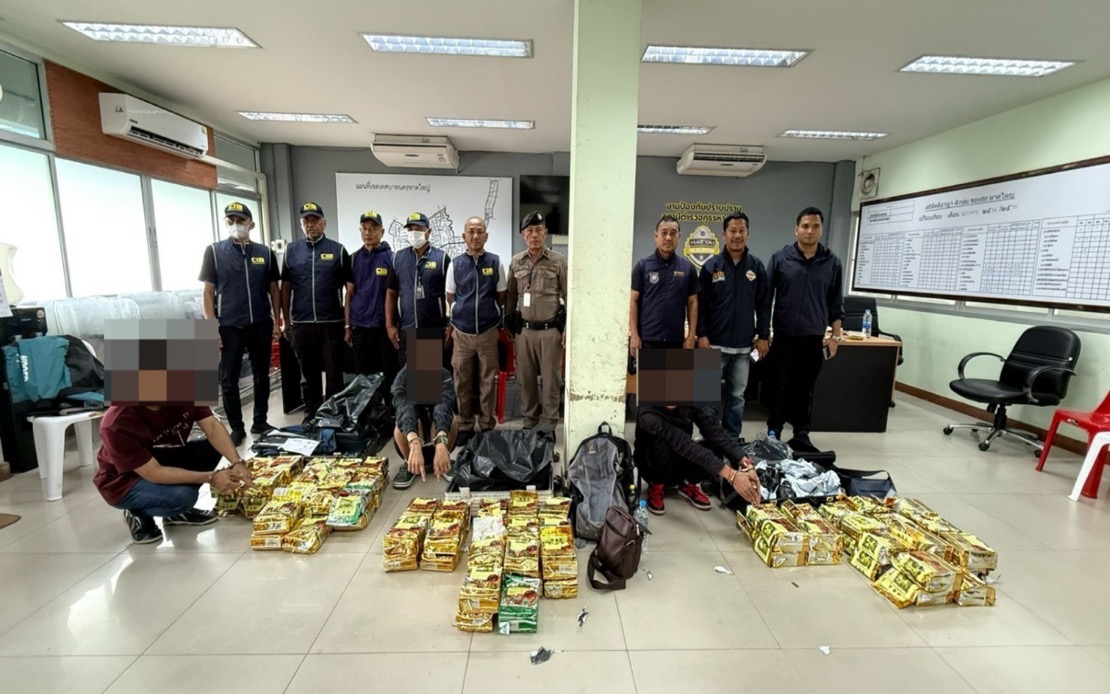
Three Malaysian men face serious drug trafficking charges after their arrest at Hat Yai Railway Station in Thailand's Songkhla province on July 31, following the discovery of 87 kilograms of crystal methamphetamine hidden across multiple pieces of luggage. The bust represents another significant seizure in the region's ongoing struggle against transnational drug smuggling, revealing the persistent vulnerability of cross-border transportation routes to organised crime networks.
The apprehension resulted from an intensive joint operation coordinated by Thailand's narcotics enforcement apparatus. The Tawan Hat Yai unit, working in collaboration with railway police, the Crime Suppression Division, the Anti-Trafficking in Persons Division, tourist police, the Narcotics Suppression Bureau, and the Region 9 Office of the Narcotics Control Board, intercepted the suspects as they disembarked from a Bangkok-bound train. This multi-layered enforcement approach underscores the scale of resources dedicated to disrupting drug movements along major transport corridors in Southeast Asia.
According to Ratchapon Palakul, the director of the ONCB's Region 9 Office, the contraband was ingeniously distributed across three wheeled suitcases and three backpacks, a concealment method designed to evade detection at checkpoints. Initial interrogations revealed that at least one suspect admitted to accepting RM8,000 in compensation from an organised syndicate to transport the narcotics into Malaysia, demonstrating the financial incentives that trafficking organisations employ to recruit couriers from neighbouring countries.
The trafficking operation's structure reflects a broader pattern observed throughout Southeast Asia, where criminal syndicates leverage economic disparities and geographical proximity to recruit individuals willing to undertake high-risk smuggling missions. The relatively modest payment offered to the couriers—approximately RM8,000 per person—contrasts sharply with the enormous street value of 87 kilograms of crystal methamphetamine, underlining the substantial profit margins that fuel these illicit networks and justify their continued operational activities.
Thailand's legal framework imposes severe penalties for such offences. The three suspects face joint charges of possessing and trafficking Category 1 narcotics with intent to distribute, an offence carrying potential prison sentences of up to 15 years and financial penalties not exceeding 1.5 million baht, equivalent to approximately RM183,000. These stringent punishments reflect both Thailand's and Malaysia's hardline stance on drug trafficking, though critics argue that such penalties often target low-level couriers rather than the influential syndicate leaders orchestrating these operations.
From a Malaysian perspective, this seizure highlights the persistent challenges facing the country's borders, particularly at land crossings and along transport networks. Malaysia's geographical proximity to Thailand, combined with established road and rail infrastructure, has historically made it an attractive destination for smugglers seeking to distribute methamphetamine throughout the region. The successful interception at Hat Yai, occurring before the drugs could cross into Malaysian territory, represents a collaborative success that prevented the substances from reaching local distribution networks.
The ongoing investigation into the identity of the syndicate's leadership and other potential accomplices suggests that Thai authorities view this as a significant breakthrough rather than an isolated incident. By unravelling the operational structure of the trafficking network, investigators hope to identify higher-level organisers and dismantle supply chains at their source. This investigative approach recognises that apprehending individual couriers, while important for disrupting specific shipments, ultimately represents only tactical victories unless accompanied by strategic operations targeting criminal hierarchies.
The incident also underscores the sophisticated nature of modern drug trafficking operations. The deliberate distribution of narcotics across multiple containers, the selection of train transport as opposed to more heavily scrutinised road crossings, and the recruitment of foreign nationals as couriers all demonstrate how criminal organisations employ strategic planning and risk management techniques comparable to legitimate businesses. This operational sophistication requires law enforcement agencies to continually evolve their detection methodologies and intelligence-gathering capabilities.
For Malaysia, the arrest carries implications beyond the immediate seizure. It reflects the reality that despite increasingly rigorous border controls and enforcement cooperation with regional partners, cross-border drug trafficking remains an entrenched problem. The involvement of Malaysian nationals as couriers also raises questions about vulnerability factors—whether economic hardship, gambling debts, or organised crime connections within Malaysia are compelling individuals to accept lucrative but dangerous smuggling assignments. Understanding and addressing these underlying vulnerabilities remains critical to long-term drug suppression strategies.

