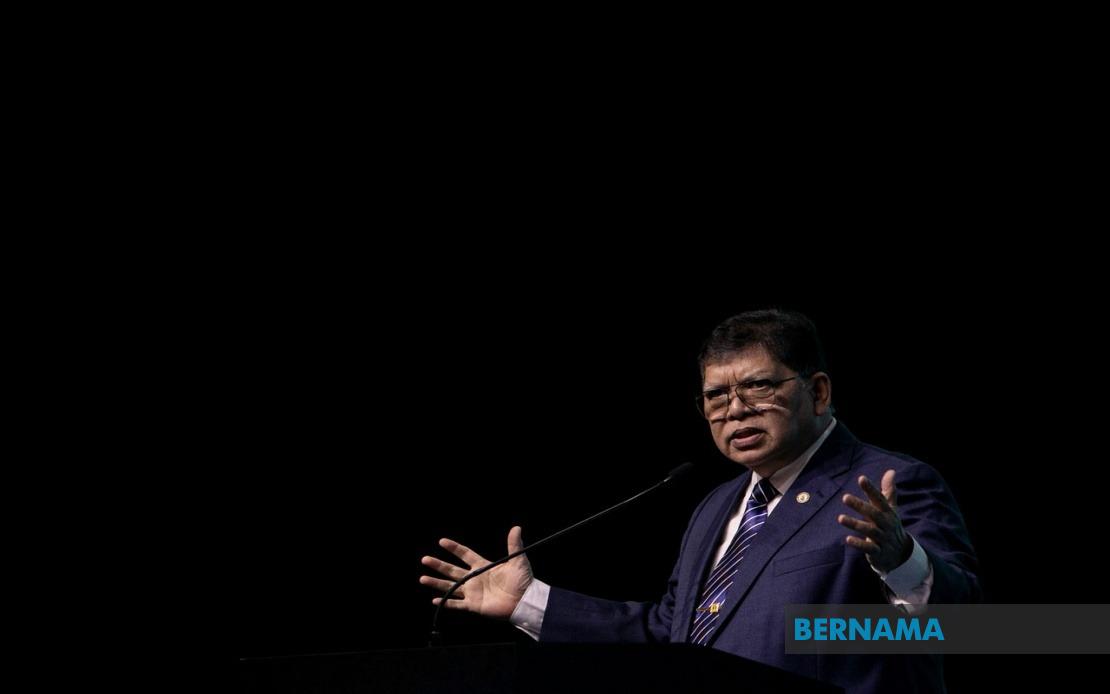
Dewan Rakyat Speaker Tan Sri Johari Abdul has identified three interconnected national initiatives capable of anchoring Malaysia's democratic foundations and nurturing a generation deeply committed to political stability. Speaking at the 8th World Conference on Islamic Thought and Civilisation in Ipoh on July 22, Johari outlined how Sekolah Parlimen, the National Service Training Programme (PLKN), and the Youth Parliament represent not merely symbolic gestures but substantive mechanisms for preparing young Malaysians to become informed custodians of democracy rather than passive inheritors of the nation's political systems.
The Dewan Rakyat Speaker emphasised that these three pillars collectively construct what he characterised as a comprehensive institutional response to concerns about democratic disengagement among youth. His framing is particularly significant given ongoing anxieties across Southeast Asia about younger demographics lacking practical understanding of parliamentary systems and constitutional governance. By deliberately positioning these programmes as strategic investments in social cohesion and institutional legitimacy, Johari addressed a broader regional challenge: how democracies can demonstrate vitality and relevance to generations shaped by digital connectivity rather than traditional civic participation.
Sekolah Parlimen operates as the foundational programme, bringing secondary students aged 16 and 17 from across the country for intensive parliamentary exposure. These immersive visits permit young participants to observe live chamber debates firsthand, transforming Parliament from an abstract governmental entity into a tangible democratic space where ideas are contested and legislation shaped. According to Johari, this direct witnessing of parliamentary procedure serves a critical pedagogical function, countering pervasive but erroneous perceptions that Malaysian democracy operates as a lifeless bureaucratic mechanism. The programme deliberately targets student leaders, recognising that head boys and head girls wield informal influence within their peer networks and can subsequently become multipliers of democratic understanding within their schools and communities.
The initiative has already demonstrated measurable reach. Johari disclosed that nearly 2,000 students drawn from over 1,000 schools have participated in Sekolah Parlimen since inception. Notably, the Speaker prioritises rural schools, acknowledging that parliamentary exposure programmes risk concentrating in urban educational institutions where proximity to federal territories facilitates participation. His personal commitment to meeting every group twice weekly underscores institutional seriousness and signals that parliamentary leadership takes youth engagement as a strategic priority rather than ceremonial obligation.
The National Service Training Programme (PLKN) addresses democratic foundations from an entirely different angle, utilising a 45-day immersive experience to catalyse cross-communal understanding and national integration. During this compressed timeframe, students from disparate socioeconomic, ethnic, and religious backgrounds coexist in structured environments requiring collaboration on physical and developmental tasks. Johari framed PLKN not as a military-style training enterprise but rather as a sociological accelerant, arguing that the programme's true objective transcends physical conditioning to create lasting interpersonal bridges. Within just 45 days of shared experience, participants develop what Johari described as genuine understanding and appreciation of their peers from unfamiliar backgrounds, experiences that prove difficult to replicate through conventional classroom instruction or abstract civic education curricula.
This sociological function gains particular relevance within Malaysia's plural context. PLKN operates as a nationally mandated shared experience cutting across socioeconomic divides that might otherwise permit young Malaysians to navigate through secondary and tertiary education with minimal genuine engagement across communal boundaries. In an era of algorithmic sorting and self-selected social circles, the programme's enforced diversity represents a countervailing institutional design intentionally fostering empathy and mutual recognition among the youth cohort destined to assume leadership positions in coming decades.
Youth Parliament represents the most innovative institutional component of Johari's trilogy, fundamentally reconceptualising how young Malaysians engage with democratic representation. Rather than replicating the first-past-the-post electoral mechanism governing parliamentary elections, the youth programme employs proportional representation, obliging participants aged 18 to 30 to think strategically about coalition-building, policy articulation, and representing Malaysia's diverse demographic composition. This deliberate structural divergence from the national electoral system creates valuable experimental space where youth confront sophisticated political questions without the stakes of actual governmental power.
Participants must move beyond individual candidate ambitions to contemplate party formation, policy manifestos, and communicating platforms addressing national concerns. Johari emphasised how Youth Parliament challenges participants to interrogate the fundamental question of representation: how might a political vehicle accommodate Malaysia's multiple communities, interests, and perspectives whilst maintaining coherent programmatic identity? This critical thinking exercise proves invaluable precisely because it operates at conceptual rather than personalised levels, forcing youth to grapple with structural governance questions rather than merely competing for individual office.
Collectively, these three initiatives construct what might be characterised as an integrated youth governance ecosystem. Sekolah Parlimen introduces students to parliamentary mechanics and democratic procedures; PLKN builds social solidarity and cross-communal empathy essential for democratic citizenship; Youth Parliament teaches complex political reasoning about representation, coalition-building, and manifesto development. Rather than operating in isolation, the programmes create a cumulative educational pathway preparing Malaysian youth for meaningful democratic engagement at multiple levels.
Johari's emphasis on preventing democratic disengagement and political instability reflects concerns increasingly shared across Southeast Asia regarding youth alienation from traditional political institutions. By positioning these programmes as essential investments in democratic sustainability, the Speaker articulated a vision where good governance emerges not from isolated policy reforms but from deliberate cultivation of democratic consciousness among rising generations. For Malaysia specifically, the programmes address persistent anxieties about national unity and political divisiveness by grounding democratic commitment in early exposure, interpersonal connection, and sophisticated political reasoning.
The initiatives also reveal assumptions about institutional capacity and resource allocation that merit scrutiny. Scaling these programmes to reach all Malaysian youth rather than select participants demands sustained budgetary commitment and administrative infrastructure. The prioritisation of rural schools acknowledged by Johari simultaneously illuminates the programmes' current reach limitations, suggesting that equitable access remains an ongoing challenge. Nevertheless, the Speaker's articulation of these three mechanisms demonstrates institutional recognition that political stability ultimately rests upon popular commitment to democratic processes, requiring deliberate intergenerational investment to ensure that Malaysia's youth possess both practical understanding and emotional attachment to representative governance systems.

