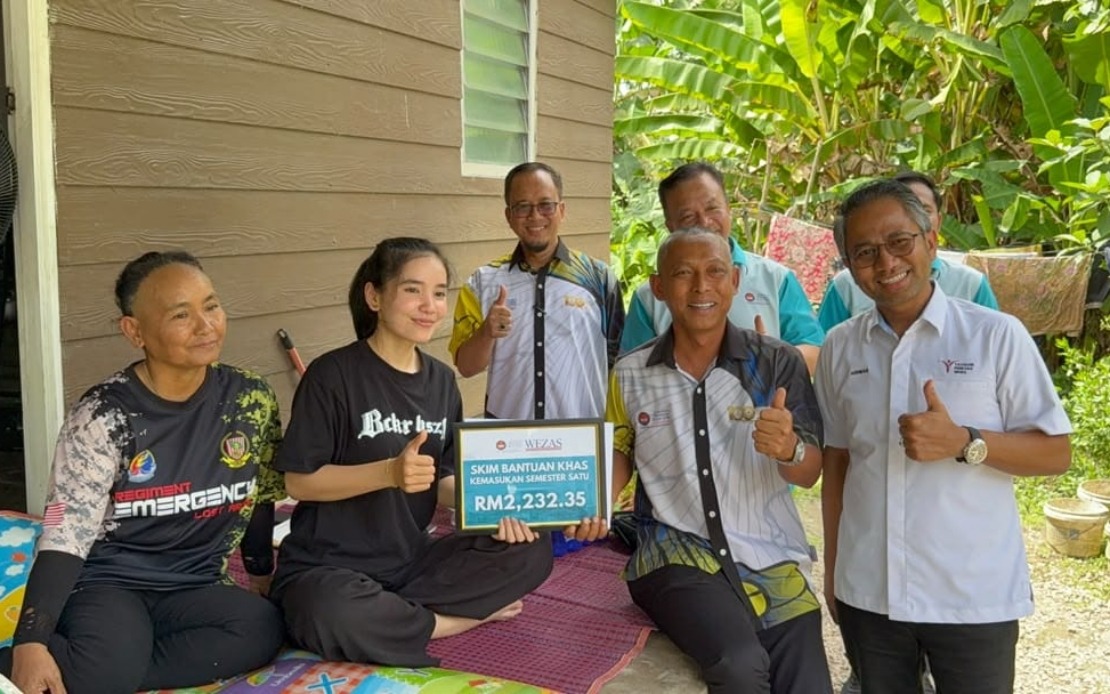
Three outstanding STPM graduates have begun their university journeys at Universiti Pendidikan Sultan Idris (UPSI) after receiving crucial financial support from the institution and Malaysia's Higher Education Ministry, offering a glimpse into how strategic collaboration between educational bodies can remove barriers for economically disadvantaged but academically promising students. Lovely Sabana Augustine, who will pursue studies at UPSI's Faculty of Human Sciences, became the public face of this assistance initiative after her circumstances gained traction on social media, where she had appealed for help to cover registration fees and essential study materials for the 2026/2027 academic session.
The youngest of four children, Sabana lives with her mother Mek Kenui in Tumpat, Kelantan, where her mother works as a school cleaner earning approximately RM800 monthly whilst also serving as a member of the Malaysian Volunteer Corps Department (RELA). Her father, a former military serviceman, passed away in 2017, placing significant responsibility on her mother's shoulders to sustain the household. Her situation exemplifies the educational access challenges faced by capable students whose families lack sufficient resources, despite their individual merit and determination to advance through higher learning.
Two other students joined Sabana in receiving support through the coordinated assistance programme. Siti Nurdianis Nordin, who will commence studies in the Faculty of Management and Economics, comes from a family struggling with unstable income as her mother relies on daily wage labour to support household expenses. Similarly, Muhamad Ilias Danish, enrolled in the Faculty of Languages and Communication, experienced the loss of his father, the family's primary earner, and now actively contributes to supporting his mother and other dependents. Each student received RM1,500 to alleviate immediate financial pressures related to university enrolment.
The funding structure reflects a multi-stakeholder approach to student welfare, with UPSI's Centre for Waqf, Endowment, Zakat, Khairat, and Sadaqah (WEZAS) contributing RM500 per student whilst Yayasan Perkasa Siswa (YPS) provided the remaining RM1,000 contribution. This distribution mechanism demonstrates how institutional Islamic charitable frameworks can integrate with government-backed student support organisations to create comprehensive assistance networks. The combined funding pools resources from religious endowments and dedicated scholarship foundations, reducing reliance on any single source and spreading financial responsibility across multiple institutional pillars within Malaysia's higher education ecosystem.
According to Hirman Awang, Director of the Department of Higher Education's Student Affairs Division, the initiative underscores the Higher Education Ministry's determination to prevent financial hardship from derailing capable students' academic trajectories. His statement emphasised that YPS functions as a frontline mechanism for student welfare protection, with each RM1,000 contribution intended to address both psychological morale and practical necessities including registration costs and foundational living expenses. This framing positions financial aid not merely as charitable intervention but as strategic investment in human capital development, ensuring that Malaysia's educational institutions capture and cultivate academic talent regardless of socioeconomic background.
UPSI Deputy Vice-Chancellor (Student Affairs and Alumni) Prof Dr Norkhalid Salimin characterised the assistance as reflective of institutional commitment to prospective students facing financial constraints, noting that the university prioritises early identification and support through its Student Affairs and Alumni Department (JHEPA) and WEZAS office. His comments suggest that UPSI has integrated student vulnerability assessment into its admissions processes, enabling the institution to proactively intervene before financial challenges force capable students to abandon their academic aspirations. This preventative approach contrasts with reactive scholarship models that only activate after students encounter crisis situations.
The broader significance of this assistance programme extends beyond the three individual beneficiaries, illustrating how Malaysia's higher education sector addresses persistent equity challenges within tertiary access. For regional context, the RM1,500 assistance demonstrates recognition that registration fees and initial enrolment costs represent genuine barriers for lower-income families, even when students have secured university places through merit-based admission. This gap between academic qualification and financial capability to actualise enrollment opportunities remains understudied in Malaysian policy discourse, yet represents a critical juncture where capable students encounter systems-level obstacles.
The timing of Sabana's case receiving viral social media attention, coupled with rapid institutional response, raises questions about visibility and equity in assistance distribution. Students who successfully leverage social platforms to publicise their circumstances may access support that similarly situated but less digitally connected peers never obtain. The UPSI-MOHE-YPS collaboration potentially operates reactively around high-profile cases rather than systematically identifying all eligible applicants, suggesting that significant numbers of deserving students may remain unassisted. Future programme refinement might incorporate proactive identification mechanisms that eliminate dependence on social media prominence as a pathway to assistance.
The assistance programme reflects deliberate policy alignment between Universiti Pendidikan Sultan Idris, Yayasan Perkasa Siswa, and the Department of Higher Education, framed as strategic collaboration ensuring ongoing attention to prospective student welfare. This institutional framework suggests embedding student financial support within regular university operations rather than treating assistance as exceptional or peripheral activity. For Malaysian higher education more broadly, the model demonstrates viability of decentralised, institution-led welfare mechanisms coordinating with centralised ministry oversight and dedicated foundation resources, creating redundancy and responsiveness simultaneously.
Sabana, Siti Nurdianis, and Muhamad Ilias now proceed toward university enrolment with immediate financial pressures partially relieved, though ongoing sustainability of their studies remains contingent on subsequent support mechanisms. Their cases illustrate both the capacity of Malaysian institutions to mobilise assistance and the continued vulnerability of lower-income students navigating tertiary education costs. As Malaysia positions itself within competitive regional higher education landscapes, ensuring that academic merit rather than financial capacity determines university access becomes increasingly critical for institutional and national competitiveness.

